



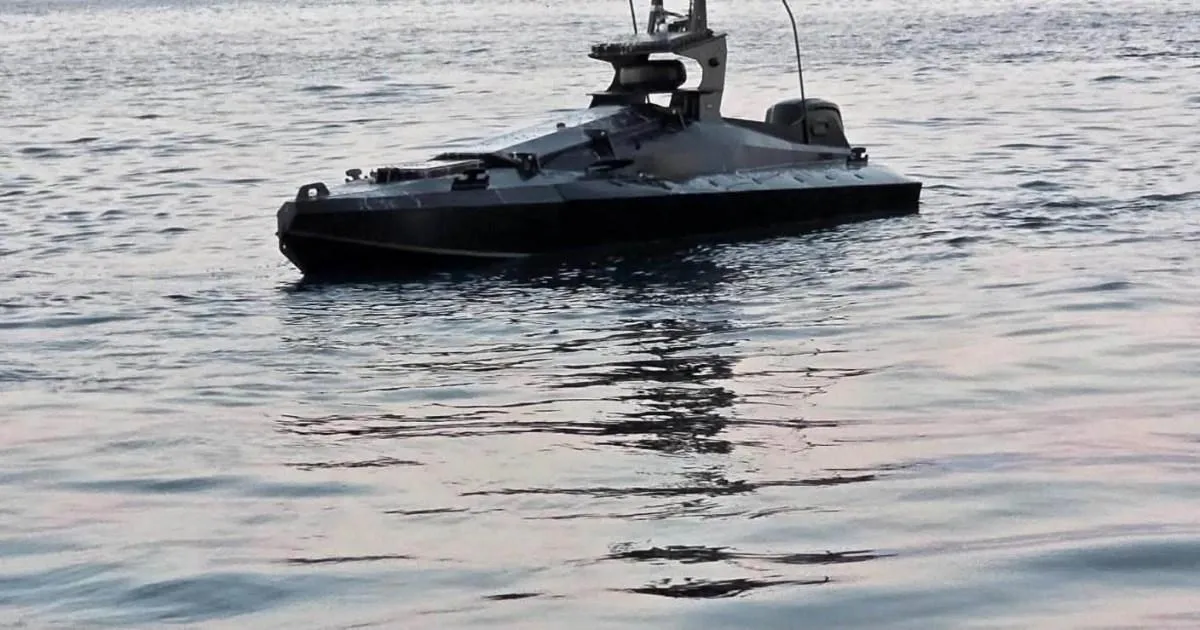
A Tense Morning in the Black Sea: Drone Threat Neutralized Near Romania’s Strategic Gas Hub
The Black Sea has long been a region of strategic importance, but in recent years it has transformed into a volatile frontier where military tensions simmer just beneath the surface. Early on a quiet Tuesday morning, that tension erupted once again when a marine drone packed with explosives was detected drifting dangerously close to Romania’s ambitious Neptun Deep gas platform. The discovery, made by a commercial vessel in the vicinity at approximately 6:30 AM local time, triggered an immediate and decisive military response. Two Romanian F-16 fighter jets screamed through the morning sky, their pilots executing a mission that would end with the destruction of the unmanned threat just a few hundred meters from the under-construction facility. The incident, while brief, underscored the precarious security situation facing NATO’s eastern flank and highlighted the very real dangers that lurk in these contested waters.
The Neptun Deep platform is not just another piece of offshore infrastructure; it represents Romania’s bold vision for energy independence and economic prosperity. When it comes online next year, this project is poised to transform Romania into the largest gas producer in the entire European Union, a remarkable achievement for a nation that has long sought to reduce its reliance on foreign energy sources. The platform is a symbol of hope and progress, but on this particular morning, it also became a focal point of vulnerability. With several hundred workers on site, the stakes could not have been higher. The decision to destroy the drone, rather than merely track it, was driven primarily by the imperative to protect human life and secure critical infrastructure that holds strategic significance for the entire region.
This incident, however, is not an isolated event but rather part of a troubling pattern that has been unfolding with increasing frequency. European Commission President Ursula von der Leyen did not mince words when she characterized the escalating situation as “hybrid warfare,” a term that captures the murky, ambiguous nature of modern conflict where traditional battlefields have given way to shadowy operations targeting infrastructure, economies, and civilian morale. Her condemnation resonated across the continent, serving as a stark reminder that the war in Ukraine has spilled far beyond its borders. Just four days prior to this incident, Spanish fighter jets had been scrambled to shoot down another drone that had violated Romanian airspace, marking the fourth unmanned aircraft to be intercepted over Romania since the beginning of the year. The frequency of these intrusions suggests a deliberate, coordinated campaign designed to test NATO’s resolve and probe for weaknesses.
Romania’s president, Nicușor Dan, responded to the incident with characteristic firmness, congratulating the jet pilots and coast guard for their swift and professional response while placing blame squarely on Russia. In a series of social media posts, he voiced his strong condemnation of what he described as “irresponsible incidents” emanating from the Russian Federation, vowing that Romania would remain vigilant alongside its NATO allies to defend against such provocations. His words carried the weight of a nation that shares a 382-mile land border with Ukraine and has found itself increasingly on the front lines of a conflict it did not start. The Romanian defense minister, Radu Miruță, added another layer of diplomatic nuance to the situation when he confirmed that Ukrainian authorities had verified the drone’s origin, definitively ruling out any possibility that it belonged to their forces. This clarification was crucial, as it eliminated any ambiguity and reinforced the narrative of Russian aggression.
The drone incident near Neptun Deep is emblematic of a broader strategy that military analysts have observed unfolding across the region. Russia, unable to achieve its objectives through conventional military means, has increasingly turned to asymmetric tactics that create disruption, sow fear, and test the resolve of Western alliances. These maritime drones, relatively inexpensive to produce and difficult to detect, represent a new frontier in naval warfare that poses significant challenges to traditional defense systems. The Black Sea, once a conduit for trade and commerce, has become a testing ground for these innovative weapons, with the potential for catastrophic accidents ever-present. The proximity of this latest drone to a facility employing hundreds of workers highlights the ruthlessness of this approach, where civilian infrastructure and human life become pawns in a larger geopolitical game.
Beyond the immediate tactical implications, these incidents carry profound strategic consequences for the alliance. NATO member states are now confronted with the reality that their territories are not sanctuaries insulated from the conflict in Ukraine, but rather potential targets in an expanding theater of operations. The response to these provocations requires a delicate balance between demonstrating resolve and avoiding escalation that could spiral into a broader confrontation with a nuclear-armed adversary. Romania, in particular, has found itself navigating this treacherous terrain, bolstering its defenses along its border while working closely with NATO partners to establish deterrence mechanisms that can respond effectively to unconventional threats. The psychological impact on local populations should not be underestimated either; the knowledge that drones can penetrate national airspace and approach critical infrastructure creates a persistent sense of unease that erodes public confidence in security guarantees.
The human dimension of this escalating tension became tragically apparent in May, when a Russian drone struck a residential building in the eastern town of Galați, located dangerously close to the Ukrainian border. Two people were injured in the attack, and the resulting fire forced the evacuation of the entire building. This incident brought the war home to ordinary Romanian citizens in the most visceral way possible, transforming abstract geopolitical tensions into a stark reminder that conflict does not respect borders. The tragedy in Galați served as a wake-up call for many Europeans who had previously viewed the war in Ukraine as a distant crisis, prompting difficult questions about their own vulnerability and the adequacy of existing defense measures. It also underscored the need for enhanced air defense systems and early warning capabilities that can protect civilian populations from threats that arrive without warning.
As the international community grapples with these unfolding challenges, the incident in the Black Sea serves as a powerful reminder of the new realities shaping European security in the twenty-first century. The response from Romania’s military demonstrated commendable professionalism and readiness, but it also highlighted the constant state of alert required to safeguard against threats that can materialize at any moment. The European Union’s leadership, through statements like those from Ursula von der Leyen, has signaled solidarity with member states facing these pressures, but tangible support and enhanced defense cooperation remain essential. For the workers at Neptun Deep and countless others across the region, the shadow of conflict looms large, transforming their workplaces and homes into potential battlegrounds. Yet resilience persists; the project continues forward, defenses are strengthened, and the resolve to protect democratic values and infrastructure remains unshaken. The Black Sea may have become more dangerous, but the determination to meet these challenges stands firm, a testament to the enduring spirit of those who have chosen to stand against aggression and defend their way of life.