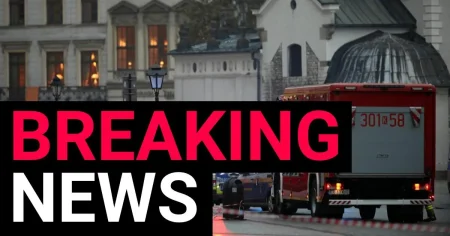



The tranquil rhythm of a Saturday afternoon in Krakow was violently shattered, transforming a bustling market square into a scene of chaos and terror. At approximately 3 pm, the air, once filled with the casual chatter of shoppers and the clatter of tram wheels, was torn apart by the sharp, deafening crack of gunfire. A lone assailant, clad in menacing military-style gear, emerged from a black Subaru and began firing indiscriminately, targeting a tram, pedestrians, and even the horses that stood nearby. The initial moments were a blur of panic and disbelief as families, tourists, and locals scrambled for cover, diving behind storefronts and seeking refuge in shops, their windows soon riddled with bullet holes. The market, a vibrant hub of daily life, had become a war zone in an instant, leaving behind a trail of blood, broken glass, and the first six victims, including four women and two men, one of whom was a British citizen. The brutal and senseless act was not a spontaneous eruption of rage but the final, catastrophic act of a young man whose life had been quietly spiraling towards this dark precipice, driven by a toxic ideology of hate that he had cultivated in the shadows of his ordinary life.
The suspect identified as 25-year-old Michal O, was not a foreign terrorist or a hardened criminal, but a Polish citizen and a cadet at a military school, living about 80 miles from the city where he committed his atrocities. This detail is perhaps the most jarring, as it underscores a chilling normalcy that often masks the most extreme radicalization. His neighbors, speaking to journalists in the aftermath, described him as a “polite, quiet guy,” a young man who would walk with his hood up, offering a friendly “good morning” without incident. This stark contrast between his benign public facade and the monstrous violence he was capable of paints a complex and disturbing portrait of a mind fractured by “far-right ideologies.” According to Poland’s Interior Minister, Marcin Kierwinski, the attacker held “very radical views” and was fascinated by far-right extremism. His choice of weaponry—a military-grade AR-15 rifle and a bulletproof vest—was not a random selection but a deliberate uniform for his ideological war. Yet, Defense Minister Władysław Kosiniak-Kamysz clarified that he was not an active soldier and had no official military connections, suggesting that his military training and weapons were personal, a dark hobby that he had perfected to deadly effect.
The day of violence did not begin in the Krakow market; it began in a quiet family home in Ostrowiec Swietokrzyski, roughly 150 kilometers away. As the city grappled with the shock of the public attack, Polish Prime Minister Donald Tusk announced a grim discovery: two women and a man, believed to be Michal’s parents and sister, were found dead at his residence. The authorities did not immediately release the circumstances, but the implication was clear—the suspect had slaughtered his own family before embarking on his deadly mission. This prelude to the main attack suggests a methodical and cold-blooded plan. The weapons he used were likely sourced from his own home, as his father was a legal firearms owner. This path of destruction, from the intimate horror of family murder to the indiscriminate violence against strangers, paints a picture of a total and complete break from reality, one where personal bonds had been severed by an ideology that dehumanized everyone, including those closest to him.
Amidst the carnage, the response from Polish law enforcement was swift and decisive, preventing an even greater tragedy. The suspect exchanged gunfire with police before he was finally taken down at close range by a lone officer. That officer, along with another, Jakub Kulik and Artur Morański, were hailed as heroes by Prime Minister Tusk. Both men were seriously wounded in the confrontation and were fighting for their lives in the hospital. Their bravery, however, did not just stop the shooter; it provided a definitive answer to the chaos, proving that even in the face of extreme evil, there are those willing to sacrifice everything to protect others. The attack left fifteen people wounded, including five foreign nationals from Austria, Germany, Portugal, Russia, and Britain. The inclusion of so many nationalities among the injured highlights the international reach of this tragedy, a grim reminder that terrorist acts are not confined by borders, impacting a global community.
The aftermath of the shooting has sent shockwaves through Poland, a nation still mourning the loss of life and grappling with the reality of a domestic terror attack on its soil. It has forced a national conversation about radicalization, the proliferation of weapons, and the hidden corners of the internet where extreme ideologies fester. The focus has now shifted beyond the immediate crime to the systemic failures that might have allowed such a plot to develop undetected. The fact that the killer was a military cadet, a person with access to training and firearms, has raised uncomfortable questions about the vetting processes and the potential for radical elements within such institutions. International voices of solidarity quickly followed, with figures like Greater Manchester’s Andy Burnham expressing his shock and sadness, stating that “the United Kingdom stands in solidarity with the people of Poland,” reinforcing the sentiment that this was an attack on shared values and common humanity, not just one city.
Ultimately, the story of that Saturday in Krakow is not just a tale of hate and violence, but a profound and heartbreaking human tragedy. The victims were people going about their ordinary lives, doing their Saturday shopping or taking a tram, unaware that they were about to be caught in the crossfire of a deranged individual’s warped ideology. The “polite, quiet guy” from the neighborhood, who murdered his own family and then opened fire on a crowd, leaves behind a legacy of unanswered questions. The psychological autopsy of such a mind will be long and complex, but the immediate pain is visceral. The city of Krakow, a jewel of Polish culture and history, is now marked by this scar. For the families of the dead, the injured police officers, and the traumatized witnesses, the echoes of those gunshots will linger for a lifetime. The nation is in mourning, but it is also in a state of somber reflection, trying to understand how a young man could become a monster, and how it can prevent such darkness from emerging from the shadows of its own communities again.