


The tragedy that has engulfed the English family has reached an even more unbearable depth with the death of six-year-old Elliot English. For almost four weeks, Elliot had been clinging to life in a hospital bed at Children’s Health Ireland in Crumlin, its intensive care unit having become the unlikely battlefield for a tiny boy’s desperate fight after a fire tore through his family home in Waterford on October 13. His heartbroken family confirmed that the little boy, so badly injured in the suspected arson attack, had finally slipped away, leaving behind a trail of grief that words cannot truly hold. The confirmation came in a statement of aching simplicity: the English family wished to confirm, with profound sadness, the passing of Elliot. That single sentence ended a season of desperate hope, a period when relatives, neighbours and strangers alike had prayed that somehow this one small survivor might be spared. But it was not to be. Elliot had already lost his mother, Kim, his father, Phillip, and his two young brothers, Callum and Jayden, in the same blaze, and now his older sister remains in hospital, still fighting for her own life. The weight of that reality is staggering, a family broken in a way that no amount of time can fully repair, and a home that once held laughter, quarrels, morning chaos and bedtime stories now holds only silence, ash and mourning.
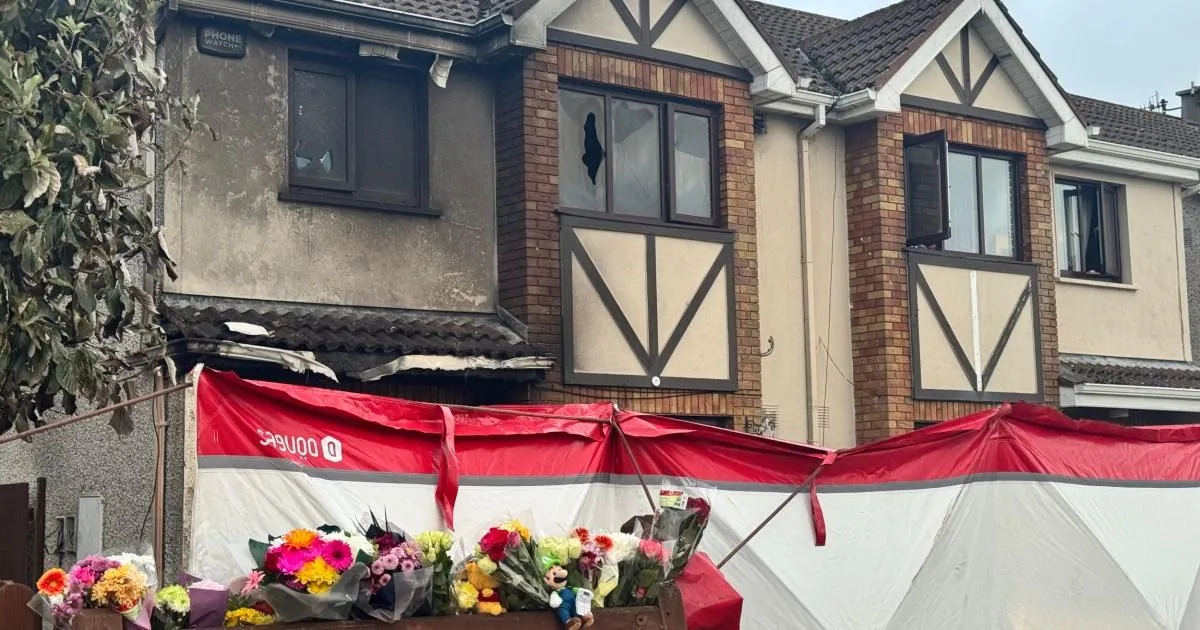
The fire that changed everything broke out shortly after five o’clock in the morning on a quiet October day. In Birchwood, Waterford, such a neighbourhood is the kind of place where people know their neighbours, where children play outside and where an ordinary house on an ordinary street carries the everyday rhythms of family life. That sense of safety was shattered in a matter of minutes. Gardaí have said they believe the fire was no accident, but rather the result of an arson attack, a word that now carries with it an extra layer of horror when applied to a home where young children slept. What happened in those dark moments before dawn remains the focus of a multiple murder investigation. Kim and Phillip English, parents in the prime of their lives, never made it out. Their sons Callum and Jayden, two children with whole futures ahead of them, also died at the scene or in the immediate aftermath, their lives ended before they could learn to drive, fall in love, or chase their dreams. Elliot, the six-year-old, was pulled from the wreckage and rushed towards the only hope that remained: a hospital that had become a sanctuary for the family’s shattered hopes. His older sister also survived the initial fire but remains in a critical condition, her own battle ongoing even as she carries the burden of knowing what she lost. There is something cruelly unjust about a fire that takes so much yet leaves enough to keep hearts in suspense, forcing a family to live between hope and dread, day after agonising day, until the final terrible news arrived.
When the family released their statement, they asked for something that every human being should be able to grant in such a moment: time, space and privacy. The family has endured an unimaginable loss, the statement said, and this latest bereavement has left relatives, neighbours and friends facing an overwhelming period of grief. Those words are the quiet plea of people who are drowning in sorrow and yet still aware that the world will knock on their door wanting answers, wanting reactions, wanting the details of pain. They should not have to explain anything. A father and mother are gone. Three sons are gone. One daughter is fighting to survive. The English family, extended relatives, friends and the entire community have been left to make sense of something that makes no sense at all. The statement was also addressed to the media, with a respectfulness that reveals how utterly exhausted the family are. They are not angry; they are beyond anger. They simply want the chance to grieve without cameras in their faces, without microphones thrust toward their tears, without strangers telling them how they should feel. In a world that often moves too fast, they are asking for the most basic human mercy: a little time to stand still and ache without interruption. The neighbours in Birchwood have already shown that they understand. Flowers, soft toys, messages and candles have created a makeshift shrine outside the ruined house, a place where people gather in silence, their faces marked by disbelief and shared sorrow.
Among those to speak publicly was local Fianna Fáil TD Mary Butler, whose voice cracked with emotion as she described the news of Elliot’s death as absolutely devastating and heartbreaking. She called him “Elliot’s little gentle soul,” a phrase that captures the tenderness with which he is remembered, not only as a victim or a headline, but as a small boy with a personality, a smile, and a place in his family’s heart. She also asked the public to remember the hospital staff at Crumlin, the doctors and nurses who for four weeks fought alongside Elliot, who monitored every breath, who adjusted medications in the middle of the night, who spoke quietly to him even when they were not sure he could hear. In a time when healthcare workers are so often taken for granted, her words were a reminder of the humanity at the heart of medicine. Those staff members are not just treating numbers; they are holding the hands of families in the most terrible hours of their lives. They witnessed the English family’s agony, helpless at times, hopeful at others, and ultimately mourning. They will carry Elliot with them long after the hospital shifts end. Butler’s tribute honoured them, but it also gave the public a way to process the tragedy: through the lens of care, compassion and the quiet dedication of people who do not tragically die in fires, but who stand beside those who do, doing everything in their power to change the ending. They could not change this ending, but they gave Elliot dignity, comfort and a fighting chance, and they gave his family the knowledge that everything possible was done.
The legal and investigative dimension of this heartbreak continues to move forward, though no court judgment can ever undo what has happened. Garda Síochána remains committed to investigating what they believe to be multiple murder following the arson attack, and their work has already led to arrests. In total, six people have been arrested in connection with the investigation, four of whom have been released without charge, leaving the community to wonder at the web of circumstances that could lead to such an act. In October, the first two people to be arrested appeared in court in connection with the attack: Jessica Dalton, 31, from Waterford city, and Cian Stacey, 21, of no fixed abode. They were each charged with one count of criminal damage and two counts of assault causing serious harm, and they were remanded into custody until their next appearance at Waterford District Court, which is scheduled to take place by video link on November 17. Those charges are grave, though they do not yet fully reflect the scale of the loss that has now unfolded, and it is likely that the legal picture will continue to evolve in the weeks ahead. For the English family, however, the criminal justice system offers no comfort. No conviction, no sentence, no statement in court will bring back Kim, Phillip, Callum, Jayden or Elliot. Five members of one household are gone. A father, a mother, and three young sons have lost their lives in an act that seems to defy rational explanation. The surviving sister will have to grow up without her parents and brothers, surrounded by love, yes, but marked forever by a single morning in October. The law will do its best to deliver justice, and society will insist on accountability, but the real punishment is already being served: an entire family has been erased from the everyday world, and those who loved them now live with the permanent ache of absence.
In the end, after all the statements, all the tributes, all the legal details and all the news reports, what remains is sorrow. There is no way to summarise the loss of a child, let alone the loss of an entire family, into a headline. Elliot’s death may be the final chapter in a story that began with a fire, but for those who loved him, his story did not end in a hospital room at Crumlin. It lives on in the memory of a boy who was only six years old, who liked the things that six-year-olds like, who had not yet learned what the world could be, and who is now beyond all pain. His mother and father, Kim and Phillip, together with his brothers Callum and Jayden, are gone too, and the thought of them being reunited only deepens the ache because it means they are no longer here with the sister who still breathes, who still fights, who still needs every ounce of strength that her family and community can give her. The calls for privacy are not just about the media; they are about creating a space where grief can be carried rather than performed, where tears can fall without explanation, and where tiny whispers of memory can be shared without being turned into public spectacle. We should honour that request. We should remember the English family not only for the terrible way they died, but for the way they lived, for the love they shared, for the children they raised and for the community they belonged to. No amount of time will make Waterford whole again, but the kindness of strangers, the quiet respect of neighbours and the gentle passage of days may offer the family the only shelter there is. As the investigation continues and the courts do their work, the rest of us can do something simpler and perhaps more powerful: hold the English family in our hearts, speak their names with tenderness, and refuse to let what happened be forgotten. Elliot is gone. His parents and brothers are gone. But their story, unbearable as it is, will remain a call for compassion, a reminder of how fragile life is, and a reason to hold our own loved ones close.