

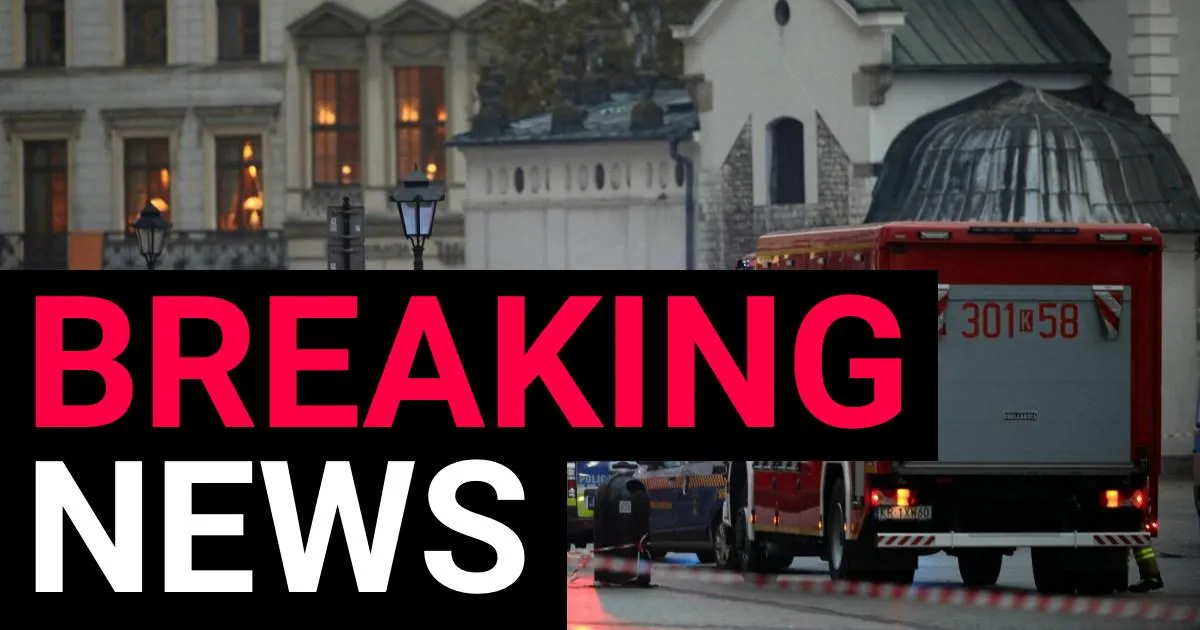
On an ordinary afternoon, the ancient cobblestones of Krakow’s Main Market Square became the scene of a nightmare. What should have been a day of quiet commerce, tourism, and daily life in one of Europe’s most beloved cities turned suddenly into chaos and bloodshed. Police in Poland have confirmed that five people are dead and around a dozen more are injured, including two police officers, after a man drove into the heart of the square, known as Rynek Glowny, and opened fire at random from his car. The attack unfolded at approximately 3 p.m., when the square would have been crowded with locals, families, students, and visitors from around the world. According to a statement from Małopolska Police, the suspect fired indiscriminately, turning a place of beauty and history into a scene of terror. Officers responded quickly, and the suspect was shot by police, detained, and taken to hospital. While the immediate danger was contained, the emotional shock will not be contained so easily. For the people who were there, for the families of the victims, and for the entire nation, this is a moment that will be remembered not as a news headline but as a rupture in the ordinary rhythm of life. The square, which has stood for centuries as a symbol of Polish culture and resilience, now carries a new and painful memory. The randomness of the violence is perhaps the most terrifying element: no specific target, no warning, just a driver weaving through a crowd with a weapon. In those moments, everyone in the square was vulnerable, and everyone who survived will carry the sound and the fear with them for the rest of their lives.
The immediate aftermath was pure panic. Witnesses described people running in every direction, unsure where the shots were coming from, desperate to find shelter. Paramedics were seen treating the wounded near St. Mary’s Basilica, the towering Gothic church that dominates the square and has watched over Krakow for centuries. An air ambulance helicopter was dispatched to the scene, its rotor blades beating overhead as emergency workers fought to save lives on the cobblestones below. Police quickly cordoned off the area and instructed residents and visitors to avoid the square entirely, but for those already inside the cordon, there was no easy escape. The images that emerged from the scene showed people fleeing with their hands raised, others huddled behind barriers, and emergency vehicles racing through narrow medieval streets. The square, normally a place where people linger over coffee, listen to street musicians, and watch pigeons scatter across the pavement, was transformed into a battlefield. The contrast between the setting and the violence is almost unbearable. Krakow’s Old Town is a UNESCO World Heritage site, a place of memory and tradition, and the Main Market Square is one of the largest medieval town squares in Europe. It is a place where history feels alive, where every building has a story. Now, that history includes a new chapter of grief. The human cost is measured not only in the dead and injured but in the trauma of everyone who witnessed the attack, the children who saw people fall, the elderly who could not run fast enough, the tourists who came to Poland expecting beauty and instead found terror. For them, the square will never look the same again.
The toll of the attack is staggering for a country where such violence is almost unheard of. Five people have lost their lives, each one a person with a name, a family, a story, and a future that has been brutally cut short. Around a dozen more are injured, some seriously, and among them are two police officers who were doing their duty, trying to protect others when they were caught in the line of fire. These officers represent the thin line between order and chaos, and their injuries are a reminder that the cost of public safety is often paid by the people who run toward danger while everyone else runs away. The injured now face long hospital stays, surgeries, rehabilitation, and the slow and painful process of healing, both physical and psychological. The families of the dead face something far worse: the sudden, senseless loss of someone they loved, a loss that will never be explained in a way that makes sense. In the days ahead, there will be funerals, memorials, and an outpouring of grief. There will also be questions. Why did this happen? Was the attacker driven by ideology, mental illness, personal rage, or something else entirely? The randomness of the shooting suggests a deep and disturbing detachment from human life, a willingness to kill strangers simply because they were there. That kind of violence is difficult to comprehend, and the human mind struggles to make sense of it. People will look for patterns, for warning signs, for something that could have been done to prevent this. But sometimes, there are no easy answers, only the aftermath and the slow work of mourning.
Polish authorities have moved quickly to investigate the attack. Prime Minister Donald Tusk described it as a “tragic shooting” and said he was being kept informed by the Minister of the Interior as police worked to establish the motive and circumstances. The suspect, who was shot by police and taken to hospital, is now at the center of a major criminal investigation. Detectives will examine his background, his mental state, his possible connections to extremist groups, and his access to weapons. They will piece together his movements in the hours and days before the attack, looking for clues that might explain what drove him to such violence. They will also investigate how he obtained a firearm, given that Poland has some of the strictest gun laws in Europe. The legal process will be lengthy, and the suspect, if he survives, will face serious charges. But for the public, the investigation is about more than justice; it is about understanding. People need to know that this was not a random act of fate but an event with causes and conditions, something that can be studied and perhaps prevented in the future. The government has promised a thorough inquiry, and the nation will be watching closely. At the same time, there is a sense of collective shock. Poland is a country that has faced enormous hardships throughout its history, from war and occupation to political oppression, but public mass shootings are rare. The idea that such an attack could happen in Krakow, a city known for its vibrant cultural life and its warm hospitality, is deeply unsettling. It challenges the sense of safety that most Poles take for granted.
Public shootings are indeed rare in Poland, largely because gun laws are stricter than in many other countries, particularly the United States. Modern firearms require a police-issued permit that is based on a specific, documented reason, such as sport shooting, hunting, or personal protection in exceptional circumstances. The process is rigorous and includes background checks, psychological evaluations, and approval from local authorities. This system has helped keep Poland’s rate of gun violence relatively low, and the country has not experienced the kind of mass shootings that have become tragically familiar in some other nations. But this attack shows that no system is completely foolproof, and that a determined individual can still find a way to commit horrific violence. The shock in Poland is therefore not just about the loss of life, but about the shattering of an assumption: the assumption that this kind of thing happens elsewhere, not here. Krakow, as Poland’s second-largest city, is a symbol of the country’s modern identity. It is a hub of education, culture, and tourism, a place where the past and the present meet. The Rynek Glowny is not just a tourist attraction; it is the beating heart of the city, a gathering place for generations of Poles. To see it drenched in blood is to see an attack on the very idea of Polish community life. The grief is national, but it is also deeply local. The people of Krakow will not recover quickly. They will hold vigils, lay flowers, and light candles. They will comfort each other and share stories. But the scars will remain, etched into the memory of the city like the cracks in its ancient walls.
In the coming days and weeks, Poland will mourn. Flags will fly at half-mast, and politicians will offer speeches full of resolve and solidarity. But beyond the official responses, there will be quieter moments of grief: a mother who will never again hear her child’s voice, a friend who will never again share a laugh, a colleague whose desk will remain empty. The injured will struggle with their recovery, and the witnesses will struggle with their memories. The police officers who were shot will be honored as heroes, and rightly so, but their bravery does not erase the pain of what happened. The suspect, lying in a hospital bed under guard, has taken lives and shattered families, and the full weight of the law will now fall upon him. But no verdict, no sentence, can bring back the dead. What remains is the human response to tragedy: the instinct to help, the need to understand, the determination to carry on. Krakow has survived centuries of upheaval, from invasions to fires to the horrors of war. It has rebuilt itself again and again, and it will rebuild itself now. The square will reopen, the tourists will return, and the sound of music will once again fill the air. But for those who were there, and for all who love this beautiful city, the memory of this day will linger. It will be a reminder of how fragile life is, how quickly everything can change, and how important it is to hold onto the people we love. In the end, the story of this attack is not just a story of violence; it is a story of loss, courage, and the unbreakable human spirit that refuses to be defeated by terror.