



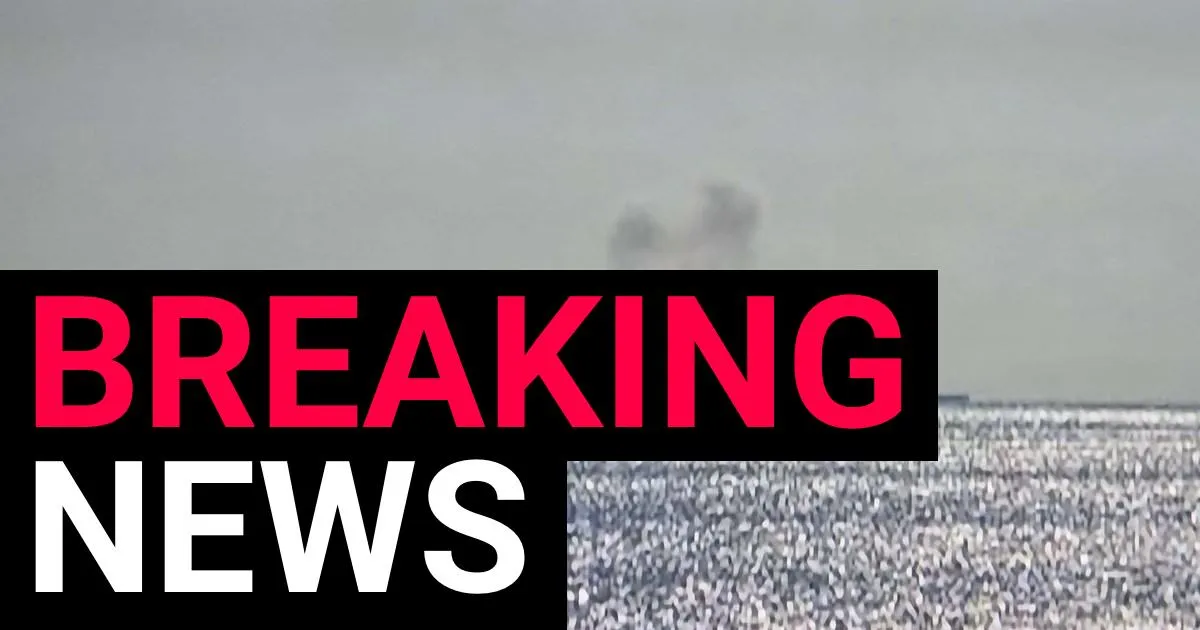
In the vast, restless expanse of the Black Sea, a journey that began with the steady hum of engines and the weight of a precious cargo has suddenly become a scene of fear, confusion, and desperate hope. The Royad Mammadov, a cargo ship sailing under the flag of Saint Kitts and Nevis, had just left the port of Izmail in Ukraine, carrying a hold full of grain bound for the Italian port of Ravenna. What should have been a long but ordinary passage across the sea turned into a violent emergency when the vessel was struck by what is believed to be a drone attack. As alarm spread across the water, the first news was grim: thirteen sailors were missing, and the ship’s captain had been injured. Fire had broken out on board, sending smoke into the open sky, and the vessel was left wounded and drifting in a stretch of sea where the rhythms of trade have become entangled with the brutal realities of conflict. The exact circumstances of the strike remain uncertain, and no one has yet claimed responsibility, but the human cost is already clear. Families waiting on shore, colleagues, and rescue teams are holding their breath as a search operation unfolds far from the safe harbors of home. The sailors who crew such vessels are not soldiers; they are ordinary people from many countries, doing a difficult and often thankless job, and now their lives hang in the balance because of a single moment of violence on the open water.
The emergency was formally raised on Monday, 5 October 2026, when the Maritime Coordination Center issued a call for help at 10:37 in the morning. The Romanian Agency for Lifesaving at Sea, known by its acronym ARSVOM, responded immediately, mobilizing resources for a rescue mission to the stricken ship. The Royad Mammadov was located in the area of the Pescăruş Platform, an offshore oil and gas installation that rises out of the Black Sea like a steel sentinel against the horizon. The vessel had been struck roughly nine nautical miles from this platform, a distance that underscores both the isolation of the scene and the urgency of the response. Rescue ships were dispatched with every bit of speed they could muster, racing against time, against the fire, and against the many dangers that still linger in the air and water around the region. A fire continued to burn aboard the cargo ship, complicating the efforts of those trying to reach survivors and casting a pall of smoke over the area. The thirteen sailors who remain unaccounted for have not been seen or heard from since the attack, and every passing minute deepens the anxiety of those who wait for news. The captain, injured and likely shaken by the force of the strike, is being attended to, but his condition is only one thread in a much larger ordeal. Around the ship, the sea stretches out under an open and indifferent sky, while a small flotilla of rescue craft pushes forward through the waves, guided by hope, duty, and the stubborn belief that there is still time to save lives.
To understand what this incident truly means, one must place it in the broader context of the Black Sea, a body of water that has become a dangerous crossroads of war, commerce, and human survival. For years, Ukraine has been one of the world’s most important suppliers of grain, and its ports along the Black Sea and the Danube have served as lifelines for millions of people across the globe. The port of Izmail, from which the Royad Mammadov departed, sits at the heart of this fragile network, a hub of activity where grain is loaded onto ships that will carry it to markets in Europe, Africa, the Middle East, and beyond. Every cargo vessel that leaves these waters carries not just wheat or corn, but also the hopes of farmers, the orders of global markets, and the food security of nations that depend on these supplies reaching their shores. Yet the Black Sea is no longer simply a route of trade; it is a contested arena where drones, missiles, mines, and naval power have turned shipping into a high-risk endeavor. Civilian vessels have been caught in the crossfire before, and each incident sends a tremor through the maritime community, reminding everyone of how fragile the boundaries have become between warfare and ordinary life. Sailors who crew these ships are not combatants; they are workers trying to earn a living, often far from their families, navigating routes that have become unpredictably dangerous. A suspected drone strike on a grain carrier is not an isolated accident. It is a grim reminder that war does not respect the boundaries of a battlefield, and that the everyday business of feeding the world can become a lethal mission.
Behind the bare details of the news report are thirteen human beings, each with a name, a face, a family waiting somewhere. They may come from different countries, speak different languages, and follow different traditions, but they share the same fear now, adrift in the aftermath of an explosion that tore through their ship and shattered the monotony of their voyage. The captain, injured but alive, carries the weight of their fate on his shoulders even as he receives medical care. There are mothers and fathers, wives and husbands, children who are trying to make sense of a phone call that brings neither news nor comfort. The missing sailors might be huddled in a corner of the ship, waiting for rescue, or they might have been thrown into the sea by the force of the blast, clinging to debris in the cold water. In such moments, the imagination is both a torment and a source of hope. Rescue teams from Romania and perhaps other nations are scanning the waters, searching the wreckage, listening for any sound that might lead them to survivors. The fire on board the Royad Mammadov adds a terrible urgency to the task, because flames and smoke can move quickly through a ship, cutting off escape routes and filling spaces with toxic air. Every minute of delay could mean the difference between life and death, between reunion and grief. The wider world may see this as a geopolitical event, a statistic in the ongoing conflict, but for those who love the missing sailors, it is a private catastrophe unfolding in real time, far beyond the reach of comfort or certainty, where hope still flickers against the darkness.
The wider implications of this attack extend far beyond the immediate rescue scene and touch the very foundations of global food supply and maritime safety. Grain shipments from Ukraine are essential to feeding millions of people, and any threat to these shipments sends shockwaves through markets, shipping companies, and humanitarian organizations alike. When a cargo ship is struck, insurance premiums rise, vessels are rerouted, and the flow of food to vulnerable regions is disrupted, often at the worst possible moment. The Black Sea has been a geopolitical fault line for years, and each act of aggression against civilian infrastructure tightens the knot of fear that binds the region and chokes its economy. The Royad Mammadov, sailing under the flag of Saint Kitts and Nevis, represents the deeply international character of maritime trade; its crew may be drawn from multiple nations, and its cargo is destined for tables far away. A suspected drone attack on such a vessel is not merely an attack on one ship. It is an attack on the very idea that trade can continue amid war, that food can move from farms to markets, that seafarers of all nationalities can do their jobs without becoming casualties of a conflict they never chose. Governments and international bodies must pay close attention, not only to the immediate rescue operation but to the deeper question of how to protect those who keep the world fed in the midst of crisis. For now, the priority is the missing and the injured, but the aftermath will demand a reckoning with the rules of war, the protection of civilians, and the safety of innocents at sea.
As the hours pass, the fate of the thirteen missing sailors remains the focus of a desperate effort to bring them home. The Romanian Agency for Lifesaving at Sea is doing everything within its power, and other vessels in the area have no doubt altered their courses to lend whatever assistance they can offer. There is something profoundly human in this response: in the face of violence and chaos, people still reach out to save others, driven by a sense of shared responsibility that transcends borders and flags. The Pescăruş Platform, standing off in the distance, serves as a silent witness to the struggle unfolding beneath its lights, a fixed point in a sea of uncertainty. The fire on the Royad Mammadov may eventually be contained, and the ship may be towed to safety or left to the mercy of the waves, but the memories of this day will not be so easily extinguished. For the sailors, if they are found alive, this will be a story of survival against overwhelming odds, a tale to tell their children and grandchildren. For the families of the missing, it will be a long and agonizing wait, filled with hope, fear, and prayer. For the rest of us, it is a reminder of the price paid by ordinary people caught in extraordinary circumstances, and of how quickly the mundane patterns of daily life can be torn apart by forces far beyond any individual’s control. The Black Sea is a cruel and beautiful expanse, capable of carrying both bread and bombs, and its waters now hold the hopes of many. In the end, this is not just a story about a ship, a drone, or a war. It is a story about human lives, fragile and precious, suspended between the sea and the sky, waiting for rescue, waiting for news, waiting for a chance to see home again.