
It began, as so many of the best and worst decisions do, with laughter and a bottle of something shared between friends. Todd Benney, twenty-four, and Henry Harrison, twenty-three, had finished their studies at the University of Bath and found themselves at that strange precipice between student life and the real world, where the future feels vast but also terrifyingly ordinary. They wanted something that would shake them awake, something that felt like a story rather than a footnote. And so, in a haze of drunken enthusiasm, the idea surfaced: drive across Africa in an old Land Rover. It was, as Henry later put it, “a drunk idea that just kind of materialised.” But that is the miracle of youth—some drunken ideas fade by morning, while others grow teeth, gather momentum, and somehow become a rust-coloured 1994 Land Rover Defender parked outside a flat, packed with supplies and maps and unreasonable hope. In September, they set off from the southern tip of the continent, making their way through South Africa, Mozambique, and Zimbabwe, through landscapes that shifted from coastal green to ochre dust, through villages and cities and empty roads that seemed to stretch into the horizon forever. They were six weeks into the journey when they reached Botswana, and the adventure still felt like a dream. Nothing had prepared them, though, for the Makgadikgadi Salt Pans.
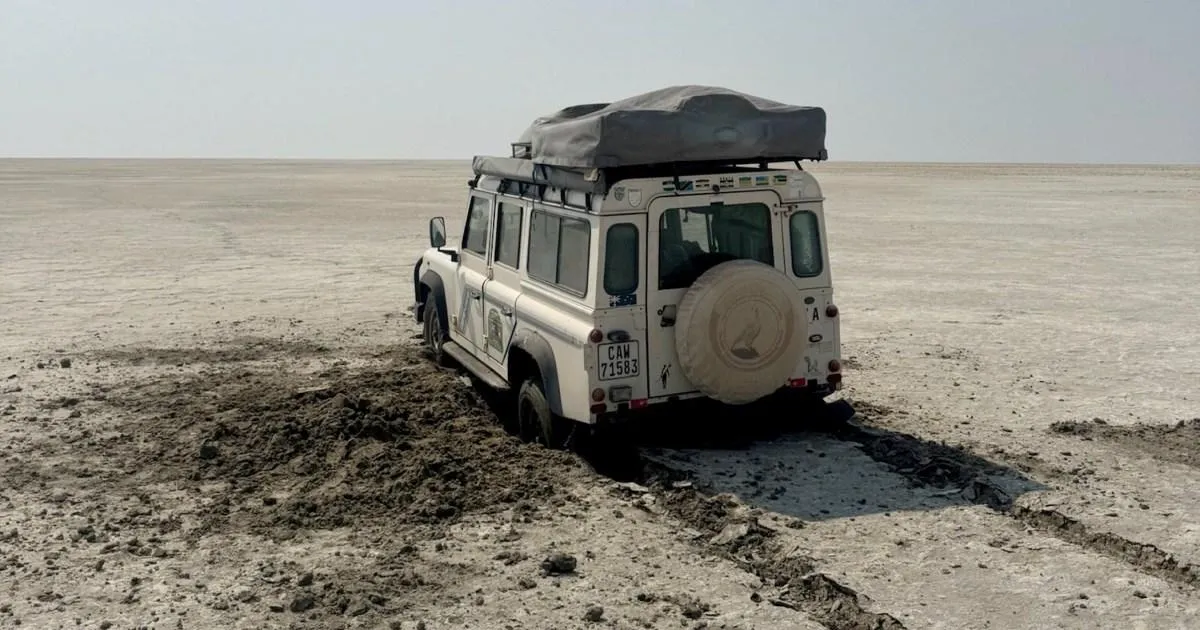
The salt pans are one of the largest on Earth, a stark and blinding expanse of white crust stretching into a heat-shimmered infinity. It is beautiful in a way that feels almost unnatural, a place where the world seems to have been erased and rewritten as a blank page. Todd and Henry drove onto the flats with the confidence of two young men who had so far survived everything the continent had thrown at them. But the engine began to struggle about fifteen kilometres in, the Defender groaning and churning as the surface beneath it turned treacherous. The salt crust, which had looked as solid as concrete, was hiding something much softer underneath. The wheels started to break through, digging deeper and deeper, and then came the sinking feeling—both literal and metaphorical—as the vehicle began to dip and tilt. “You could hear the car going, going, going, then gone,” Todd remembered. “It was completely submerged into the ground.” They had made it thirty-five kilometres into the middle of nowhere, and when they stepped out, there was nothing but white salt in every direction. No tyre tracks, no trees, no buildings, no sign that any human had ever been there. The only sound was the wind, and their own breathing. They tried to stay calm. They checked their phones: no service. They checked their maps: a village, supposedly, thirty kilometres away. It was the only option. They grabbed what they could, including a twenty-litre bottle of water, and began to walk.
Walking across a salt pan sounds simple enough, but in that environment, it becomes a slow and merciless torture. The sun beat down on them with an intensity that seemed personal, and there was no shade anywhere—not a rock, not a bush, just an endless white glare that burned their eyes and skin. They walked and walked, their steps slow and heavy, the village never seeming to get closer. By late afternoon, around six-thirty, the light began to fade, and they realised with a cold horror that they were no closer to their goal. It was then that they noticed the animal tracks in the dust around them—large, fresh, unmistakable. Hyena, perhaps, or lion. The bush began to feel alive with sounds and shadows. “This is when we first thought f*** we’re in trouble,” Todd said. The only way to reach the village was to cut through that bush, with its hidden eyes and sharp teeth. They stood there in the twilight, two young men with torn feet and dry throats, facing a choice that should never have to be made: risk being eaten alive in the dark, or turn back and try to find the car that was likely half-buried in the salt. They chose the car. Henry’s engineering mind had remembered a small detail that would save them—before they left, he had dropped a pin with what3words, a navigation app that gives every location on Earth a unique three-word address. With a screenshot of Google Maps and the coordinates in his head, they began the long trek back through the night, their hearts pounding at every rustle in the grass, every distant cry of an animal that might be watching them, waiting for them to fall.
What followed was fourteen hours of walking over two days, roughly seventy kilometres on feet that were slowly being destroyed. Henry, who had set out in Birkenstocks, watched his sandals turn into instruments of torture, the straps rubbing and cutting until his feet were torn to pieces. Todd was a little better off, but not much. They rationed the water until it was barely a few drops at a time, tipping the bottle into each other’s mouths, feeling the liquid evaporate almost before it touched their tongues. The heat was relentless, and there was no shelter from the sun when they had to stop, no tree, no rock, nothing but the shimmering horizon. Henry began to suffer from heatstroke, his mind clouding and his steps becoming unsteady. Todd kept pushing him, kept talking, kept forcing him to take another step, then another. They were no longer two friends on an adventure; they were two creatures reduced to the most basic instinct: survive. Every time they spotted fresh animal tracks, their blood ran cold, but they kept moving. They talked about home, about their families, about the stupid, magical idea that had brought them here. They laughed, weakly, at the absurdity of it all. And then, when they finally reached the edge of the salt pans and stumbled into a guard station, they were alive—barely, impossibly alive. The guards saw their condition and immediately escorted them to the police station, then to the hospital, where they were checked over and given fluids and painkillers. It was there that a police commander looked at them with something close to disbelief and told them how lucky they were. A couple had got lost in that same area, he said. They were never found. They had walked into the bush and simply disappeared, swallowed by the same silence that had almost taken Todd and Henry.
The car, meanwhile, was still out there, submerged in salt. It took emergency services three days to reach it and pull it free. The Defender had been sitting in corrosive saltwater for four days, and the men expected it to be a wreck, a monument to their near-death experience. But somehow, against all logic, the old engine coughed and sputtered and roared back to life. It was a miracle, or perhaps a testament to the stubbornness of a 1994 Land Rover. They sat in the car, covered in grime and sweat, and laughed until they cried. Then they did the only thing that made sense: they kept going. They continued their journey through Zambia, Malawi, Tanzania, and Kenya, crossing borders and rivers and mountain passes, sleeping under stars and in dusty hostels, meeting strangers who would become friends. The fear they had felt did not leave them, but it changed, becoming something quieter, more profound. They had faced the edge and come back. They had learned what they were made of, and what they meant to each other. The trip, which had once been about seeing Africa, was now about something else entirely—the astonishing, quiet resilience of the human spirit, and the unbreakable bond that forms when two people survive the impossible together. They reached the end of their route in December and sold the Land Rover in Tanzania to another traveller, who drove it to South Africa and sold it again. Todd says he wants to track it down one day, to find the old car that nearly killed them and saved them all at once.
Looking back, Todd and Henry will tell you that they were lucky. But luck only goes so far. They had prepared, as much as anyone can prepare for the unforeseen. They had water, they had the what3words app, they had each other. The experience stripped away everything unnecessary and left behind something raw and real. They learned that the world is far bigger and more dangerous than any map can show, but also that the human body can endure far more than the mind thinks possible. They learned that fear is not something to be ashamed of; it is a signal, a guide, and sometimes a teacher. And they learned that friendship, true friendship, is not about having fun together—it is about walking seventy kilometres in the blistering sun, with torn feet and burning thirst, and still refusing to leave the other behind. The story of two university mates who drove across Africa in a Land Rover begins as a joke and ends as a legend. But for Todd and Henry, it is just the beginning. They are already dreaming of the next trip, the next impossible idea. And somewhere out there, maybe in a dusty garage in South Africa, the old Defender is waiting for them, its paint faded and its engine scarred, but still alive, still ready, still willing to take them somewhere they never expected to go. The risk remains. It always will. But now they know they can survive it, together.