

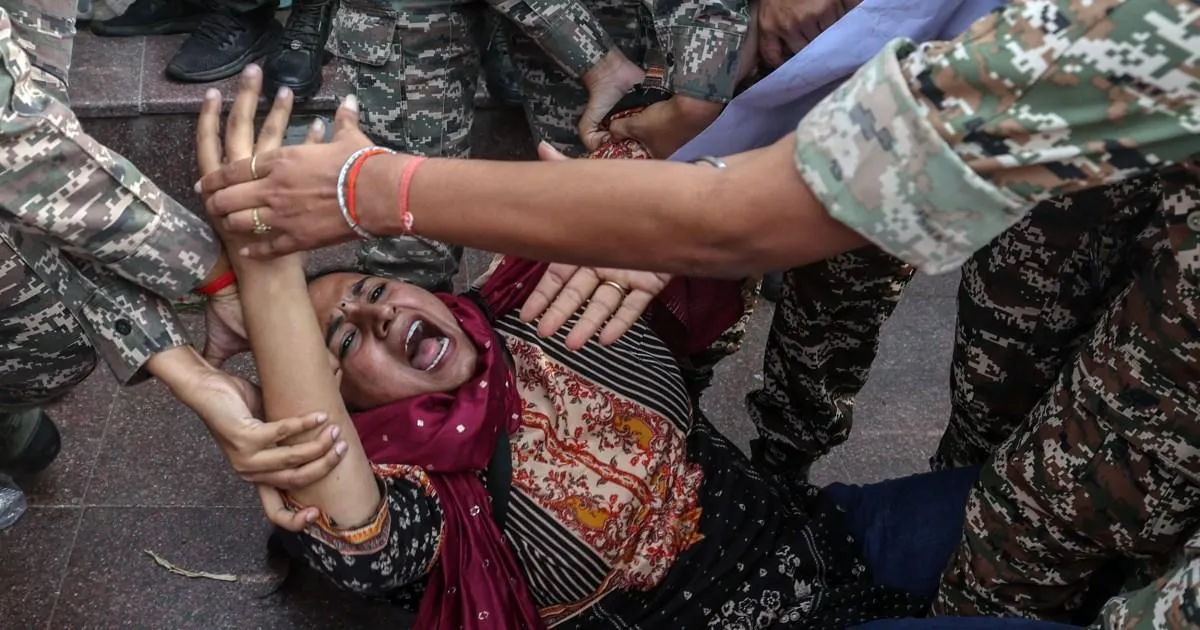
On a tense and heavily militarized morning in the Indian capital, the sprawling city of Delhi woke up to a scene more reminiscent of a conflict zone than a democratic metropolis. Thousands of police and paramilitary personnel, including Rapid Action Force units in full riot gear, cordoned off large swathes of the city, while authorities shut down internet services and closed transport hubs in a sweeping, preemptive security operation. The target was a planned protest by the “Cockroach” youth movement, a group demanding the resignation of India’s Chief Election Commissioner over allegations of voter list manipulation. But the crackdown went far beyond stopping a rally; it swept up more than two thousand protesters, opposition politicians, journalists, and even ordinary civilians who happened to be in the wrong place at the wrong time. In a city of over thirty million people, the air was thick with uncertainty and fear. Families were separated, commuters were stranded, and the fundamental question of whether peaceful dissent could still find space in India’s democracy hung in the balance. The authorities had effectively sealed off the Jantar Mantar area, a historic site often used for public demonstrations, transforming it into an inaccessible fortress of barricades and armed personnel. For many, the overwhelming show of force felt disproportionate to the threat posed by a youth-led movement that had promised to gather peacefully and voice its concerns through democratic means.
The highest-profile detentions came from the skies. Abhijeet Dipke, the founder of the Cockroach Janta Party, along with senior leaders Saurabh Das and Ashutosh Ranka, were taken into custody the moment their flight from Mumbai touched down in Delhi. Footage captured the tension inside the aircraft, with Dipke challenging the officers who approached him, while his colleagues chanted “long live the revolution” in a defiant display that quickly spread across social media. For the young leaders, it was a stark introduction to the consequences of challenging power. But the human cost of the crackdown soon became even more personal. The group alleged that authorities refused to provide updates on the leaders’ whereabouts and health, even after news arrived that Dipke’s grandmother had passed away. It was a cruel, wrenching moment that transformed abstract political conflict into a deeply human story of grief and helplessness. Police later stated that Dipke had been informed of the death and offered help to travel home for the funeral, but the initial silence from authorities only deepened the anger and despair felt by his supporters. The detentions were not limited to the movement’s founders. Opposition leaders and former chief ministers, including Mamata Banerjee of West Bengal, Arvind Kejriwal of Delhi, and Pinarayi Vijayan of Kerala, were also detained, according to television reports. Journalists, too, were caught in the dragnet. Representatives of two news outlets said police briefly detained four of their reporters, and a Reuters journalist was also held before being released. Even the All India Students’ Association accused police of illegally confiscating the phones of its president and an activist at a detention centre, raising serious concerns about legal safeguards and the treatment of those in custody.
Amid the chaos, the voices of ordinary citizens emerged as powerful reminders of what was at stake. Aditi Sharma, a protester, spoke with deep concern about the government’s approach to peaceful demonstrations. She insisted that peaceful protest is not a threat to security but a fundamental expression of democratic freedom. “The purpose of a peaceful protest is to make the public’s concerns heard, not to create disorder,” she said. “When citizens are prevented from reaching a protest site, it raises serious questions about their freedom to express concerns and demand accountability.” Her words echoed the frustration of many who felt that the right to assemble, so carefully enshrined in constitutional promises, was being crushed under the weight of state machinery. A research scholar who was detained near Jantar Mantar described how police intervened while demonstrators were holding posters and speaking to journalists. There was no clear explanation, no transparent process—just torn posters, a bus, and detention. “We were peacefully holding posters and speaking to journalists when the police intervened. We were not given a clear explanation for our detention before being taken away in a bus. Our posters were torn, and even after we were detained, we were not allowed to speak freely to the media,” the scholar said. This sense of arbitrary treatment, of being silenced without due process, left many feeling that the government was more afraid of ideas than of violence. Activist Sonam Wangchuk issued a grave warning, saying he would be “compelled” to consider further protests if the detained demonstrators were not released soon. The threat of escalating unrest hung heavy in the air, but so did the determination of those who believed that raising one’s voice is not a crime.
Police, for their part, defended the massive operation with a list of official reasons. They said permission for the demonstration had been denied because the application was submitted late, because the organisers had failed to comply with conditions imposed during an earlier protest, and because of concerns about public safety, law and order, and traffic management. To some, this sounded like a reasonable administrative response to a volatile situation. To others, it was a justification for state-backed intimidation. In a democracy, the right to protest is not supposed to be contingent on the government’s convenience. What made the crackdown even more troubling were the stories of civilians who had nothing to do with the protest but were caught up in the police sweep. Shahid, a 30-year-old who had travelled to Delhi from Bhagalpur in Bihar, said he had only come to the area to look for food. He had no interest in any political rally, yet he found himself treated as a suspect. “I did not understand why I was being treated as someone connected to the demonstration,” he said. Saurabh, a 22-year-old from Karol Bagh in Delhi, also questioned whether officers were making any meaningful distinction between demonstrators and ordinary people going about their daily lives. “Some people seemed to be looking for food, while others were trying to arrange transport or get on with their daily work,” he said. “Security may be necessary during a major protest, but it should be implemented carefully.” His words captured a simple but profound truth: security measures that disregard the innocent erode the very trust they are supposed to protect.
The underlying anger that drove thousands onto the streets was not born overnight. It was rooted in a deepening crisis of democratic integrity. The protest was aimed at Chief Election Commissioner Gyanesh Kumar over a revision of voter lists that critics say disproportionately benefits Prime Minister Narendra Modi’s ruling Bharatiya Janata Party. The Indian Express newspaper reported that two election commissioners had questioned Kumar’s voter-list revisions, which removed roughly 130 million names from the electoral rolls. For opposition parties, the mass deletions were not a technical matter; they were an existential threat to fair elections. They believe the removals affected the outcome of recent state elections won by the BJP and have cast a dark shadow over voting in the world’s largest democracy. Kumar has remained silent on the allegations, while the Election Commission and the BJP have forcefully denied any wrongdoing. But the perception of a rigged system is a dangerous thing. When citizens begin to believe that their votes can be erased, that the foundational promise of democracy has been broken, the consequences can be profound and unpredictable. The near-daily protests over this issue have become a rallying cry for a generation that feels disenfranchised and ignored. The security crackdown, far from calming the situation, only seemed to confirm the fears of those who believe that those in power will go to any lengths to protect their dominance, including silencing the very people they are supposed to serve.
The movement itself has a remarkable and painful origin. The Cockroach youth movement began in May after India’s Chief Justice Surya Kant likened unemployed young people to “cockroaches.” What was intended as a dismissive remark became a spark for a wave of youthful defiance. Young people, already struggling to find work in a stagnant economy, adopted the insult as a badge of honour. The movement grew as students and job seekers began to voice their frustration not only with unemployment but also with the fairness and reliability of competitive examinations. Allegations of paper leaks have repeatedly raised questions about recruitment processes, the security of exams, and the prospects of candidates who spend years preparing for government jobs. The frustration had already boiled over months earlier when protests over exam paper leaks forced Modi’s education minister to resign. Now, the Cockroach movement has evolved into a broader anti-government protest, driven by allegations of corruption, tampering with voter lists, and heavy-handed policing of dissent. It speaks to the desperation of a generation that has been promised opportunity but has been given precarity; that has been promised justice but has seen silence; that has been promised a voice but has been met with tear gas and barricades. As the sun set over Delhi, with buses full of detained protesters disappearing into police lines and families left waiting for news, the question that lingered was not whether this particular protest would succeed, but whether a democracy that cannot listen to its young, its poor, and its dispossessed can truly call itself a democracy at all.