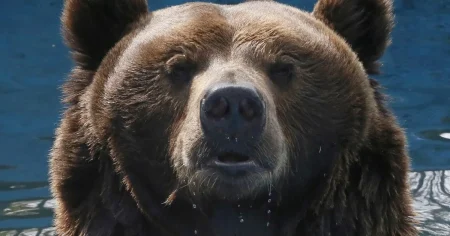

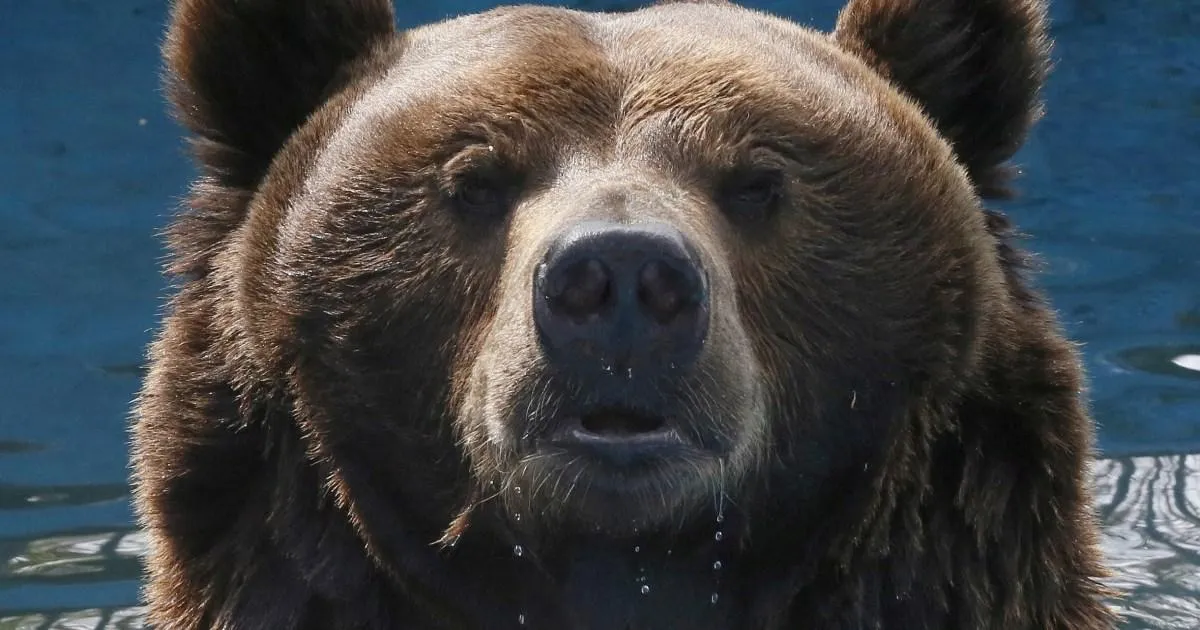
The Altai Mountains stretch across southern Siberia like a sleeping giant, their birch forests, winding rivers, and wild valleys far removed from the noise of modern Russian cities. In the remote Altai region, life is still closely tied to the land. People tend livestock, grow crops, and keep bees in wooden hives placed along forest clearings. It was there, about twelve miles from the tiny village of Solton, that a fifteen-year-old boy was spending a day doing what he had done many times before. He was checking on his family’s beehives, maybe listening to music through earbuds, maybe just enjoying the quiet rhythm of the countryside. The air would have smelled of grass and warm pine. The only sounds were the wind and the buzzing of bees. It was the kind of afternoon that made you forget that the forest had teeth. Then something changed. A rustling in the undergrowth. A large, dark shape moving through the trees. The boy saw the bear—a Siberian brown bear, one of the largest predators in Russia—and his body responded before his mind could catch up. He ran to the nearest tree and climbed, branches scratching his face, his heart hammering in his chest. But a brown bear is not a creature that loses interest easily. It reached the tree, pulled itself up or simply grabbed the boy, and dragged him down with terrifying force. The child hit the ground with a scream that pierced the afternoon. The bear was on top of him, teeth and claws finding soft flesh. In that moment, the peaceful clearing became a killing ground, and a boy’s only hope seemed to be the impossible chance that someone, somewhere, would hear him.
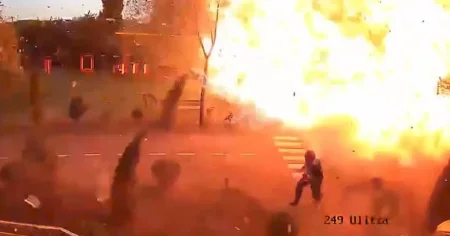
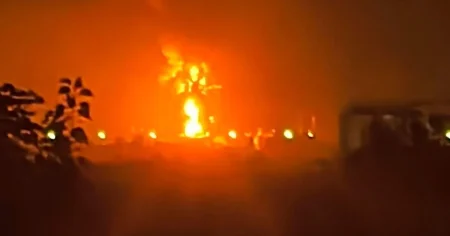
Then came a sound no one had ever heard in such a moment: the sharp, violent pop of a smartphone exploding. The bear had clamped its jaws onto the boy’s backside, biting down on the back pocket of his trousers. Inside that pocket was his phone, a common enough object for any teenager, always charged, always in reach. The pressure of the bear’s bite and the piercing of its teeth damaged the phone’s lithium-ion battery. Those batteries are essentially small, powerful chemical reactors wrapped in metal and glass. They are designed to be safe, but when they are punctured, the internal layers can short-circuit and ignite, sending out a burst of flames, heat, and gas. That is exactly what happened in the wild forest, in the middle of a bear attack, at the worst possible moment and the best possible moment. The explosion was not massive, but it was sudden and hot, and it must have been a shock to the bear’s face and sensitive nose. The animal recoiled, startled by the heat and the sound. The boy, burned and bleeding, was released. The bear stepped back, shook its head, and decided that this particular prey was more trouble than it was worth. It turned and disappeared into the forest, leaving behind a body in the grass. The boy lay there, his clothes torn, his skin burning, his whole world reduced to pain and breathing. And yet he was alive. A phone that most adults might call a distraction had just saved his life. The same device that teenagers use to scroll, to text, to record every boring second of their lives had become an accidental protective charm, a small piece of human technology that turned a predator into a frightened animal. For a split second, the wild had met the wired world, and the wired world had won.
The aftermath was a race against time. The attack occurred far from any hospital, in a landscape where mobile phones sometimes barely work and roads turn to mud in the rain. The boy was carried or helped to safety by the same neighbor who had heard his scream. That witness later described the horror and the instinctive response: “I heard him scream, turned my head, and saw the bear already dragging him down from the tree, so I unleashed the dogs.” The dogs rushed at the bear, barking and biting at its legs, adding to the confusion and helping to drive it away. But the damage had already been done. The teenager was rushed to Biysk Central City Hospital, where doctors saw the full extent of the attack. Chief physician Sergei Kovyazin said: “The patient arrived with multiple injuries to his head, scalp, facial bones and neck. These injuries presented the greatest challenge.” In addition to those wounds, his brain, chest, and lower body were injured. His condition was critical; the word “critical” means something specific in medicine, and it is never a word families want to hear. He was later moved to Moscow, thousands of miles away, for complex surgery. Imagine being fifteen years old, waking up in a hospital room far from the familiar smells of pine trees and beehives, your face wrapped in bandages, your body held together by wires and stitches. The pain would be relentless. The fear would be even worse. His family must have spent every hour beside his bed, watching monitors, praying, trying to understand how a normal day could have turned into such a nightmare. The doctors, too, must have felt the weight of it. A child’s life in their hands, a case that would be discussed in medical conferences, a body that had been through a brutal test and was still refusing to give up.
Meanwhile, the mood in the region grew tense. A man-eating bear—or at least, a bear that had attacked a human—could not simply be allowed to roam free. Local authorities and hunting organizations mobilized. Sergey Bundin, head of the Belovodye hunting reserve, told reporters: “We’re doing everything we can and won’t stop until we’ve shot this bear.” This is the blunt language of a community that no longer sees an animal but a threat. The hunt would likely be difficult, because a brown bear is fast, powerful, and knows the terrain better than any hunter. But they would not stop. The boy’s ordeal was part of a larger pattern of violence between humans and bears across Russia. According to CNN, at least sixteen fatal encounters were recorded across the country in September alone. That number is horrifying. It means that for more than two weeks, on average, someone somewhere in Russia was killed by a bear. In a country as huge and wild as Russia, these animals are not just characters in old folktales; they are real, present, and increasingly desperate. People in rural areas know to keep their trash secure, to avoid walking alone in the forest at dusk, to keep a dog or a rifle nearby. But even with all those precautions, the bears are appearing closer and closer to homes, schools, and hospitals. The balance that once existed, with bears staying deep in the forest and humans staying in their villages, is breaking apart. Every attack, every close call, leaves behind a community that is more afraid, more suspicious, more determined to meet the next bear with violence. Fear is contagious, and in the Altai region, it is spreading faster than any animal can run.
Why is this happening? The most likely answer is hunger. Over the past months, severe wildfires have burned through vast stretches of Siberia, destroying the forests that provide brown bears with their natural food: berries, nuts, roots, insects, and small animals. When the forest burns, the bears lose their pantry just before winter, the season when they need to stock up on fat to survive hibernation. Desperation drives them out of the wilderness and into human spaces. They are not monsters; they are starving animals looking for anything that will keep them alive. In the city of Norilsk, a brown bear was captured on camera walking through wasteland in front of a hospital, driven by hunger, barely acknowledging the buildings around it. That image says everything about the crisis. The bear was not angry. It was not even aggressive. It was simply starving, moving through a human landscape like a ghost, looking for food in a place where no food should be. In the Altai region, the boy’s bees were, to the bear, not a family’s livelihood but a meal. The hives would have smelled of honey, wax, and life. The bear did not plan to attack the boy. It was after the hives, or it was startled into violence. A bear that is starving will take risks it would never take in a healthy year. A bear that is startled will strike first. The collision was inevitable in a landscape where the wild and the human no longer have any separation. Climate change, deforestation, and human expansion have pushed the bears out of their old territories. There is no clean answer, no easy villain. The bear is both a killer and a refugee. The boy is both a victim and a survivor. And the forest, which once seemed so vast and forgiving, is now a place where two species are fighting for the same narrow strip of land.
And yet, for all the tragedy and fear, this story is also one of astonishing luck. A boy survived an attack that should have killed him. He survived because he had a sharp ear, a loyal neighbor, brave dogs, and a phone that exploded at exactly the right moment. It is impossible to know what the boy will remember most—the enormous shape of the bear, the pain of its teeth, the sudden crack and heat from his pocket, or the sound of the neighbor’s shouts. He has a long road ahead. His condition was critical, and the road to recovery will be measured in months, not days. But he is alive. That is the part of the story that no one can take away. The bear, if it is found, will probably be shot. That is another loss, another death in a world that no longer has easy answers. But in the silence of the Altai forest, among the hives and the birch trees, there is still space for hope. The boy’s phone exploded, and the bear ran, and a young life was given a second chance. It is not a neat ending. It is not a fable with a moral. It is just the messy, painful, beautiful reality of survival. When he is older, he might tell this story around a fire, and people will gasp and laugh at the phone part, and someone will say it was fate. He might not know what to believe. All he will know is the feeling of waking up in a hospital, alive, while the world outside went on. And when the boy is old enough to tell the story himself, he will probably shake his head in disbelief. He might even laugh, in the way people do when they look back on the worst day of their lives and realize they made it through. The bear, the teeth, the scream, the explosion, the dogs, the surgery—it all becomes a single, impossible story. And the strangest part is that it is true.