


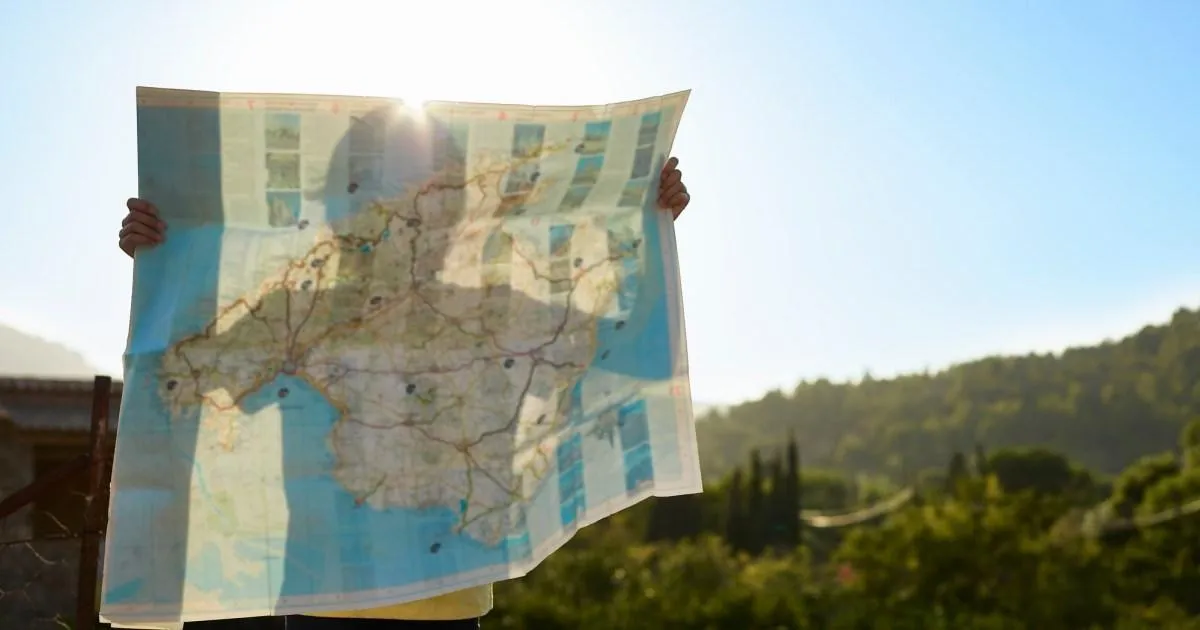
In an age where the glowing screen of a smartphone is the first thing we reach for in the morning and the last thing we look at at night, it’s no surprise that it has also become our primary compass. The days of unfolding a large, rustling paper map across the hood of a car or consulting a dog-eared A-Z before setting off on a journey are, for many, a distant memory. We now live in a world where the blue dot on a digital screen guides our every turn, telling us when to go, when to stop, and when to veer left. But as we seamlessly navigate our lives through this digital lens, a pressing question emerges: what happens to our own internal navigation systems? Experts are beginning to voice a concern that our deep reliance on this technology is quietly eroding the fundamental human skills of spatial awareness and traditional map reading, leaving younger generations potentially vulnerable if the digital safety net ever fails.
The concern isn’t just about the loss of a quaint, nostalgic skill, but about a fundamental shift in how our brains process the world around us. For centuries, humans have been wayfinders, using a complex combination of memory, observation, and environmental cues to traverse landscapes. This was not a passive activity; it required active engagement with the world—noting landmarks, understanding the relationship between geographic features, and building a mental map of our surroundings. This process, known as spatial cognition, is a dynamic and vital function. However, the advent of turn-by-turn GPS navigation has, in many ways, short-circuited this process. When we simply follow a disembodied voice or a visual arrow on a screen, we are offloading the cognitive heavy lifting to a machine. We become passive passengers in our own bodies, less aware of the route we are taking or the landscape we are moving through. The brain, ever efficient, simply switches off the spatial processing centers that would normally be firing with activity, as we become blind to the environment in a way that a paper map would never allow.
This shift in cognitive function is particularly pronounced in younger generations. Raised in a world where the internet and smartphones have always existed, many people under the age of 30 have never had the need, or perhaps even the opportunity, to navigate using physical tools. The 16-to-24 age group, with near-saturated smartphone ownership, represents the first generation to have had virtually unlimited access to digital navigation from the moment they began to explore their world independently. The paper map, once a household staple, is now an unfamiliar object. The very idea of plotting a route using a grid reference or a road atlas column is foreign. Instead, their geographic literacy is defined by the map application on their phone. This reliance isn’t necessarily born of laziness, but of a simple lack of exposure. Much like a child who learns a language from immersion rather than from a grammar book, they have learned navigation through the immersion of digital tools, and the grammar of the paper map is a language they have never been taught. The vast majority will likely never have grappled with the complexities of an A to Z, a Collins road atlas, or a topographic Ordnance Survey map, all of which were once indispensable tools in any household.
The implications of this shift go beyond the mere ability to read a map; they touch on our fundamental connection to the environment. Human behavior experts argue that this technological reliance is cultivating a generation with a diminished sense of spatial awareness and a weakened “connection to the landscape.” When you navigate with a paper map, you are not just following a line; you are learning about the shape of the land, the course of rivers, the density of urban areas, and the relationships between places. You are building a rich mental model of your world. In contrast, the phone screen shows a simplified, sanitized version of the world, filtered through a user interface that prioritizes efficiency over exploration. The result is a kind of cognitive thinning, where the rich tapestry of the physical world is reduced to a series of routes and destinations. This disconnect can lead to a sense of placelessness, where one can physically be in a location but have little sense of its geography, history, or character, feeling lost and disoriented even when standing in the midst of it all.
However, the experts are also quick to point out that this is not a one-way street. The human brain is an incredibly adaptable organ, and these navigational skills are not lost forever. Even if our spatial processing has become dormant through disuse, the latent ability is still there, waiting to be reactivated. The brain is highly efficient in its use of resources; if a behavior isn’t being practiced, it will reprioritize its energy elsewhere. But like a muscle that hasn’t been used in a long time, it can be re-strengthened. The fact that many people can still recall the layout of their childhood neighborhood or the main route to a frequently visited destination shows that the basic capacity for wayfinding is intact. The challenge is that many people would likely struggle if forced to navigate outside of their regular, memorized routes without digital assistance. They might know how to get to the supermarket or their friend’s house, but a sudden need to navigate an unfamiliar area on paper would be a monumental task. For many, the reliance on GPS is so absolute that they panic at the thought of missing a turn or losing service, a feeling of anxiety that is completely foreign to those who grew up navigating by the sun and street signs.
Interestingly, some experts draw a parallel between the rise of digital navigation and the advent of the calculator. When calculators became commonplace, they removed the need for everyday basic mental arithmetic, and a general decline in those specific skills was observed. Similarly, GPS navigation has removed the need for everyday spatial problem-solving. Yet, unlike the calculator, which has arguably made complex calculations more accessible, the effect of GPS on navigation is more nuanced. It doesn’t just make navigating easier; it fundamentally changes the cognitive process involved. It’s not just about the destination, but about the journey of the mind. There is also a school of thought that suggests humans are inherently better at positioning and navigation than computer systems. Our ancestors crossed oceans and continents using stars, currents, and wind patterns. Even today, our innate sense of direction, when actively engaged, is a powerful and resilient tool. Large systems that rely on GPS, like the maritime industry, are built with redundancies and can frequently survive without it, highlighting the fallibility of the technology itself and the resilience of human-led systems.
Ultimately, the real vulnerability identified by experts is not necessarily a sudden, catastrophic loss of GPS, but a slow, creeping erosion of a crucial human skill. It is a “problem waiting to happen,” a cognitive vulnerability that could be exposed by a range of events, from a widespread internet outage or a cyber-attack to simply a dead phone battery at an inopportune moment. While the UK’s road signage is considered “reasonably good” and would help mitigate some of the chaos, it is no substitute for the internal compass that comes with active navigation. The true way forward, as suggested by those at the Ordnance Survey, is not to abandon technology but to use it in a more balanced way. Our digital tools have undeniably helped people travel with more confidence. Yet, confidence that is completely dependent on a device is a fragile confidence. Rebuilding a connection with our environment—by actively noticing landmarks, understanding directions, and even learning to use a map for leisure—isn’t about rejecting progress. It’s about fostering a resilience that ensures we are never truly lost, with or without the help of a satellite. It is about recognizing that the world around us is not just a backdrop for our digital maps, but the very landscape we inhabit, and the more we understand it, the more at home we truly are.