


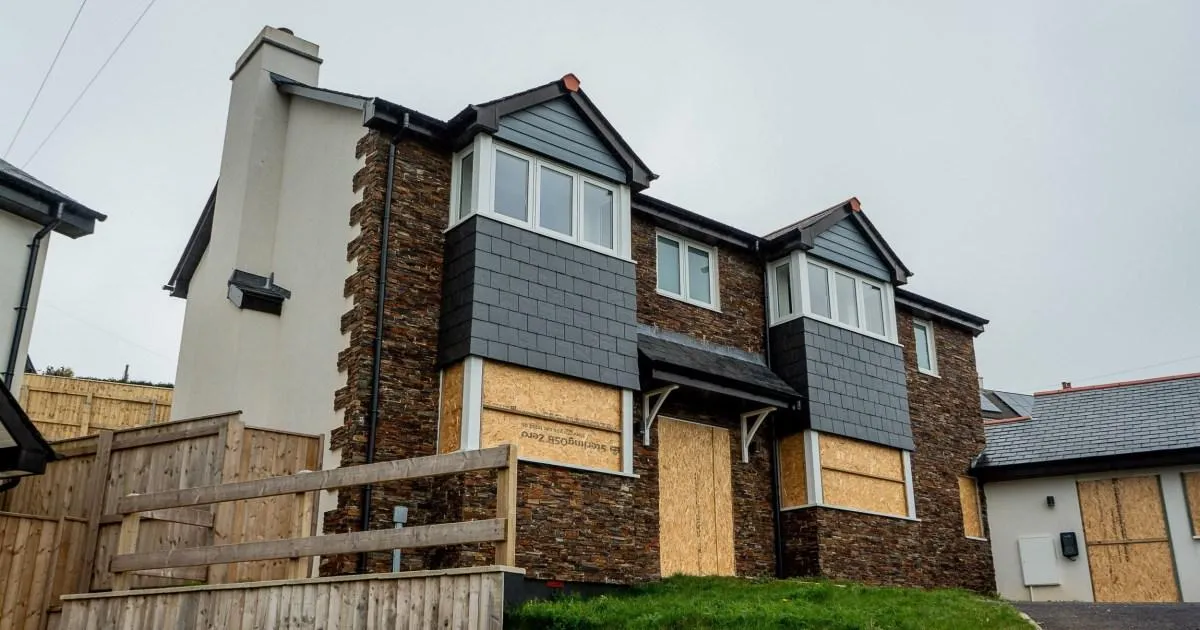
In the quiet village of Calstock, tucked into the lush green folds of Cornwall’s Tamar Valley, there is a place that time seems to have forgotten. It is not a ruin from centuries past, nor a forgotten monument, but a housing estate that was supposed to be full of life by now. Instead, Bridge View Nurseries stands as a boarded-up ghost estate, a collection of empty homes staring out at the surrounding countryside with dark, hollow windows. For seven years, not a single person has moved in. The 33-home development, once approved with great hope and promise, was meant to deliver much-needed housing for the area, including 15 affordable homes for local families. But today, just 10 houses have been built, some only partially finished, and the entire site has been put up for sale. The asking price is undisclosed, available only “on application,” and the silence around the estate is broken only by the wind and the occasional bird. For the people of Calstock, this unfinished development is not just an eyesore; it is a daily reminder of a dream that collapsed, a promise broken, and a housing crisis that continues to tighten its grip on communities across Cornwall.
The story of how this estate came to be frozen in time is one of spiraling costs, bureaucratic delays, and finger-pointing. The development was first granted planning permission in 2018, with a further application approved in 2025. The original vision was ambitious: 33 homes, with nearly half designated as affordable, to help ease the severe shortage of housing in southeast Cornwall. The developers, Michael Wright and Adele Fulner of Construction Partners Ltd, said they were committed to delivering these homes. But the project soon ran into serious financial trouble. Costs spiraled, and the developers claimed that delays by Cornwall Council left them facing £1.2 million in interest payments. They argued that the council took years to approve revised plans, and by the time approval came through, construction costs had soared beyond their budget. Additional requirements, including a second road and a retaining wall costing £750,000, further ate into their finances. In a revised Section 106 agreement with the council, the number of affordable homes was reduced from 15 to 10. Even that, however, did not save the project. Work ground to a halt in 2019, and the site has been derelict ever since. The 1.55-hectare (3.85-acre) plot now includes the 10 existing properties, some completed and others unfinished, along with foundations for further homes and part of a retaining wall. An 11th property had also been started, but its condition has deteriorated so badly that it may need to be demolished and rebuilt entirely.
For the villagers of Calstock, the abandoned estate is a source of deep anger and frustration. One resident, whose son’s home is next to the site, did not hide their disgust. “It has been frozen for a few years, absolutely ridiculous,” they said. “At the moment the whole debacle is disgusting. Just give it to the local council to allocate to Cornish locals.” Another resident questioned why developers are allowed to walk away from unfinished projects, leaving communities to live with the consequences. They called for councils to have the power to impose completion deadlines or revoke planning permission when developers fail to deliver. “I dread to think how many unfinished properties there are in the UK that could be used to reduce homelessness, overcrowding and people living in substandard accommodation,” they added. The sense of injustice is heightened by the fact that none of the affordable homes have even been started. While 10 private homes stand empty, waiting for someone to finish them, local families continue to struggle to find housing they can afford. South East Cornwall is one of the most deprived areas in the country, and residents are painfully aware that these homes were not built for them. “Perhaps building houses for wealthy people from outside the area isn’t the best way forward for the community,” one local said. The estate, once a symbol of progress, has become a symbol of everything that is wrong with the housing system: speculative development, broken promises, and communities left to pick up the pieces.
The physical condition of the site tells its own story. According to the estate agent’s listing, 10 of the 23 planned homes for private sale have been built, and eight of them are close to completion. But all remain empty, some still needing flooring, white goods, and other finishing touches. The listing describes the development as sitting in an elevated position with views across the surrounding countryside and the nearby viaduct. Calstock and the surrounding parish are part of a UNESCO World Heritage Site, recognised for their landscape and history of tin and copper mining. It is a place of remarkable beauty, but the beauty is marred by the sight of unfinished buildings, overgrown plots, and the skeleton of a retaining wall. For anyone considering buying the site, there are significant burdens attached. A Section 106 contribution of almost £100,000 is required towards education and open space. The roads must be completed to an adoptable standard, which means further investment. The condition of the partially built 11th property, which may require demolition, adds another layer of complexity and cost. Potential buyers will need deep pockets, patience, and a willingness to navigate a tangled web of planning obligations and community mistrust. The listing is a strange mix of opportunity and warning: there is a chance to complete a development in a beautiful location, but it comes with the weight of years of failure and a community that has been burned before.
Cornwall Council, for its part, has defended its position. A spokesperson said the council is committed to working with developers to ensure housing developments and the agreed number of affordable homes are delivered in line with planning permission. They acknowledged that issues with the development have been ongoing for several years and said the council has done all in its power to work with the company. However, they stressed that the council must adhere to local and national planning policy, including local neighbourhood plans. The spokesperson added that the council remains in active discussions with stakeholders to find a solution to secure the delivery of the development, including the vital affordable housing element. The developers, meanwhile, have blamed the council for years of delays, claiming that the revised Section 106 agreement took so long to approve that construction costs became unmanageable. They say they were caught between rising prices and a slow-moving planning system, and that the £1.2 million in interest payments was the final blow. It is a classic blame game, with the community caught in the middle. The villagers do not care whose fault it is; they just want homes. They want the boarded-up windows to be opened, the unfinished walls to be completed, and the empty houses to be filled with people. They want their children to be able to afford to live in the place where they grew up, and they want the beautiful landscape of the Tamar Valley to be a place of life, not decay.
In the end, the Calstock estate is more than a local story. It is a parable of the housing crisis that grips the United Kingdom, where the need for homes is urgent, but the system seems incapable of delivering them. Across the country, there are unfinished developments, empty properties, and planning permissions that have been granted but never acted upon. The reasons are always the same: costs, delays, and a lack of accountability. The people of Calstock have called for the homes to be compulsorily purchased and made available to local people at affordable prices. They have asked why councils cannot force developers to finish what they start. They have watched as years have passed, and nothing has changed. The sale of the site is an opportunity, but also a risk. It could bring in a new developer with the resources and determination to complete the project, or it could lead to more years of neglect and uncertainty. The listing promises views across the countryside and the viaduct, but what the community wants to see is something far more precious: neighbours, families, and the sound of children playing in the street. The empty homes in Calstock stand as a silent accusation, a reminder that housing is not just about buildings, but about people. Until the site is brought back to life, the ghost estate will continue to haunt the village, a symbol of hope deferred and a challenge to everyone who has the power to make things right. For now, the only thing certain is that the wait continues, and the people of Calstock are left to wonder when, if ever, their village will be whole again.