


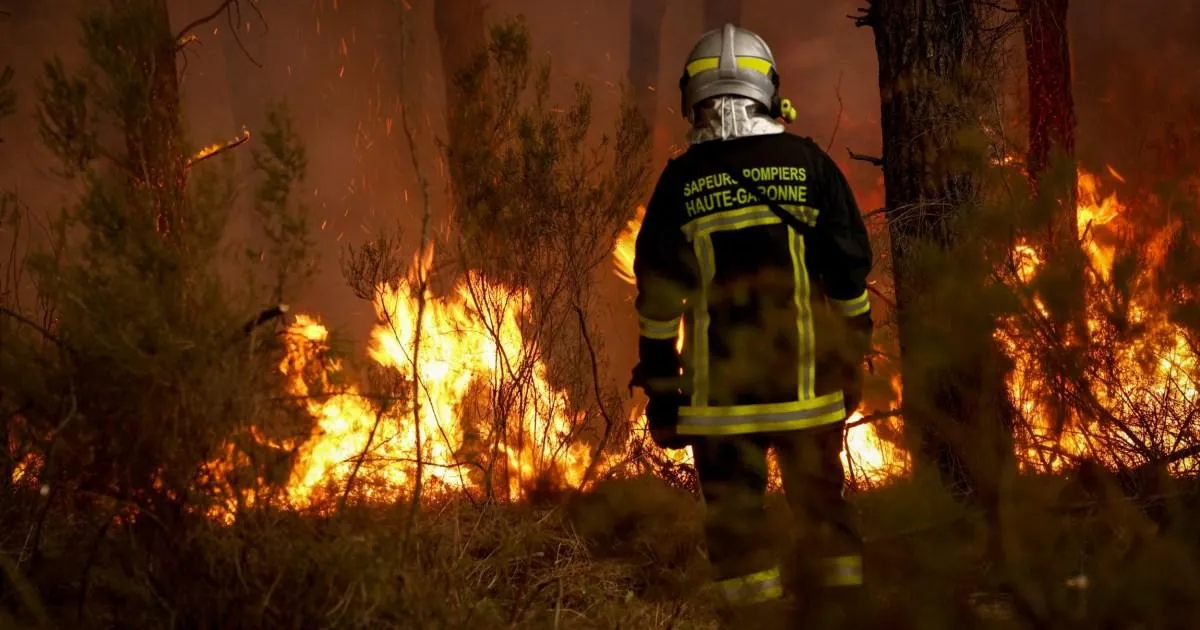
The United Kingdom is bracing itself for a fourth heatwave this year, a daunting prospect that arrives just as images of “apocalyptic” wildfires emerge from France and Spain. In the vicinity of Bordeaux, residents are living through a terrifying reality, with massive blazes encroaching within nine miles of the city. As scorching temperatures and arid conditions fuel these continental infernos, a palpable anxiety has settled over Britain—a concern amplified by the fact that many regions are already hovering on the brink of drought after weeks of parched weather. With the Met Office issuing yellow heat alerts for significant portions of England, the question on everyone’s mind is whether Britain is destined to face its own version of these devastating wildfires.
The current meteorological outlook is stark. Parts of England are expected to hit peak temperatures of 33°C this week, further desiccating an already brittle landscape. While Scotland has been grappling with its own weather-induced trauma—including a major wildfire in the Cairngorms that required the mass evacuation of local residents—emergency services across the UK are on high alert. Fire science experts, such as Dr. Zak Campbell-Lochrie, warn that this cocktail of high heat and low humidity is effectively turning the British countryside into a tinderbox. As the vegetation continues to dry out, even the smallest spark—a discarded cigarette or a neglected barbecue—could trigger a fire that spreads with frightening speed, putting both rural communities and infrastructure at significant risk.
Perhaps more concerning than the fires themselves is the growing strain on the emergency services tasked with fighting them. Experts caution that our fire-fighting infrastructure is feeling the weight of repeated, relentless pressure. When wildfires strike, they are notoriously resource-intensive, requiring not just personnel but specialized equipment and aerial support. With multiple incidents potentially blooming at once, the ability of fire crews to respond effectively is being pushed to the limit. Each new heatwave exacerbates a cycle of exhaustion and depletion, leaving the nation with less resilience to handle the unpredictable and dangerous outbreaks that characterize this new, volatile climate reality.
However, it is important to provide some perspective amidst the fear: climate scientists broadly agree that the UK is unlikely to experience the catastrophic, sprawling infernos currently devastating the Mediterranean. The primary difference lies in the landscape itself. Unlike the Mediterranean, which is defined by highly flammable, natural wildlands, much of Britain’s geography is dominated by agricultural farmland. Experts like Bob Ward, of the Grantham Research Institute, point out that our cities are generally buffered from large-scale, continuous natural fuels. This structural difference acts as a natural firebreak, making it difficult for flames to achieve the same runaway momentum that has forced evacuations in southern Europe.
Despite these environmental safeguards, we are far from immune. A sobering reminder of our vulnerability occurred in July 2022, when wildfires on the fringes of London destroyed nearly 20 homes. It was only due to a fortunate, last-minute shift in the wind that the capital avoided a far more localized catastrophe. This event served as a clarion call that wildfires are not merely a “countryside problem” but a mounting threat to our urban interfaces. As we look ahead to the next few decades, the consensus is clear: these events are expected to increase in frequency and severity, necessitating a fundamental change in how we manage our land and protect our built environment.
Ultimately, the most critical factor in the UK’s wildfire risk is human behavior. Because nearly all major fires on our shores are either accidentally or deliberately started by people, the solution lies in a renewed culture of fire safety. As the risk climbs, there is a strong argument for stricter, more enforceable bans on lighting fires or using barbecues in vulnerable areas during heatwaves. Safeguarding our future will require a dual approach: a commitment to better urban planning that draws clearer lines between residential zones and wild vegetation, and a collective, nationwide vigilance to ensure that our beautiful landscapes are not consumed by preventable human error. Facing this warming world requires both caution and wisdom in equal measure.