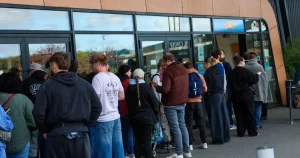



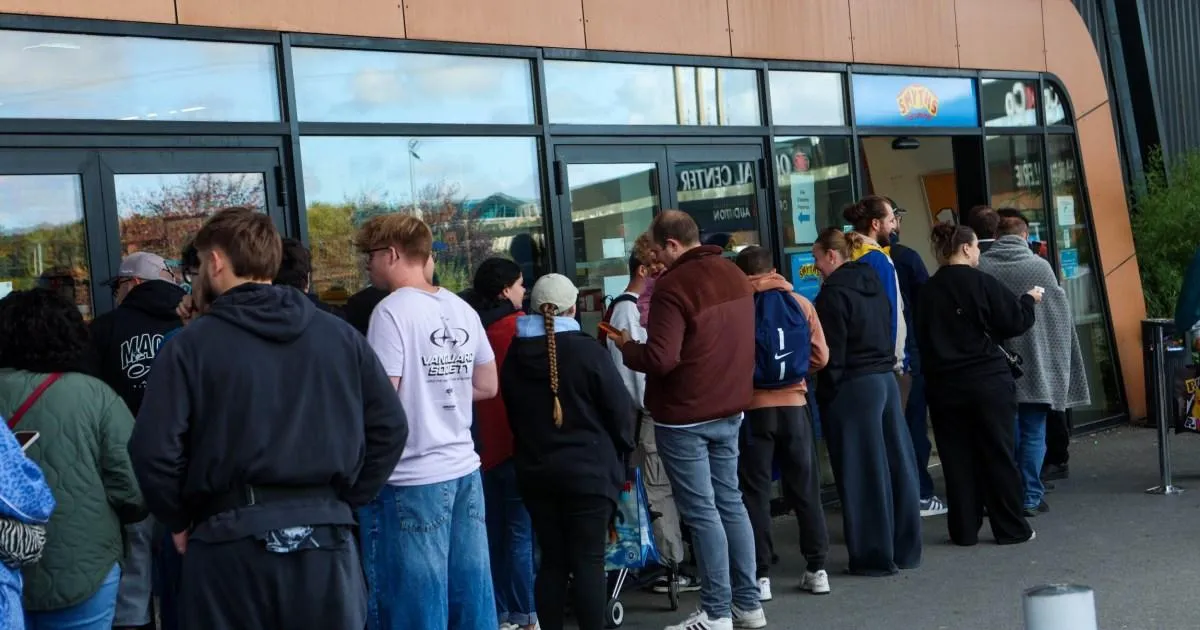
Early risers in Norwich were met with an unusual sight this morning: a long, eager line snaking around the entrance to Sports Direct, with hundreds of people clutching fold-out chairs, thermos flasks, and binder folders, all waiting for one thing—Pokémon cards. The occasion was the release of a special collection celebrating the franchise’s 30th anniversary, and for the devoted fans lining the pavement, it was not just another product drop. It was a ritual, a pilgrimage, a chance to recapture the feeling of opening a pack for the first time. Some had arrived at dawn; others had never really gone to bed. Dan, one of the fans in the queue, had camped outside the shopping centre since 1.30am, unwilling to risk missing out on the cards that had been shipped to HMV and Game inside Chantry Place. By the time the shops opened, the crowd had swelled into a buzzing, good-natured throng of collectors, traders, and nostalgic adults, all sharing tips, comparing card lists, and swapping stories about the ones that got away. The sheer scale of the turnout was a reminder that three decades after Pokémon first appeared, its pull remains remarkably strong.
Among the early arrivals were four friends—Sean, Cameron, James, and Dan—who had coordinated their efforts to make sure at least a few of them got what they came for. James had set his alarm for just after 4am and arrived by 5, hoping his early start would pay off with an Elite Trainer Box, the premium bundle containing nine booster packs. “I think I will be able to get an ETB hopefully,” he said, trying to sound confident, though the nerves were visible. “It has nine packs inside, so I’ve got a decent chance of getting something good.” The others nodded in agreement, but Dan, the one who had camped overnight, was playing a different game. He wasn’t just there for the box; he was hunting a single, elusive card—a “Treekachu,” a special anniversary card that can reportedly fetch more than £700 on the secondary market. “Got to be in it to win it,” he joked, though his sleeping bag suggested he was anything but casual. Cameron, who joined the queue around 7am, had his eyes on a Charizard, the fire-breathing icon that has been the holy grail of collectors since the very beginning. Sean, the most philosophical of the group, summed up their shared mindset with a simple slogan: “I’m hoping to get an ETB, which I’m pretty sure I should. Pokémon all the way.” For them, this wasn’t about profit alone—it was about being part of something bigger, a community that had stayed loyal through school playgrounds, university dorm rooms, and now adult life with disposable income.
The scenes in Norwich were echoed across the country and beyond. In Leeds, a queue snaked down the street outside Travelling Man, a specialist game shop that opened its doors at 10am. Some fans had brought camping chairs, clearly expecting a long wait. Inside, manager Khalid Morton watched the growing line with a mixture of delight and pragmatism. He had stocked what seemed like a fair amount of the new cards, but he knew the math of Pokémon collecting all too well. “There’s a fair amount, so I’d expect they’ll sell out in the first couple of hours,” he said. Morton also explained that the hype wasn’t just about nostalgia, though nostalgia was certainly a huge part of it. For older fans, the 30th anniversary collection was a chance to reconnect with their childhoods, to feel that familiar weight of a pack in their hands and hear the crinkle of foil. But there was also serious money involved. “Currently, the secondary market for these is quite high,” he noted, and that had drawn a new kind of collector—one who studied market trends as carefully as card stats. In Sheffield, the response was even more intense. Forbidden Planet had to implement a one-in, one-out system to manage the sheer volume of people, with staff doing crowd control almost as much as customer service. Dan Liles, wearing a bright Pikachu hat that made him easy to spot, managed the queue with calm authority, noting that fans had been waiting since around 7am. Even across the English Channel, in the French town of Flers-en-Escrebieux, hundreds of fans lined up outside a Smyths store, proving that Pokémon’s appeal knows no borders.
It is worth remembering just how far Pokémon has come. What began as a Nintendo Game Boy game in Japan in 1996 quickly became a cultural phenomenon unlike anything the world had seen. Later that same year, in October 1996, the Pokémon Trading Card Game was launched, and it has been growing ever since. More than 85 billion cards have been produced to date—a number so vast that it’s almost impossible to picture. Stacked together, they would circle the Earth many times over. And while most cards are worth only pocket change, a select few have achieved legendary status, with one rare card once selling for £12 million at auction. That combination of accessibility and possibility is what makes Pokémon so unique. A kid with a few pounds can still buy a pack and dream of striking gold, while a serious investor can spend a fortune on graded, sealed boxes. The 30th anniversary collection taps into both fantasies. For every collector methodically checking pull rates, there is someone like Sean, who just wants to open packs with his friends and say “Pokémon all the way” with a grin. The queue outside the shops was not just a line of customers; it was a living timeline of the franchise’s history, from first-generation purists who remember trading cards on the playground to newcomers who discovered Pokémon through streams and social media.
What makes these queues so compelling is not the cardboard itself, but the stories people bring with them. Every person standing in line has a reason for being there. Some are chasing a childhood memory—maybe the Charizard card that was traded away in an unwise schoolyard deal and never replaced. Others are hunting for investment-grade hits, carefully preserving their pulls in sleeves and top loaders, watching prices fluctuate on auction sites. And many are simply there for the joy of the hunt, for the electric moment when a pack is ripped open and a rare card shines up at them. The atmosphere in Norwich felt more like a festival than a retail event. Strangers compared binders and traded duplicates. Someone pulled out a dusty old Pokémon game cartridge and suddenly a group was huddled together, reliving their first playthrough. Dan, the overnight camper, was offered coffee by people he’d only just met. Cameron and James, who had started the morning as acquaintances, were now deep in conversation about which packs were worth buying twice. The staff at HMV and Game, who had probably expected a busy morning, looked genuinely surprised by the energy. What they were witnessing was not just a product launch; it was a community gathering, a celebration of shared memories and enduring friendships. The hours of waiting felt less like a chore when everyone around you was speaking the same language—the language of Pokémon.
As the morning wore on, the queues slowly shrunk, and the shops began to sell through their stock. Some fans emerged triumphant, holding Elite Trainer Boxes carefully under their arms, their faces glowing with relief. Others left empty-handed, but even they did not seem too disheartened; there were always more packs, more releases, more chances. James’s early alarm paid off, and Dan’s overnight camping meant he had the first pick of the rarest pulls. Whether he found his Treekachu remained a matter of luck, but he had already won something greater: the pride of being first in line. Cameron’s search for Charizard continued, but he carried home a binder’s worth of new cards and new friends to trade with. Sean’s prediction came true, and his ETB was safely in his hands. The final image is not just of a consumer rush, but of a culture that has survived thirty years and evolved into something wonderful. Pokémon began as a simple Game Boy game, but it grew into a shared world where a drawing of a yellow mouse could bring together thousands of people across Norwich, Leeds, Sheffield, and France. It gave them a reason to get up early, to camp in the cold, to stand in line and talk to strangers. It gave them hope—the hope of finding something rare, something valuable, something nostalgic. And for a few hours on an ordinary morning, that hope was enough to fill the streets with laughter, conversation, and the unmistakable joy of Pokémon.