
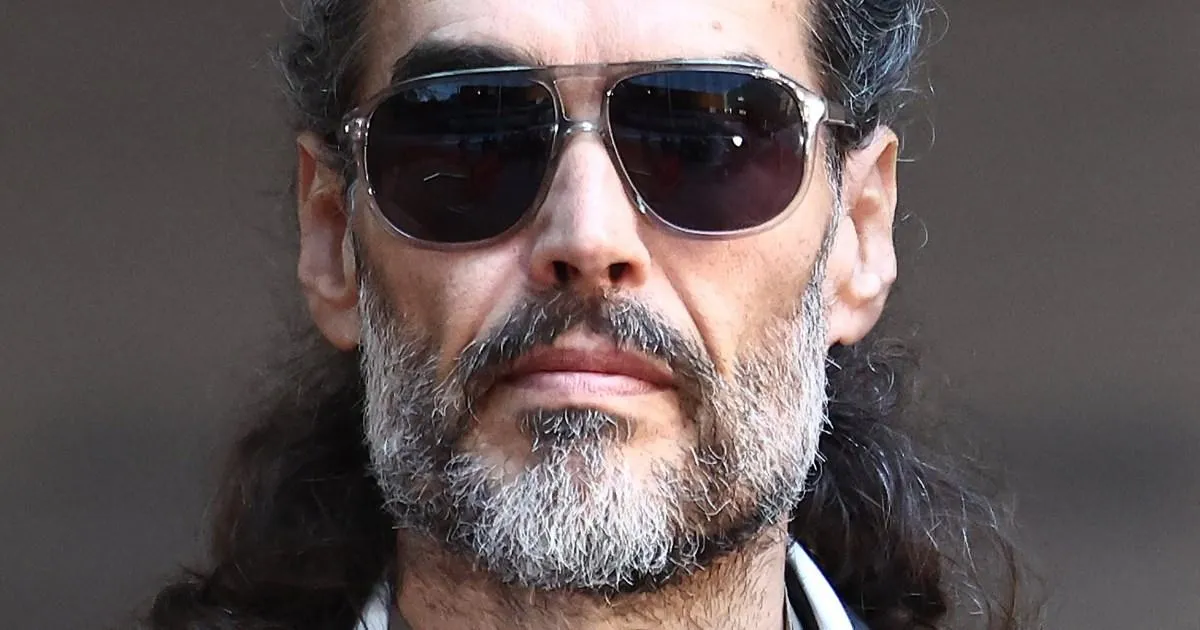
At Southwark Crown Court, one of Britain’s most recognisable comic voices has been reduced to a man fighting for his freedom. Russell Brand, once famous for his laddish charm, shaggy-haired irreverence and ability to make audiences laugh at the most uncomfortable truths, now stands accused of a far darker story. In her closing speech, prosecutor Riel Karmy-Jones KC painted a devastating picture of the entertainer, describing him as someone who treated women as “disposable commodities” and “amusements in his playground of orgasms.” The court heard that Brand, 51, is accused of attacking women in a hotel room, at his luxury London home, in workplaces, and even in a Soho bar toilet. Over the course of the trial, six women have come forward with allegations spanning more than a decade, from 1999 to 2009, and the prosecution said their evidence reveals a man who pursued control, felt disdain for the women he encountered, and was fixated on a boastful personal goal of having sex with 5,000 women. The prosecutor pointed to Brand’s own writing and interviews — including a 2007 book in which he discussed his “birthright orgasm” and a 2017 interview in which he referred to women as “amusements” in a “playground of orgasms.” These words, said Ms Karmy-Jones, were not just crass celebrity bravado but a window into how he viewed the women who now accuse him. The courtroom, filled with journalists, legal teams and members of the public, felt the weight of the prosecution’s closing remarks as she urged the jury to see the pattern behind the allegations and to hold the defendant accountable for what she described as a ruthless and predatory approach to sex.
The heart of the prosecution’s case, as laid out in the closing speech, was the claim that Brand’s behaviour followed a chilling and consistent pattern. According to Ms Karmy-Jones, the women did not know one another, had no reason to collaborate and had nothing to gain from coming forward except the emotional relief of finally speaking about encounters that have “haunted them for years.” Each woman, the prosecutor said, described a similar sequence: compliments, flattery and flirtation, followed by a sudden and terrifying “personality change.” In language that seemed to hang in the air, Ms Karmy-Jones told the jury: “His eyes changed, he snapped, from charming to frightening to nasty.” She said the women maintained that Brand did not listen when they said no, that he did not stop, and that he showed no concern for their distress. “Pulling, pushing, tugging, thrusting,” the prosecutor said, before adding that in the alleged rape cases, “he kept on going until he achieved his ultimate aim.” The prosecutor reserved some of her most searing language for the treatment of one complainant, allegedly raped by Brand, saying that in his mind she was “just a hole, just another number to add to his 5,000 notches which he was marking up.” Concluding her speech, Ms Karmy-Jones said women as a whole were disposable to Brand, that he “didn’t even need to know their names” and that they were simply “a means to an end.” She urged the jury to accept the women’s testimony as “not an invented truth, not a reimagined truth, but the real truth of what happened to them” and invited them to find Brand guilty on all counts. It was a powerful and emotional end to the prosecution’s case, reminding everyone in court that behind the celebrity headlines and legal arguments are real people whose lives have been profoundly shaped by the events they described.
The charges themselves cover a broad and disturbing range of alleged incidents, each one now distilled into a series of careful legal questions that the jury must answer. There are seven allegations in total, and the judge, Mr Justice Bennathan, has given the jury a detailed roadmap to guide their deliberations. The first count relates to an alleged rape in a hotel room during the 1999 Labour party conference. The second concerns an alleged attempted indecent assault at the MTV offices in central London in 2001, where a worker claims Brand tried to drag her into the toilets. The third and fourth counts involve a Soho bar, with allegations of sexual assault and rape against a woman he met at a birthday party. The fifth count is an alleged sexual assault at a radio station, where a staffer says she was pinned against a wall, groped and subjected to unwanted kisses. The sixth count relates to an alleged rape at Brand’s Hampstead townhouse in 2009, involving a young fan he met at his stand-up show. The seventh and final count involves an alleged sexual assault during the filming of a Channel 4 project in 2009, when Brand is said to have put his head in a woman’s lap after she was forced to give him a massage. In all cases, the jury has been instructed to work through a series of yes-or-no questions, focusing on whether the complainant consented, whether Brand knew they did not consent or did not reasonably believe they did, and whether the contact was deliberate and sexual. The judge told the jury they should aim for unanimous verdicts and stressed there would be “no pressure of time” to reach their decisions. The jury is expected to retire to begin its deliberations on Tuesday, but before that they will hear from Brand’s defence barrister, Ian Winter KC, who will give his own closing speech, followed by the judge’s summing-up of the evidence.
Russell Brand himself has spent days in the witness box, and his evidence stands in stark contrast to the portrait painted by the prosecution. He has denied forcing any of the women into sexual activity and told the court that consent is “more important than sex itself” and “non-negotiable.” He said it was “devastating” when he was first publicly accused of rape and sexual misconduct in extensive media reporting by The Times, The Sunday Times, and Channel 4 Dispatches in 2023, and he conceded under questioning that he blames the media “in some ways” for the criminal charges he now faces. In response to the allegation from the 1999 Labour party conference, Brand said he remembered meeting the “vivacious” woman and thought, when she asked him back to her hotel room, that “at the bare minimum it was better than sleeping in the shared accommodation” and that there was “at least the possibility of sex.” He denied recalling jumping around on the hotel bed like an “ostrich” but admitted he did “mess around, fool around and show off a lot.” He told the jury he would have repeatedly asked the woman during sex if she was enjoying it, saying things like “Am I doing this right? Do you like this? Is this OK?” — not because he was particularly sensitive, but in order to “elicit approval.” When his own barrister asked whether it was possible he had portrayed himself in that way, Brand replied, “I don’t think so.” The cross-examination is likely to have tested his credibility, with the prosecutor accusing him of staying silent during police interviews so that he could “forge” his account around the evidence after seeing it. Brand denied this, saying he was simply doing his best to participate.
The details of Brand’s denials and explanations for the other allegations are equally significant, because they go to the heart of whether the jury can be sure that the events occurred as the women described. On the MTV allegation, Brand said he had no memory of the alleged attempted indecent assault and insisted he intended no non-consensual assault, sexual or otherwise. Regarding the Soho bar incident, he remembered being introduced to the third complainant by a friend who said something like, “There’s a bird here who really wants to meet you, mate.” Brand described the woman as “wide-eyed” and “flirty” and flatly denied grabbing her breast moments after meeting her. He acknowledged going into the bathroom with her but said he did not drag her by the arm, and when asked what he invited her in there for, he said simply, “For fooling around, making out.” On the radio station allegation, Brand denied jumping on a woman and sloppily kissing her, saying such behaviour did not sexually arouse him and was unlikely to lead to intercourse; he added that he could not remember the woman at all. In the most serious charge of rape, involving the 21-year-old fan at his Hammersmith Apollo show, Brand said he could not recall picking her out after the gig, but he agreed that they had consensual sex, including an awkward encounter at his Hampstead home. He denied forcing her into anal sex, claimed she did not say no or tell him to stop, and described her attitude as “coquettishness, coyness.” When prosecutor Ms Karmy-Jones accused him of “rough and violent” sex that was entirely about his own pleasure, Brand replied: “It potentially was about my pleasure, but it was not rough or violent.” On the final allegation, the Channel 4 massage, he denied seeking sexual gratification and said he could not see what benefit would be derived from putting his head in the woman’s lap.
As the trial moves towards its conclusion, the human dimension of the case is impossible to ignore. For the six complainants, the decision to come forward and give evidence in open court has undoubtedly been an enormous ordeal. The prosecution has emphasised that they have nothing to gain, no shared story, no coordinated campaign — only the hope of closure and the chance to be believed after years of carrying what they describe as traumatic memories. The trial has also thrown a harsh light on the intersection of celebrity, power and vulnerability, showing how a famous man’s charm and status could create opportunities for alleged abuse and leave his accusers feeling powerless to resist or report what happened. Brand, for his part, maintains his innocence, and under the legal presumption of innocence he must be treated as such unless and until the jury is sure of his guilt. His defence will argue that the encounters were consensual, that his behaviour was, at worst, that of a man who pursued sex obsessively but without criminal intent, and that the media furore surrounding his public accusations has poisoned the atmosphere in which the trial is taking place. The jury’s task is unenviable: to weigh the credibility of each woman against the denials of a man who admits to hedonistic behaviour but insists he never crossed the line into rape or assault. In the coming days, they will retire to consider the 22 questions put to them by the judge, with the expectation of unanimous verdicts and no time pressure. Whatever the outcome, this trial has already forced a reckoning with some uncomfortable questions about how society views male celebrities, how women’s testimony is received, and how the pursuit of pleasure can curdle into something far more sinister. For the six women, and for Russell Brand, the wait for the jury’s verdict will be agonising — but it may also bring, one way or another, a long-awaited resolution.