


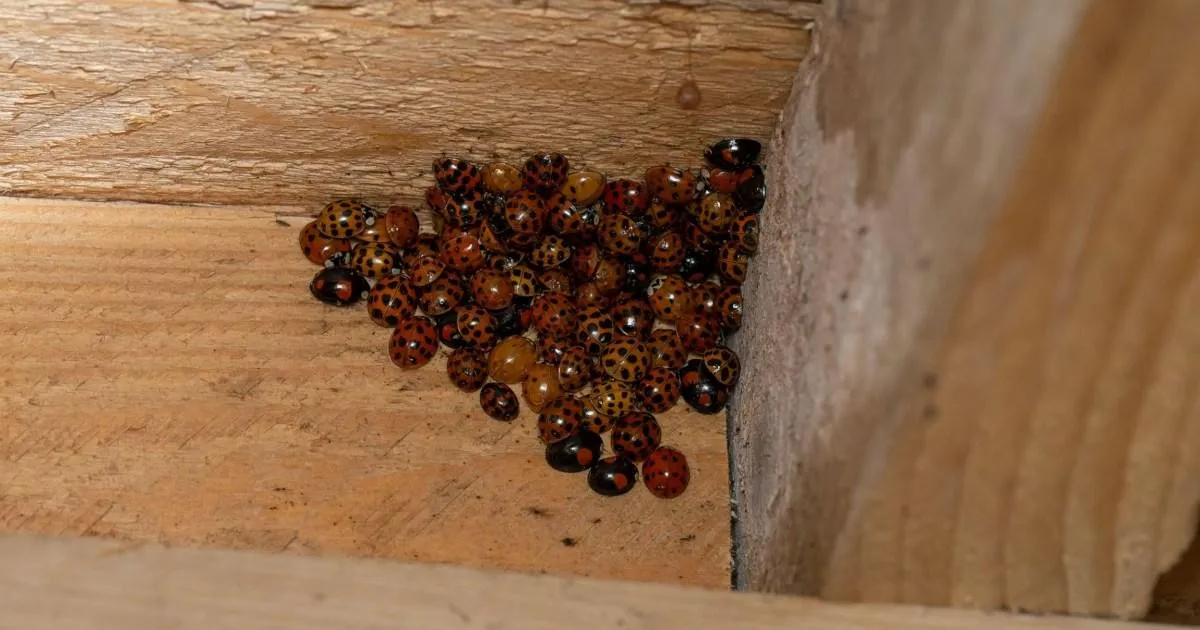
It is that time of year again. The clocks have changed, the evenings have a distinct chill, and the heating has started clicking on in homes all over Britain. For most of us, that means pulling on woolly socks, making a hot drink, and settling in for a quiet evening. But for an increasing number of people, the close of autumn brings another seasonal tradition: discovering that their homes have been colonized by harlequin ladybirds. These invasive insects, also known as Asian ladybirds or Asian beetles, are swarming across the UK in huge numbers, and they have a particular talent for finding their way indoors. First spotted in Britain in 2004, they have since spread from Cornwall to the North East of England, and they are now a familiar sight in both rural and urban settings. Unlike the native ladybirds that tend to hibernate alone, harlequins gather in enormous groups and use buildings as their winter refuge. They creep through gaps in window frames, crawl under doors, and squeeze through the tiniest cracks in walls and loft spaces. One homeowner in South Tyneside was so taken aback by the experience that he took to social media to complain. He wrote that his property was “absolutely inundated with those fake ladybirds,” adding: “There are literally thousands all over my house.” The phrase “fake ladybirds” is telling. At first glance, they look like the familiar red-and-black insects from children’s stories, but something is not quite right. They are larger, more domed, and somehow more menacing. When you lift a curtain and find a mass of them clustered together on the sill, or look up to see them on the lampshade and along the curtain rail, the invasion feels more like a scene from a horror film than a harmless wildlife encounter. They seem to be everywhere at once, and yet they move slowly enough that you can never escape them. You brush one off your sleeve and feel another land on your neck. It is enough to make you wonder whether you are the one who should be hibernating.
For such a small creature, the harlequin ladybird is surprisingly hard to pin down. It comes in a bewildering array of colours and patterns, which is exactly why it was named after Harlequin, the masked jester from traditional comedy. Some are red with black spots, looking every bit like the classic ladybird from picture books. Others are orange, yellow, or black with red markings, and a few are almost entirely pale with only faint spots. With so many looks, it’s no wonder people end up talking about “fake ladybirds” – they seem to mimic the real thing while never quite matching it. The Natural History Museum points out that harlequins are also larger than the native seven-spot ladybird, with a more rounded, domed shell. They can bite, too. The bite isn’t serious, but it can cause minor irritation and leave a small red mark, which is enough to make anyone think twice before picking one up. Max Barclay, senior curator of beetles at the museum, says the species is actually quite easy to identify once you know the secret: turn it over. Native ladybirds have black undersides and black legs, while harlequins have orange undersides and orange legs. That single difference is far more reliable than the wing pattern, which can change dramatically from one individual to the next. To the casual observer, a harlequin might look like a strange ladybird; to an expert, it is unmistakable. And if you see one, there are probably dozens more hidden nearby, because these insects are sociable in a way that native ladybirds are not. They like to gather in large numbers, clustering together on walls, windowsills, and inside loft spaces. It’s that urge to be together, combined with their adaptable nature, that makes them such a common sight in British homes. They are not just visitors; they are settlers, and they have an uncanny ability to turn up in the least convenient places, from the corner of a bedroom ceiling to the inside of a wellington boot. If you find one on your curtains, it’s worth checking the folds – you may already have a cluster waiting there.
The real problem with harlequin ladybirds is not their bite or their odd colouring. It’s their appetite. They are voracious predators, and while they do eat aphids, which sounds helpful, they don’t stop there. They also eat the eggs and larvae of other ladybird species, and they compete for the same food sources, such as pollen and nectar. This makes them a direct threat to native British ladybirds. Research by the UK Centre for Ecology and Hydrology has shown that several native species have declined since the harlequin arrived. The two-spot ladybird, once one of the most common species in the UK, has been hit particularly hard. It has disappeared from areas where harlequins have become well established. The harlequin is bigger, stronger, and more aggressive, and it tends to win when there is a conflict over food or shelter. It also carries a fungal infection called laboulbenia, which can spread to other ladybirds through contact. The fungus isn’t harmful to humans, but it can cause yellow rings to form on an infected ladybird and may affect its overall health. In this way, the harlequin doesn’t just outcompete native species; it actively weakens them. For ecologists, the spread of the harlequin is a worrying example of how quickly an introduced species can disrupt an entire ecosystem. For the rest of us, it means that the ladybirds we see in our gardens are not always the friends we remember from childhood. Some of them are invaders, wearing familiar colours but behaving very differently. The simple, gentle ladybird of the past is being pushed aside by a tougher, more adaptable beetle that has evolved to thrive in a world shaped by humans. It is a quiet crisis, happening in flower beds and hedgerows while we go about our daily lives. But the harlequin’s success is entirely human-made, and understanding its habits is the first step to managing the problem.
How did we end up with an aggressive ladybird from Japan in our homes? It is a classic tale of good intentions with unintended consequences. Harlequin ladybirds were introduced to North America in 1916 as a biological pest control. Farmers needed a natural way to protect their crops from aphids, and the harlequin seemed like the perfect solution. A single adult can eat up to fifty aphids a day, making it a tiny but tireless worker. The experiment worked almost too well. The beetles not only controlled aphids; they thrived beyond all expectations. They spread across the continent, then reached Europe, and have since been increasingly reported in South America and Africa. In Japan, their native home, natural enemies keep their numbers in check. In new regions, those enemies are absent, so nothing stands in their way. They have also changed their hibernation habits. Traditionally, harlequin ladybirds spent the winter in caves, hollow trees, and other sheltered spots. But they have adapted to city life and now see our houses as the perfect winter refuge. Attics, wall cavities, window frames, and porches all offer the same protection as a cave, but with the added bonus of central heating. That is why, as the temperature drops, they move indoors. They are not trying to annoy us; they are simply following an instinct that has served them well for generations. The good news is that they don’t damage buildings. They don’t chew wires, eat wood, or lay eggs in the foundations. The bad news is that they defend themselves by producing a yellow, oily liquid that can stain walls, curtains, and furniture. The British Pest Control Association advises against squashing them for exactly this reason. Instead, the best approach is to sweep them gently into a dustpan and take them outside. It’s a small act of compassion, but it also protects your home from the one real mess these beetles can make. But if you have ever seen what happens when one of these beetles is accidentally stepped on, you will know why it is worth taking the gentler route.
The invasion is not confined to the inside of houses. As the weather turns colder, outdoor encounters are becoming more common, and some of them are genuinely startling. One dog walker from Sunderland described being “attacked” by a swarm while she was simply trying to enjoy a walk. A photograph she shared showed at least twenty ladybirds crawling over her fleece, and she wrote in disbelief: “Has anyone else been attacked by the plague of ladybirds today! This is the craziest thing I’ve ever seen. I even had one on my face!” It is hard to read that and not sympathise. One minute she was walking her dog, enjoying some fresh air; the next, she was covered in crawling beetles. They were on her shoulders, her arms, her collar, and apparently even her face. They weren’t biting her or trying to cause harm; they were just finding a warm, moving surface to cling to. But that distinction is small comfort when you are in the middle of it. The word “plague” might seem over the top, but it captures the feeling of being overwhelmed by tiny animals. The experience is a reminder that harlequin ladybirds are not just a household issue. They are everywhere – in parks, along riverbanks, in gardens, and on footpaths. They have become part of the British landscape in just two decades. If you do find yourself caught in a swarm, the best thing to do is stay calm and brush them off gently. Waving your arms and panicking will only disturb them, and if they feel threatened, they might release that yellow defensive fluid. Better to pick them off one by one, take a deep breath, and remember that they are more interested in finding a warm place for winter than in bothering you. In the meantime, try to see the absurdity: here we are, some of the most intelligent species on the planet, being outnumbered by a beetle smaller than a fingernail.
So what should you do if you find your home overrun by harlequin ladybirds? The first thing to remember is not to panic. These beetles are not a threat to your health, your family, or your pets. They do not carry diseases that affect humans, and they are not interested in living in your food cupboards. The worst thing they can do is stain your curtains with that defensive yellow fluid, and even that is easy to avoid. Do not squash them. It may be your first instinct, but it is also the worst way to deal with them. Instead, take a dustpan and a piece of card, gently sweep the insects into it, and carry them outside. The British Pest Control Association recommends this method precisely because it avoids causing them to release their defensive liquid. If the infestation is severe, you can seal gaps around windows and doors, install fine mesh over vents, and check the edges of your loft for openings that might be letting them in. In extreme cases, a professional pest control service can help remove them, but for most people a little patience is all that is needed. It is also worth remembering that the harlequin ladybird is an invasive species with a real ecological footprint. Its presence is a problem for native ladybirds, and it is reasonable to want to keep it away. But the individual beetle in your bedroom is not a villain. It is just a small creature trying to survive the winter, and it has no idea that it is causing you stress. Our homes, with their warmth and shelter, look like paradise to it. A little compassion, along with a dustpan, can solve the situation without turning your home into a battlefield. The harlequin ladybird is here to stay, but that doesn’t mean you have to share your sofa. It just means learning to live with one of the more unexpected consequences of a changing world.