

1.
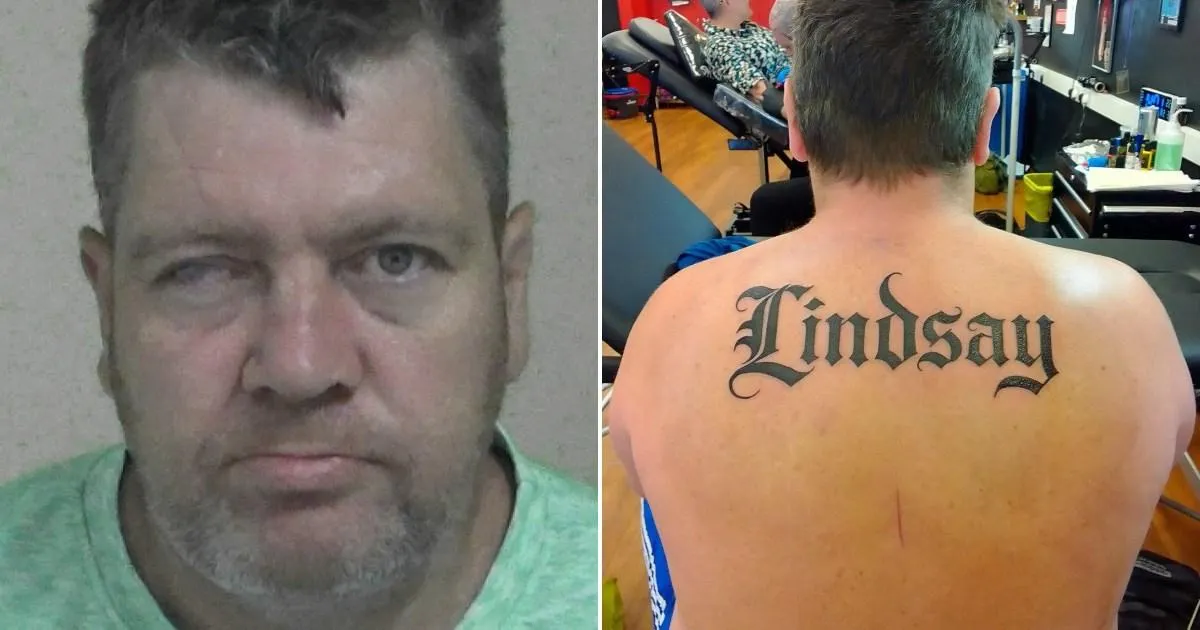
Imagine scrolling through your phone one ordinary evening, perhaps after a long day, when a notification appears. It’s a Facebook friend request. The face attached to the request is not one you want to see again. Your stomach tightens. You open the profile picture, and there, in a photograph clearly intended for you to find, is the broad, bare back of a man you fear, emblazoned with your name in massive, permanent letters. This was the chilling reality for a woman in the United Kingdom, a victim of a stalker named Nigel Blackburn. The 43-year-old’s tactic was not a clumsy attempt at reconciliation, but a deliberate and terrifying act of coercion. He had her name—“Lindsay”—tattooed across his upper back in huge lettering, and he used that image as his Facebook profile picture, ensuring that his victim would know immediately that his obsession had not faded, but had become etched into his very identity. Newcastle Crown Court heard the case, and through its details, a deeply disturbing picture emerged of a sustained campaign of harassment that left the woman convinced he would eventually kill her. The photo was not an isolated gesture; it was the face of a form of terror.
Blackburn had already been jailed for attacking her, but the story did not end with his release. The restraining order that was meant to be a legal barrier had been rendered fragile. The fact that her name was tattooed on his back was not simply a testament to their past together but a public, physical declaration of possession that he weaponized through social media. To outsiders, a friend request may seem trivial, a barely noticed digital ping. But for a survivor of abuse, every notification is a potential doorway to fear. The fact that he chose to display the tattoo—taken by someone else, posed, perhaps intentionally since he could not photograph it himself—tells us that this was all about making sure she saw his control. He wanted her to know that she was never entirely out of his mind, and that his devotion had been written into his skin, hoping it would also be carved into her psyche. The court case would later become a public record of how what some might dismiss as “cut off behavior” can be a carefully designed shout of menace.
**2. The timeline of events presented in Newcastle Crown Court reveals a pattern of escalating intimidation that began long before that particular profile picture. In November of the previous year, Blackburn was jailed for attacking the same woman. Upon his conviction, a restraining order was put into place, designed to keep her safe and create a legal boundary. A cycle meant that any contact, direct or indirect, would trigger a criminal response. He was released in March, and after four months of apparent calm, the boundaries were dismantled. On July 16, he stood outside her home, screaming, breaking the order in the most blunt way. For a woman already living in the echo of a previous attack, hearing his voice outside her door must have been a horror from a bad dream. But he was not finished. The court was told that after the screaming outburst, he turned to social media, and the notification arrived—his friend request, with the tattooed back at the photograph.
From that point, he revealed the extent of his obsession. Not content to target her directly, Blackburn also contacted two of her friends and told them that he still loved her. He created this web to send a message to her through them, making his intent more difficult to escape. He let her network know he was thinking of her, and through them, she would receive the bruised echo of his attachment. Then, he did something even more unnerving: he sent the same tattoo photo to her father. That calculation was chilling. In involving the father, he was no longer just a man attempting to reach a woman who no longer wanted him—that could be framed as a desperate, misguided lover. Contacting her family as a strategic move to reinforce his pursuit, to prove that his reach extended beyond her space and into hers infancy, her family, her father. In a case such as this, every act of “contact” carries an implicit threat. He didn’t need to write “I will find you” in a text message; the behavior itself said it all. He was aware of the restraining order. He was aware of the consequences. But he continued anyway, showing a total lack of compulsion toward the law. The court heard he was meant to be on a tag, and his unsettling proximity to her home and city, during a period when he should have been constrained, only amplified the psychological terror. It was not just that he was contacting her; it was that he seemed to believe he was entitled to, no matter what the law said.
**3. The toll on the victim was immense and described with heartbreaking understatement in her impact statement. The court heard that she was so disturbed by Blackburn’s behavior that she left her home and moved out of the area entirely. She had to abandon her home, the neighborhood, her routines, the sense security that comes with anchors her life, all because a man refused to take no for an answer. “She genuinely fears if she stays at home the defendant will attend and kill her,” the prosecutor, Emily Sanderson, told the court. That mental state is not unusual in stalking cases, but it remains impossible to overstate. Imagine the strain of living in a defensive state your own home, where a noise outside becomes a primal event and a car door opens you bolt to the window, your heart racing. For this woman, fear had become an everyday companion. In her impact statement, she said that being in fear has become like a “normality”. The word is startling and heartbreaking. Human beings adapt to survive, but when fear becomes a foundation of normal life, that constitution is distorted. She didn’t say “I am frightened” but “this is normal.” That suggests an internal fatigue, a fine-grained shift in biology and spirit that millions of victims survive through but should never become their normal. “I just want him to leave me alone so I can move on with my life,” she said. This is a simple request that every person should be allowed to seek. Yet the justice system was now being called upon to produce it.
The move out of her area is a permanent punishment; it is the victim being forced into exile. She is the one who has to rebuild, to find a new doctor, a new job circle, new cafés, new safe routes home. She has to hope that in her new place, no one will know her name, no one will recognize his tattoo. This is a self-banishment not aided in a narrative in which the abuser remains free in the old territory. The Facebook photo was a crucial reminder of why she left, and also a reminder that if she ever returned, he’d be waiting with a promise etched into his skin. The trauma can become a loop: she might close her eyes and see that face—not his face, but his back—a self-portrait made of her name. The reconstruction is metaphysical, a stolen identity. A ordinary victim’s mental state can be affected not just by the immediate incident but by the terrifying knowledge that the person’s obsession is not redeemed by time. The tattoo is not something that fades last. It represents a promise of permanence, of a lifelong reminder of her within him. The idea that she was permanently “under his skin” is inverted: he was under hers.
**4. Within the court, Blackburn’s criminal record painted a more alarming picture, which uncovered a pattern of abusive behavior. The court heard that he had a history of harassment also, severely, at the hands of a previous ex-partner. This was not a one-time lapse of a former partner. It was a repeated and ingrained model of behavior. The fact that he had already been placed under a restraining order and gone to prison for attacking the woman in this case was enough, but to know that another woman before her had also been subject to his harassment is a deep concern. It highlights a failure of intervention. It indicates that Blackburn’s methods aren’t a response to one specific relationship, but rather a template he uses to control, dominate, and put fear into partners he perceives as his property. When he needs to show his power, he works in particular patterns: public screaming, flirting with friends, family, and the like. In this latest chapter, he admitted the charges against him—breach of a restraining order and stalking causing fear of violence. This is a stage for this kind of Malcolm admission: He knew he was doing. By pleading guilty, he avoids a detailed public trial, but also acknowledges that his actions were intentionally designed to cause the exact fear that the verdict described. He officially brought the label “stalker” into investigative. There is a certain amount of about admitting that in a courtroom, under oath, he admitted to it all. This was not in the execution of a madness, he must be a con adder, but the evidence was presented.
His punishment was two years behind bars. To many, that sentence will seem insufficient. For The victim, it offers a temporary reprieve, but when he is released, he will again, unless the state makes significant intervention, find his way back into the community. The criminal record with the earlier victim will likely be used in any future case, but the cycle is painful. It is a grim testament to how domestic abuse and stalking remain a criminal justice gap. While violence is punished, the psychological war is often seen as unquantifiable. The two-year sentence, however, feels like a protective measure that expires. The victim has moved, but will she be able to move on? Given that he will one day be free, she must face the horror that she has become one of a list of women he will be targeting. In her name, on his skin as a record of his conquest, and a proof of his refusal to let go.
**5. And in the convicted human, behind the crime, the court heard a mitigating portrait that sought to explain his behavior. Sam Faulks, defending, described Blackburn as a victim of violence in the past, in a way that is hard to dismiss. He had been attacked in the past: ammonia was squirted in his face, which caused him to lose one of his eyes. He had been stabbed, and also attacked with a baseball bat. These horrific events have left a lasting mark on that perhaps not just physically but psychologically. He was said to have been suffering with Post-Traumatic Stress Disorder (PTSD) due to these experiences. It is easy for the public to hear such things and misinterpret them as excuses for his actions. But a good defense lawyer’s job is to present a clear context of how a person came to be. While his trauma does not excuse the stalking, it does underline that he was himself a product of brutal, damaged circumstances. The defense explained that he had been working hard while both in prison and on remand, trying to become an enhanced prisoner. This is a status given to one who behaves, practices rehabilitation, and engages with the system positively. The fact that a man with such a violent background could be recognized by prison officers as a positive leader is a challenging knot. It does not reflect his dangerousness in certain contexts, but it also shows that a different person might be buried beneath the skin.
The narrative he tried to present was not all grim and glum. “There’s hope,” Faulks said. It is a hopeful statement, but it must be reconciled with the constant pattern of harassment. A man who seeks excuse record by citing his own experience of violence, yet still seems to believe he has a right to stalk and terrorize a woman, is dangerous. The victim impact was fully about that: his remorse, his complaints, his own pain after being attacked with ammonia, stabbed, and bashed in with a bat did not stop him from choosing to attack another, more. In a legal sense, those past experiences must be considered in sentencing, and indeed, in some other human sense, it is always true that the broken people break others. But it does not soften the person. The hope mentioned in the defense is he can perhaps be a person who does not turn his own trauma into projected anger, and finally be the kind of enhanced prisoner that he is when in a structured environment. The wider system, though, must protect the public, especially women. The entire narrative of his past is sad, but it is not a way for him to say a self-pity tale.
**6. Blackburn’s wrong actions create a beyond-the-courtroom narrative about how stalking uses modern technology and symbolism to intensify terror. In the old days, he might have sent letters or telephoned the house. Today, he could send a friend request from his bunk, and a slight piano of anxiety carries through iCloud. The tattoo is the fixation of an item. It is comparable to displaying a trophy, but the trophy is the victim’s identity. It is a 1987 tale about possession, rewriting because now it can be broadcast immediately. The humanization of this story requires us to see the woman, Lindsay, as not just a victim who testified to being terrified, but as a woman who says “normality” in a sense of fear. She has been made to feel like a fugitive in her own life. She is forced to perform a strange act: cover her own tracks, hide her own name. In the face of this, we should offer not just “support” but a systemic awareness about the signs of stalking. A common pattern—such as requesting a friend from the abuser’s friends, or screaming at the victim’s home—must be taken seriously before it escalates to a final act. The law has a clearer measure of that. The earlier charge of harassment of another ex-partner in his past should perhaps have triggered more intense intervention, or at the very least, a deep transformative parole package. Could this outcome have been prevented? We can’t know, but it is impossible not to wonder: What if a previous judge had put a purely stricter order, or if mental health support had been offered after his PTSD diagnosis? Perhaps still, and it’s in that question that a new hope resides.
Two years in prison is a measure of time, but the regret in this woman and her hesitation may be longer. And yet, from her impact statement, the deepest hope arises from her courage to demand the right to move on. She has an instinctive dignity. Her his legal case is that a need for a world in which a person’s name is not a symbol of possession to be etched into flesh, but the personal property of the individual herself. The court declared him guilty and gave a sentence; but perhaps the final act is not the judge’s gavel but the story being shared, the persistent reminder that behind the courtroom headline of a bizarre tattoo is a real woman who is rebuilding, one small, brave day at a time.