


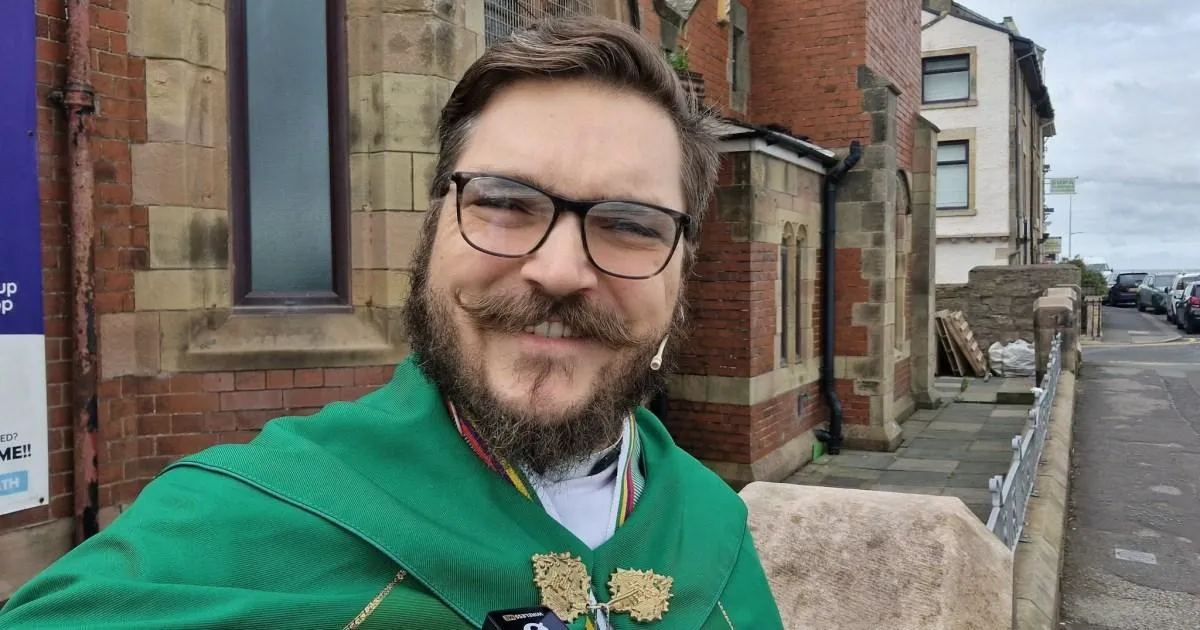
In the quiet coastal town of Morecambe, England, a storm has been brewing within the walls of a small, independent church. The Emmanuel Free Church of England, a registered charity that enjoys the financial benefits of that status, has come under intense scrutiny after sermons delivered by its leader, Reverend Brett Murphy, were brought to public attention. The content of these sermons is not merely controversial; it is profoundly hateful, targeting multiple communities with language that has shocked observers and prompted formal complaints to regulatory bodies. At the heart of the issue is a fundamental question about the intersection of religious freedom, charity law, and the public good. When does preaching cross the line from religious doctrine into outright bigotry that should not be subsidized by taxpayer-funded privileges? The case has ignited a debate about whether the mantle of religion can be used to shield speech that many would consider deeply harmful, and whether institutions that promote such division should continue to enjoy the legal and financial protections afforded to charitable organizations.
The specific remarks that have drawn the ire of secularist groups and community members came during an online sermon where Reverend Murphy did not mince his words. He reportedly described Judaism as a “demonic cult” and a “false religion,” employing language that echoes the most pernicious antisemitic tropes throughout history. To further punctuate his point, he quoted a figure from the Christian nationalist movement, adding a chilling rhetorical flourish: “When the jews are bad, they’re very, very bad.” The dehumanization did not stop there. In a separate diatribe, Murphy turned his attention to Islam, claiming that “absolute r** turn to Islam” because they are “desperate.” The casual use of such a severe slur, combined with the vilification of an entire global faith, paints a picture of a religious leader who sees his mission not as one of outreach or compassion, but of aggressive denunciation of all who do not share his specific worldview. This is not a theological disagreement; it is a wholesale attack on the dignity and legitimacy of other belief systems and the people who practice them.
Murphy’s venomous rhetoric extends beyond the Abrahamic faiths. He has a documented history of inflammatory statements directed at the LGBTQ+ community, referring to the gay pride flag as the “sodomite flag” and actively campaigning to end the right of gay couples to adopt children. His vitriol seems to know no bounds, encompassing a hostility towards any expression of identity or faith that falls outside his narrow interpretation of Christian orthodoxy. This is a man who believes his country is under existential threat, as evidenced by his comments on immigration. “We’re being invaded by an army of heathens who want to kill us,” he warned, describing Muslims in derogatory terms and calling for them to be kept out of the country. His language is that of a culture warrior engaged in a cosmic battle, and in his mind, anyone who is not on his side is an enemy of the faith and the nation. This combative stance is not new; he previously resigned from the Church of England, a denomination he now dismisses as heretical, after making derogatory comments about a senior leader who came out as transgender.
The fact that Emmanuel Free Church is a registered charity is the crux of the legal and ethical concerns. The National Secular Society (NSS), a prominent advocacy group for the separation of religion and state, has formally reported the church to the Charity Commission. Their argument is straightforward and compelling: charity status is not a right but a privilege, granted to organizations that act for the public benefit. In the UK, the “advancement of religion” is considered a charitable purpose, and this allows churches to claim significant tax reliefs and other financial advantages. While many churches use this status to run food banks, provide community services, and engage in international aid work—activities that undeniably benefit the public—the NSS contends that Murphy’s church has perverted this purpose. How can an institution that actively promotes social division, antisemitism, and homophobia be said to be acting for the public benefit? The NSS argues that the virulent homophobia and social division espoused from the pulpit are completely incompatible with the legal obligations that come with charitable status. To allow them to continue accessing public funds, even indirectly through tax breaks, is, in their view, a scandal that forces the public purse to bankroll repugnant rhetoric.
Alejandro Sanchez of the NSS articulated this frustration clearly, stating that this case is just the latest in a long line of religious charities promoting antisemitism and homophobia. The group is calling for urgent reform of charity law to ensure that no organization can exploit the sector to promote hate and division. This is not a call for censorship, but for accountability. While religious freedom is a cornerstone of a democratic society, that freedom should not be absolute when it collides with the harms of hate speech. The NSS’s position is that the special privileges afforded to charities come with strings attached, and those strings have been severed by Murphy’s actions. His scheduled conference, “Make Great Britain Christian Again,” is a stark indicator of his agenda, which borrows heavily from the rhetoric of American Christian nationalism. This is a political movement that seeks to impose a specific religious framework on the nation, and Murphy’s sermons suggest he is willing to use inflammatory, fear-based language to achieve those goals.
The situation in Morecambe forces a broader societal reckoning with how we define the limits of religious expression in the public square. The church has not yet responded publicly to the complaint, and the Charity Commission will now have to make a judgment call on a complex and sensitive issue. On one hand, they must respect the autonomy of religious organizations to interpret their own doctrines. On the other, they have a legal duty to prevent charities from engaging in activities that are contrary to the public interest. The line between preaching to one’s own congregation and broadcasting hate speech to the world has been blurred by online platforms, making the reach and impact of such sermons far greater than ever before. The decision made by the commission could set a significant precedent, determining whether charitable status is compatible with aggressive, exclusionary rhetoric. For many watching this unfold, the case is a litmus test of whether the law has the teeth to protect minority groups from hate speech cloaked in the garb of religion. It also serves as a reminder that while freedom of speech is paramount, it is not a shield against the consequences of one’s words, especially when those words are designed to dehumanize and marginalize entire communities. The ultimate response from the Charity Commission will be watched closely, as it will speak volumes about the values modern society intends to uphold in the face of escalating religiously-motivated hostility.