



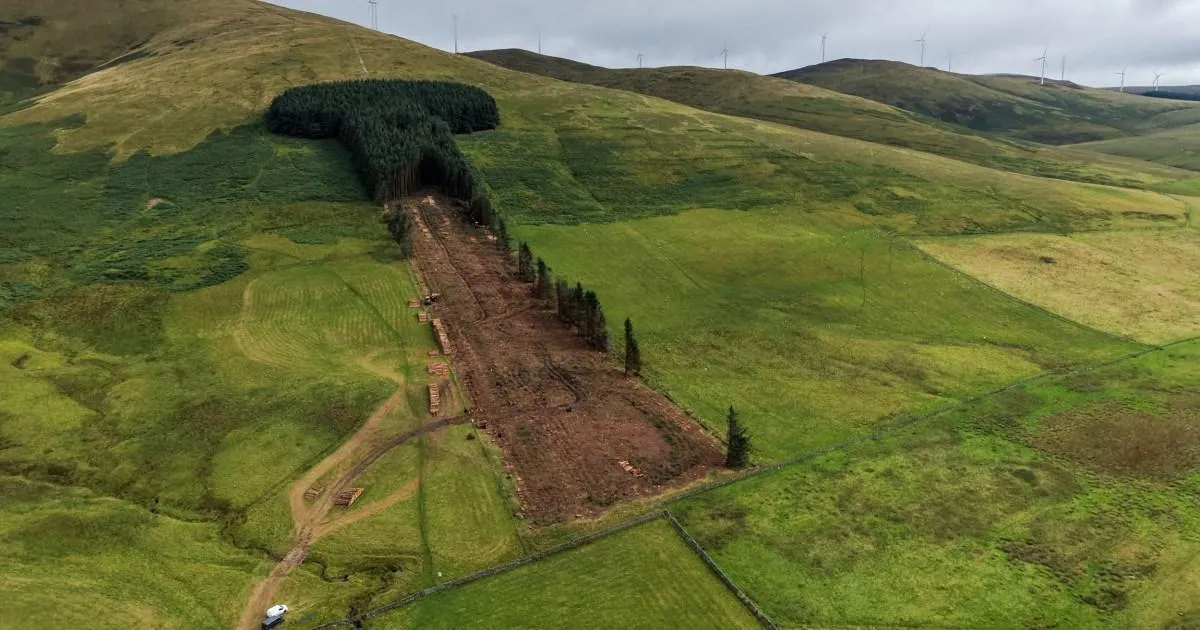
For the better part of two centuries, travellers hurtling along the M74 motorway in southern Scotland have been greeted by an unexpected and unmistakable sight: a perfectly formed, phallic-shaped woodland sprawling across a hillside. Known affectionately as “Penis Woods” or the “Treenis,” this peculiar plantation of trees on Tewsgill Hill, just south of Biggar, has been a source of amusement, curiosity, and even pride for generations. It was, in many ways, a giant, woody wink from the Scottish countryside—a natural landmark that made people smile, point, and reach for their cameras. But now, that iconic silhouette is disappearing. The woodland, officially named Castle Crawford Wood, is being chopped down, and after weeks of work, only the tip remains. For locals and travellers alike, it feels like losing an old friend—one that happened to look like a giant penis, but an old friend nonetheless.
The story of Castle Crawford Wood begins in the early 1800s, when the trees were first planted on the slopes of Tewsgill Hill. Over time, as the trees grew and the landscape matured, their outline began to take on a rather distinctive shape. By the time the M74 motorway was built, the woodland had become a beloved roadside attraction, a quirky piece of topiary on a grand scale. It appeared on maps as far back as 1849, and for more than 200 years, it has stood as a silent, leafy sentinel welcoming people to Scotland. For many, it was the first thing they saw as they crossed the border, a cheeky hello from a nation known for its humour and warmth. The woodland was not just a collection of trees; it was a conversation starter, a shared joke among millions of drivers, and a strange, wonderful piece of cultural heritage that existed nowhere else in the world. Its shape was so deliberate, so unmistakable, that it was impossible to ignore—and that was precisely why people loved it.
Now, however, the beloved woodland is being felled, and the decision has sparked outrage. Scottish Forestry, the government agency responsible for regulating tree felling, approved the removal of the wood after determining that it had reached “the end of its natural lifecycle.” The trees, many of which were planted in the 1800s, were experiencing significant windblow, leaving them unstable and dangerous. The site, visible to thousands of motorists every day, had been felled and replanted several times throughout its history, but this time, the scale of the work has caught people off guard. As the chainsaws have roared to life and the familiar silhouette has begun to disappear, a campaign to save the woodland has gained momentum. A petition, started by a concerned supporter, has gathered more than 2,700 signatures, with signatories calling for the “Penis Woodland” to be protected as a cultural landmark. The petition’s creator wrote: “The Penis Woodland is a cultural landmark visible from the M74 in Scotland. This iconic cultivation is going to be felled. It’s not just any woodland, it’s a penis-shaped woodland, visible from the motorway.” The plea was heartfelt, if a little unusual, and it resonated with thousands of people who felt that Scotland was losing a piece of its irreverent soul.
The shepherd in charge of the day-to-day running of the farm where the woodland sits has tried to explain the decision, and his words offer a more nuanced picture than the outrage might suggest. In a statement, he said: “We feel that, for the safe keeping of the wood itself, it has to be done sooner rather than later as the damage will get worse and it will look nothing like a ‘T’ in a few years if we don’t. We plan to get it back to its former glory ASAP. This is not for any financial gain. Once re-replanted and fenced, it will probably leave a loss.” He went on to describe the sorry state of the trees, many of which had already fallen and were rotting, while others were dying where they stood. “There are a lot of trees down which will be rotting, and a lot that are still standing are dying swell. We’ve sorted these things before, but eventually comes a time when you need to cut your losses and completely fell it and start again. If you want it to have any chance of staying the shape it is for hundreds of years to come, it’s the only way to do it.” His argument is practical, even compassionate: by cutting the trees down now, they can replant and ensure that the famous shape survives for another two centuries. But for those who have grown up with the woodland, the sight of bare hillside is a painful one, and the promise of a future replanting does little to ease the sense of loss.
The emotional attachment to the woodland is deep, and the petition has been flooded with comments from people who see it as far more than a joke. One supporter wrote: “This stretch of woodland is not only a memorable and wonderful landmark for those who have seen and visited it but holds so much life within that would otherwise be lost with its destruction.” Others spoke of childhood memories, long road trips, and the simple joy of spotting the “Treenis” on the horizon. For many, it was a marker of home, a sign that they were nearly there, or a moment of levity on an otherwise tedious journey. It was a piece of the landscape that made people feel connected to something bigger than themselves—a shared, slightly naughty secret that united strangers on the motorway. The woodland was never just about the shape; it was about the reaction it provoked, the laughter it inspired, and the way it turned an ordinary commute into a moment of delight. Losing it, even temporarily, feels like losing a small piece of that collective joy.
Scottish Forestry, for its part, has defended the decision, emphasising that the felling is part of a long-established management plan. A spokesman said: “Following assessment and public consultation, Scottish Forestry has approved the felling of the woodland, which is in progress. This forms part of the wood’s long-established management, with the site having been felled and replanted several times throughout its history. The area is required to be restocked with an appropriate mix of tree species, helping to ensure a sustainable woodland long-term.” It is a measured, bureaucratic response, but it does little to quell the sadness of those who have watched the woodland disappear. The promise of replanting offers hope, but it will take years for the new trees to grow into the familiar shape, and decades before they reach the height and presence of the originals. For now, all that remains is a stump of the former glory, a bare hillside, and a community holding its breath, waiting to see whether the “Penis Woods” will rise again. The story is a strange and poignant reminder of how even the most absurd landmarks can become woven into the fabric of our lives. We laugh at them, we love them, and we mourn them when they go. In the end, Castle Crawford Wood was never just a joke—it was a testament to the quirky, unexpected ways that nature and human culture intertwine, and a reminder that sometimes the things we treasure most are the ones that make us smile.