

A Brother’s Courage: How a 13-Year-Old’s Quick Thinking Saved His Newborn Sibling
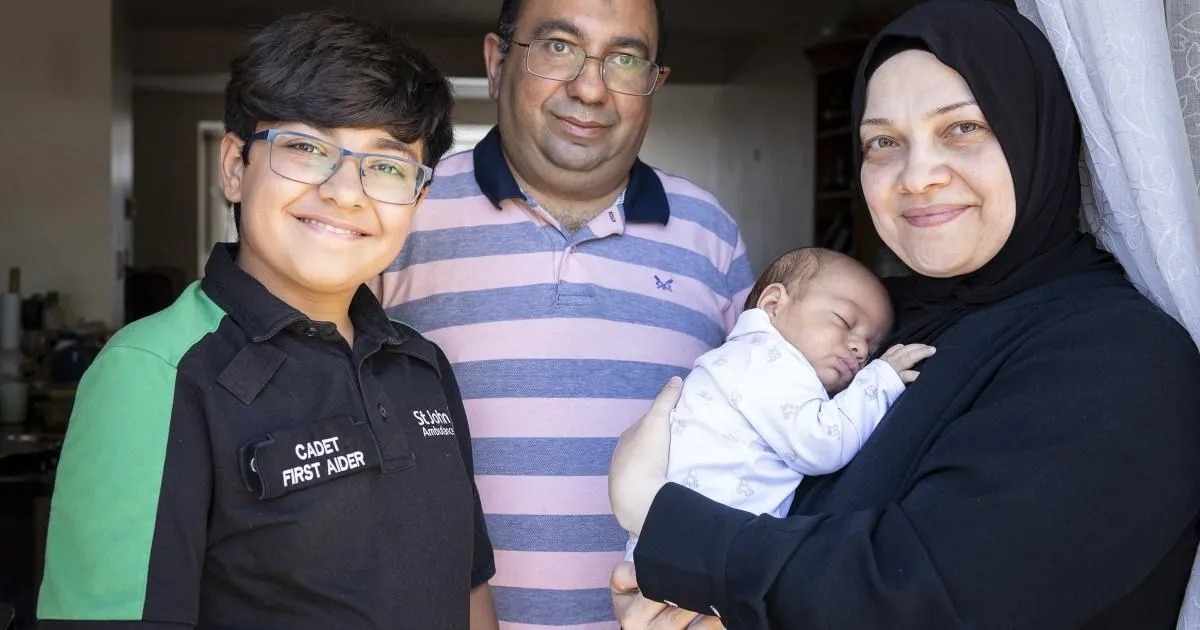
The quiet afternoon in a West London family home was shattered by the kind of terror that every parent dreads. Thirteen-year-old Maitham Ali was in his bedroom when he heard the unmistakable sounds of panic rising from downstairs. His mother’s voice, his grandmother’s cries—something was terribly wrong. Racing down the stairs, he found his family in complete chaos, their faces etched with raw fear. His two-day-old baby brother, Mohammad-Jawad, had suddenly vomited, and the newborn’s tiny airway had become completely blocked. The baby’s skin was turning a frightening shade of blue as he desperately opened and closed his mouth, trying to draw breath that wouldn’t come. In that moment of absolute crisis, while his mother and grandmother were frozen in helpless terror, this young teenager became the calmest person in the room, drawing upon skills he had learned as a St John Ambulance Cadet during what seemed like ordinary weekly sessions that would now prove to be anything but ordinary.
What happened next would transform Maitham from an ordinary teenager with dreams of studying dinosaurs or ancient civilizations into a real-life hero. As his family stood by in paralyzing fear, Maitham took control of the situation with a composure that seemed far beyond his thirteen years. He instructed his mother to position the baby face-down along her arm, supporting the newborn’s head carefully with her hand, and then to deliver firm back blows between the shoulder blades—not too hard, he emphasized, but with enough force to dislodge whatever was blocking the tiny airway. It was a textbook first aid response, taught to him by St John Ambulance volunteers who likely never imagined their young cadet would need to use these skills so soon, and in such a terrifying situation. After just two back blows, the miracle happened: Mohammad-Jawad let out a cry. While most people would have interpreted a baby’s cry as a sign of distress, Maitham understood it as exactly what they needed to hear. The sound meant the airway was open, that precious oxygen was flowing into his baby brother’s lungs again. The color began returning to the infant’s cheeks, and the nightmare that had begun only moments before started to recede.
For Raghad, Maitham’s mother, the memory of those terrifying moments remains vivid and emotional. She admits she was completely unprepared for such an emergency, having had no formal first aid training herself. In her desperation, she had been trying to suck the blockage out of her baby’s mouth and nose with her own mouth—an instinctive but potentially dangerous approach that doctors at the hospital would later tell her was not the right method. Her eldest son, however, was a rock of stability in the chaos. She describes her disbelief at witnessing her teenage son transform into someone she barely recognized, a composed young man issuing clear instructions, keeping everyone focused, and ensuring that someone called for an ambulance while they continued to care for the baby. The relief she feels is palpable when she speaks about it, acknowledging that her baby’s life was saved by her son’s presence of mind and the knowledge he had gained through St John Ambulance training. It was, she says, as if all his years of learning had converged on this single moment, preparing him for exactly what needed to be done.
Maitham’s journey to becoming a lifesaver began years before this dramatic June day, when he was just nine years old and joined St John Ambulance as a Badger, the organization’s youngest age group. His older sister Judy had expressed an interest in pursuing a career in medicine, which prompted his mother to enroll both children in the organization. What started as an extracurricular activity alongside his sister would become so much more meaningful than anyone could have anticipated. Maitham had previously harbored dreams of working in paleontology or archaeology, fascinated by ancient worlds and long-extinct creatures. But his training with St John Ambulance, combined with his experience saving his baby brother, has fundamentally shifted his perspective about his future. The teenager is now considering a completely different path, one that would see him following in his sister’s footsteps toward a career in medicine. Just a week after the incident that changed his family’s life, Maitham successfully completed his Community First Aid course, proving that his commitment to learning these vital skills was more than just a momentary interest sparked by his heroic actions.
The statistics surrounding infant choking highlight just how critical Maitham’s actions were. Recent research conducted by St John Ambulance among 2,000 Britons revealed that 34 percent of people worry about their baby choking and not knowing what to do, while nearly a quarter admit they have never learned any first aid at all. These are not abstract concerns—official data from the Office for National Statistics shows that between 2020 and 2024, twelve children under the age of five died from choking in England, including nine babies. These numbers represent families who experienced heartbreak that could potentially have been prevented with proper first aid training. Raghad, who now plans to learn first aid herself after her terrifying experience, emphasizes how important it is to know what to do in an emergency. Her son’s story is a powerful testament to the difference that training can make, a difference measured in the beating heart of a newborn baby who might otherwise have become another statistic.
Maitham’s unit leader at St John Ambulance, Tom Canavan, speaks with immense pride about his young cadet’s actions. While he admits to being amazed by what Maitham accomplished, he insists he wasn’t entirely surprised. Throughout his time with the organization, Maitham has demonstrated compassion, confidence, and a willingness to step forward when others might hold back. Through his training as a Cadet, he developed not just the technical first aid skills, but more importantly, the courage to use them when it truly matters. In emergency situations, Canavan notes, many people freeze or begin to doubt themselves, but Maitham remained calm, recognized that his family needed help, and immediately put his training into action. It is a level of maturity, bravery, and self-belief that goes far beyond what anyone would expect from a teenager. Now, Maitham is sharing his story as part of St John Ambulance’s new Save a Life September campaign, an initiative designed to encourage people across the country to learn first aid through free public demonstrations and online guidance. Throughout September, volunteers will deliver free demonstrations in public spaces nationwide, aiming to give half a million people the confidence to respond when someone is choking, bleeding severely, or experiencing cardiac arrest. Since relaunching this campaign in 2024, St John Ambulance has already taught more than 800,000 people vital first aid skills, and this year they hope to reach another 500,000 people, taking their total beyond one million. As Canavan eloquently puts it, you are never too young to learn lifesaving skills—a few minutes spent learning how to help someone who is choking, or a few hours learning CPR, could one day make the difference between life and death. In the Ali household, that difference was made by a thirteen-year-old boy whose training turned a moment of pure terror into a story of hope, courage, and the enduring power of being prepared when it matters most.