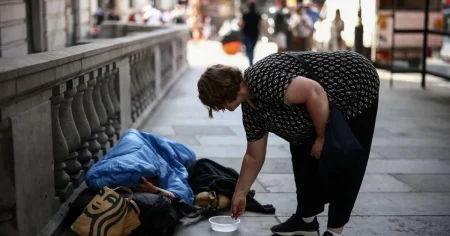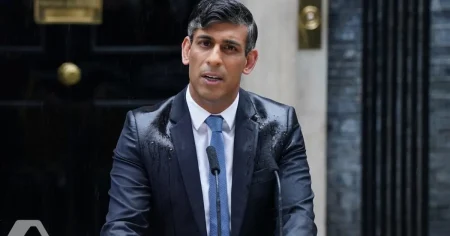
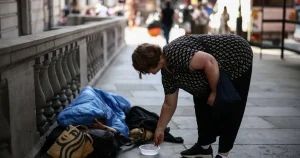

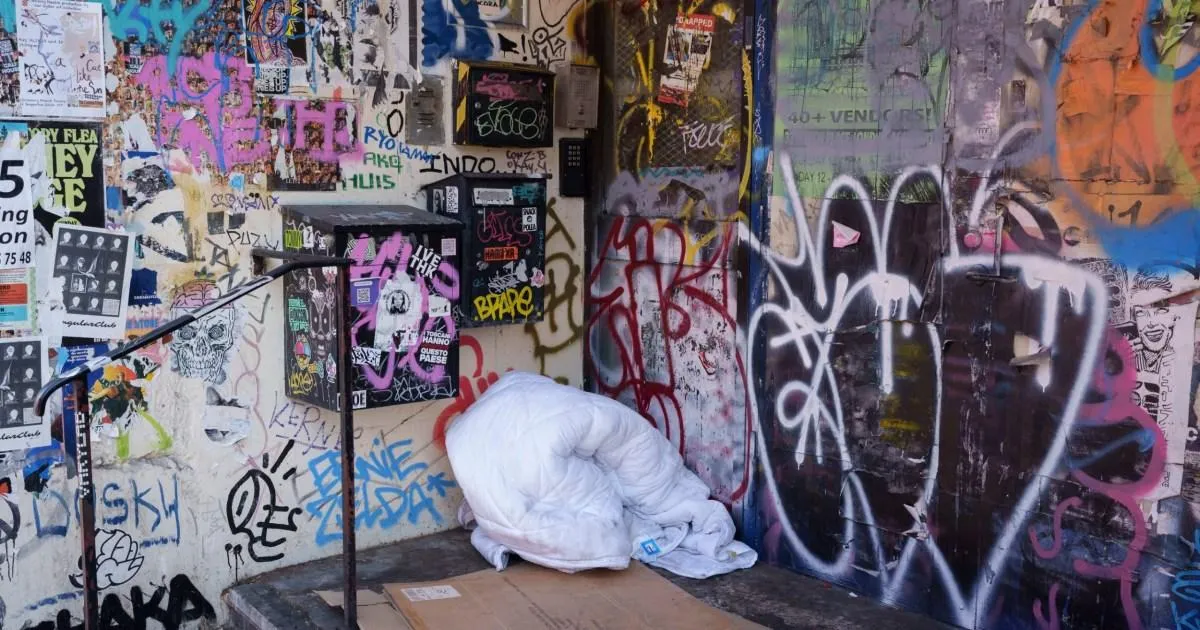
A month ago, Andy Burnham stood outside 10 Downing Street and made a promise that sounded, even to the people who wanted to believe it, almost impossibly bold. If he became Prime Minister, he said, the very first instruction he would give was to end rough sleeping in the UK. It was the kind of line that political operatives dream of: simple, moral, urgent. But on the same night, and on the streets just beyond the place where he stood, the real world was giving its own answer. According to Chain, the database that tracks rough sleeping across London, around 782 people were recorded in Westminster alone, spread beneath shop doorways and inside the shadows of government buildings, sleeping in doorways where the city’s official life had gone quiet. No borough in the country consistently has that the same obstruction. Across the capital, the figure remained close to 4,000, not as a statistical spike or a winter-temporary bump, but as a stubbornly entrenched daily reality. This is the paradox of Westminster: a city whose monuments command the world’s attention and whose politics endlessly promise change, yet where a quiet emergency has become the most ordinary sight in the world. Burnham’s pledge was about more than compassion; it was a statement of intent. But goodwill alone has always struggled to withstand the cold. The fact remained that people are still out there every night, in winter coats and sleeping bags, waiting for someone to be as good as their word. And so, this week, Burnham and his would-be Housing Secretary Angela Rayner tried to take the first step forward by announcing an aim that was both smaller and bolder than the original promise: in the whole of England, they said, no one should be sleeping rough from Christmas. That is now the deadline.
That ambition is undoubtedly right, but can it actually be done? Emma Haddad, chief executive of the homelessness charity St Mungo’s, offers arguably the most honest expert in London. “The ambition is absolutely right,” she says. “Can it be done? I’d like to say yes. We’ve seen it done before, particularly during the pandemic, where we made a huge difference in bringing people in. Will we have brought in every person sleeping rough by Christmas? I don’t know.” The fact she can’t say yes illustrates the difficulty: rough sleeping is not a single accident that can be fixed by a single gesture, but a complex web of personal history, systems, and opportunity. Its causes are intertwined with problems of housing affordability, only benefit, mental health, addiction support, prison release, and violence. Some people have been outside for years, developing coping mechanisms that make shelter feel unfamiliar and threatening rather than safe; others are newly stranded, still in shock after losing everything. The Christmas target doesn’t promise to have solved these problems by the season of chestnuts and hymns. The ambition is to find enough people, trained and enough compassion, to invite them in — not to force them, but to make an offer of accommodation realistic and supportive enough that any soul can accept. Yet even that is a challenge. Charity leaders and politicians often make rough sleeping the subject of headline-making, but it cannot be resolved simply by opening a hotel or handing out a donation. The question beneath all the declarations is one of invested, staffing, honest outreach, and enough places that feel human, not institutional.
One of the more uncomfortable conversations in the rough-sleeping debate is that not everyone will immediately accept the offer of a room, no matter how warmly it is made. That idea feels smaller until it is put into practice. Some will say no because they are worried about being separated from a partner, a friend, or even a dog who has been their only companion during the months on the street. Some have slept outside so long they have built around themselves a way of controlling an utterly uncontrollable life, and the thought of handling a bed in a strange, unfamiliar room can be as frightening as another night in the cold. Some have had bad experiences with institutions before, times when help has come with conditions, judgment, or too many questions. Others are still in the middle of a mental health struggle and simply do not have the energy or the clarity to process the idea of moving. For those people, “no” is often not a rejection; it is a deeper signal that they need more than a bed, they need trust. In those circumstances, Emma Haddad’s words matter; the key, she says, is not necessarily to get everyone into a room on a particular night, but “to have made an offer to everybody, so that there are choices and options for people.” That is the difference between something genuinely helpful and something that just looks like help. It means there must be a variety of places, because different people need different things; some will want a self-contained flat, some will be more comfortable in a hostel they’re already used to, a few will want a place in the same area with their friends. But even that requires the most basic component: a real, warm, safe space.
Here, at least, there is cause for cautious hope. The Prime Minister and Emma have both pointed to a famous precedent from the first period of the COVID-19 pandemic in 2020, When an emergency scheme shown the trick of rapid action could be achieved with unusual speed. At that moment, hotels across the country were sitting empty because lockdown meant no one could travel. The state did something rarely seen in homelessness policy; it reversed the logic of public life. Instead of expecting street dwelling people to fit into large crowded hostels or shelters with strict rules, the Government and local councils opened those hotels as self-contained accommodation. For months, in a remarkable surge, people were brought out of the cold, helped by an extraordinary availability of individual rooms and by a level of political will.
It was extraordinary, but it was also an exception engraved into the peculiar conditions. The hotels were not ordinary housing, and the scheme was paid for in a way that sustained it could never be permanent. That became clear once rooms were needed again for tourists and travelers. The emergency scheme faded back into reality, reminding anyone watching that a one-off rescue is not enough. Emma, still, believes there is enough space out there if enough life is put into it. “There will be some homes that can be brought on stream quickly,” she says. “There will be communal spaces. There will be empty flats. There will be a mixture of places.” Councils and housing associations might have empty housing that could be brought up to standard “with a bit of capital investment to renovate”; night shelters could be opened beyond the barriers. Why could be assembled from several sources: a repurposed that just hours before wasn’t seen as a place to live. It’s a less dramatic image than the 2020 hotel emergency, but in a different way, it’s more important, because it shows the problem is not exactly impossible to solve; it’s about whether the political will is strong enough to find the answer.
Burnham, to his credit, hasn’t tried to describe this Christmas plan as a permanent fix. Writing in the Guardian, he says, “I don’t pretend this is a permanent fix — far from it. It’s not enough just to help people when they fall on hard times. It’s our job to catch people long before they hit the pavement, and that means dealing with the multitude of reasons why someone might be sleeping rough in the first place.” These words are also the rest of the Christmas story. Ending rough sleeping means ending the whole never-ending flow of people who are forced into rough sleeping. It means keeping the system from pushing a young care leaver and the outside because there is no one to keep them. It means not releasing someone from prison, with nowhere to go, to jump from the gate straight to their own sleeping bag. It means making rents less abusive, better living benefits, mental health and addiction treatment in the centers rather than being forced to gate keep. Burnham’s own promise, after all, was not simply to give people safety for a night, but to end the scandal altogether. Served at Christmas is the beginning of a process, not the end result. And that process must be repeated every night of the year. For a very uncomfortable and a strong challenge: if you can’t guarantee a safe Christmas bed after the same passion, why can’t you guarantee it on any other night? The best response is not eloquent.
Still, Emma Haddad of St Mungo’s believes the path is available if the country is willing to follow it. In her pragmatics, the road to ending rough sleeping has three distinct Poles. First, emergency measures: the kind of action announced today, made in mass and with a clear deadline. That gives people immediate relief from the streets and minimizes the danger of every winter night. Second, early intervention: spotting the warning signs before someone actually loses the roof over their heads, and treating people with an eye toward prevention at the institutions where so often, people fall through the cracks. That means working with prisoners before release, with asylum seekers leaving temporary housing, with mental-health patients leaving hospitals, and with families feeling the pressure building. Third comes the other blow that is the reason someone first became homeless: an unreasonable housing market where a job at the same time doesn’t keep pace, and where rents grow faster than wages; the cuts that leave our own people on the street, and the specialized mental health, addiction, and support services that can make or break so many lives later. “If you address all three,” says Emma, “then you’ve got someone off the street who already want it. You’ve stopped more people coming in, and you’ve switched off the tap that causes that in the first place.” She says, of course, that three of them is easier written as a sentence than done. But the conversation: “You’ve prevented more people coming onto the streets or becoming homeless, and you’ve switched off the tap that causes that in the first place.” The message is not some magical sudden solution; it’s an emergency. It’s a form of prevention at every stage. It is a decision not to accept that are father becomes old as a daylight.
Across the city, thousands of people are still asleep in the open this Christmas, and each one has a story, a name, and a family. There is no way to know if the new Christmas promise will become reality. As she was brought up, the best possible answer to can be done: it’s been done before. During a crisis of her own, the country discovered how much could be achieved when a problem was suddenly treated as an emergency, when generating the buildings, funds, and the public will opened all at once. That memory is both a frustration and a challenge to democracy. It now shows that it is not impossible, and that is one of the most powerful emotions. The plan, according to Burnham and Rayner, points in the right direction. But the proof of lovingness is always in the room, in the bed, in the offer, in the hand that reaches out from the inside. By Christmas, the UK will see if this moment’s hope can withstand the cold, turn good intentions from press releases into reality, and convince people who have lost faith that they will not be forgotten. The first instruction is still a promise. The last one has to be a guarantee.