

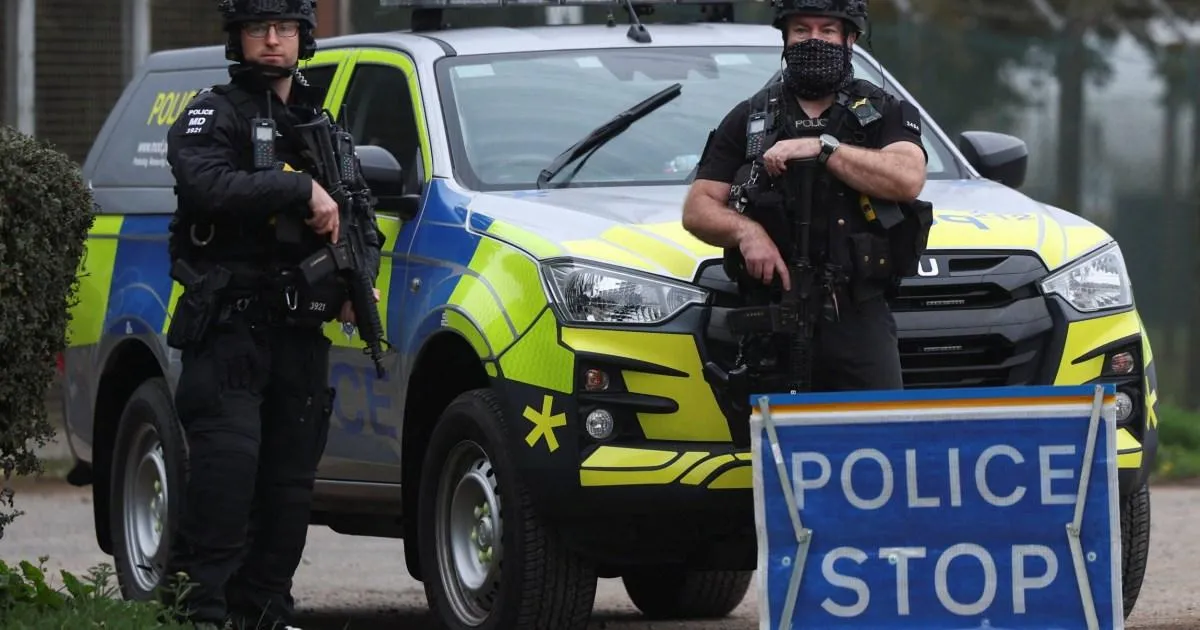
The quiet countryside around RAF Fairford in Gloucestershire is not the kind of place where you expect to see armed police, sealed-off roads, and families hurriedly leaving their homes with only the clothes on their backs. But for a few tense days, that became the reality for hundreds of local residents. On Sunday morning, five British men were arrested near the Royal Air Force base, suspected of involvement in explosives offences and terrorism after three vans were discovered in the area. The base itself is no stranger to weighty military operations—it has been used by the United States Air Force to carry out strikes against Iran—but for the people who live in the surrounding villages and farmlands, this was a shocking intrusion of global conflict into their everyday lives. Around 85 households were evacuated as a precaution while specialist officers moved in, and the fear that something far worse had been prevented hung heavy in the air. Even as residents were allowed to return home on Monday, the cordon remained, and the sight of police vehicles and forensic tents served as a grim reminder that the investigation was far from over.
The details that have emerged so far paint a troubling picture, though also one of relief. According to the head of Counter Terrorism Policing, no improvised explosive devices were found inside the three vans. That might sound reassuring, but a quantity of petrol was recovered from the vehicles, and that is enough to keep investigators on high alert. Petrol, after all, is a simple but devastating ingredient in fire-based attacks, and its presence near a military installation suggests that whatever was being planned was not harmless. The men were detained on suspicion of explosives offences and terrorism, and the fact that they were British nationals adds another layer of complexity to the case. It is one thing to imagine an external threat, but quite another to confront the possibility that the danger comes from within the country’s own borders. For the local community, the evacuation was an ordeal in itself—neighbours helping each other pack, farmers checking on livestock, families wondering when they would be allowed back—but the uncertainty did not end when the cordon was lifted. The scene remained an active crime scene, with counter-terrorism officers continuing to examine the vehicles and the surrounding land, and every new piece of information seemed to raise more questions than answers.
Security experts have been quick to offer their analysis, and the picture they paint is deeply concerning. Will Geddes, a security consultant, told reporters that what happened near RAF Fairford looked like a “dry run rehearsal before an attack.” In his view, the men may have been conducting hostile reconnaissance—driving routes, observing patrol patterns, taking note of access points, and testing how far they could get before being noticed. Terrorist plots rarely materialise out of nowhere; they are usually preceded by careful planning and preparation, and it is often during this phase that operatives are caught. Geddes called this the “penultimate dry run before actually doing the attack itself,” suggesting that the arrests may have come at a critical moment, just before the alleged conspirators were ready to strike. What makes this even more alarming is his warning that not everyone involved may have been detained. The farmer who first raised the alarm mentioned seeing additional individuals running into the woods—perhaps three or five more people who were not captured. If that is true, then the group may have been larger and more organised than initially thought, and some of those who slipped away could still pose a threat. Geddes warned that these individuals, driven by desperation and fear of capture, might decide to accelerate their plans and target another location considered previously.
A former counter-terrorism officer echoed this assessment in separate comments to the press, explaining that detectives would be looking closely at whether the five men were carrying out a “dry run” before a real operation. He pointed out that the fact no explosives had been found in the vans did not necessarily mean the threat was neutralised. The barrels removed from the vehicles appeared to be empty, which could mean the men were simply checking out the lay of the land—studying road layouts, security response times, and potential escape routes. If that was indeed the case, then the arrests were a stroke of extraordinary fortune, a chance encounter that may have prevented a tragedy. The phrase “chance arrests were very fortunate indeed” captures the uneasy mix of relief and anxiety that follows such events. It is impossible to know what might have happened if the farmer had not noticed something suspicious and alerted authorities, or if police had arrived a few minutes later. The former officer’s comments also highlight the immense difficulty of preventing terrorism in a country where attackers can operate without sophisticated weapons, using everyday items like petrol and vans instead. This is not a problem that can be solved purely through intelligence or surveillance; it requires the cooperation of ordinary people who notice when something feels wrong.
The broader implications of this incident stretch far beyond a single field in Gloucestershire. Security sources indicate that other governmental facilities have been placed on high alert, with confidential sources describing a mood of deep anxiety among officials about possible follow-up attacks. This is not a situation that is over or contained, as Geddes put it, and the psychological impact on those involved is likely to be lasting. RAF Fairford is not just any airbase; it has been a staging point for American military operations against Iran, making it a symbolic target for anyone seeking to retaliate against Western policies. The men arrested near the base are British nationals, which raises uncomfortable questions about radicalisation at home, about how ordinary people can be drawn into extraordinary violence, and about the networks that support them. It also serves as a reminder that the threat of terrorism is not monolithic—it shifts and adapts, moving between external plots and internal conspiracies, between sophisticated devices and crude but effective methods. The fact that petrol rather than explosives was found is hardly reassuring; in recent years, attacks involving vehicles and fire have caused devastation around the world, from London to Paris to elsewhere, and they require little in the way of training or resources.
For the people who live near RAF Fairford, the days ahead will not be easy. The evacuation may have ended, and life may be returning to some semblance of normality, but the memory of police sirens and helicopters will linger. There is comfort in knowing that the authorities are taking the threat seriously, that counter-terrorism officers are working around the clock to piece together what happened and who else might be involved. But there is also a lingering sense of vulnerability, a feeling that the safety of a quiet English countryside can no longer be taken for granted. The residents who were forced to leave their homes have shown remarkable resilience, and their cooperation with the police has been praised, but no one should underestimate the emotional toll of such an experience. In the coming weeks, more details will likely emerge about the men in custody, their backgrounds, and their alleged plans. What is certain is that this incident has served as a stark wake-up call, not just for the authorities but for ordinary citizens as well. In a world where threats can appear without warning, often hidden in plain sight, vigilance is not just a duty—it is a form of collective self-defence. The dry run was interrupted, the attack may have been stopped, but the underlying forces that drive such plots remain, and the need for understanding, compassion, and determination has never been greater.