

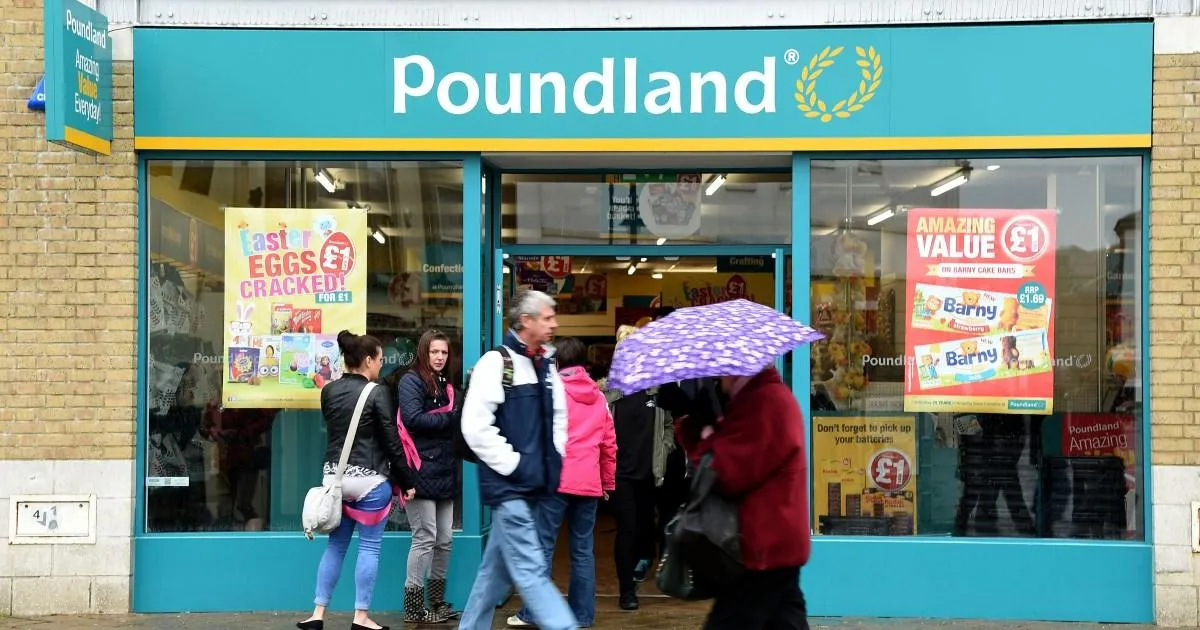
The news of Poundland’s possible collapse has landed with the force of a shockwave, not just for the people who work there but for anyone who has ever wandered its brightly lit aisles in search of a bargain. More than 12,000 employees and 600 stores across the UK and Ireland are now caught in a cloud of uncertainty after the American owners, Gordon Brothers, filed a notice of intention to appoint administrators. The company, which has been a fixture of British high streets for over three decades, was already struggling when Gordon Brothers acquired it from the Polish retail group Pepco for a nominal £1 last year. Now, despite a reported 8.4 per cent rise in sales in the three weeks leading up to October 18, the owners have rejected a rescue bid and are preparing for what could be a painful dismantling. For the staff stacking shelves, the cashiers scanning barcodes, and the warehouse workers loading lorries, this is not a corporate transaction; it is the terrifying possibility of losing a livelihood at Christmas time. The human weight of the story is impossible to ignore, and no one feels it more acutely than Steve Smith, the man who founded Poundland in 1990, built it into a national institution, and now watches from the sidelines as it teeters on the brink.
Steve Smith sold Poundland in 2006 for £250 million, but his emotional connection to the business has never faded. Speaking to Metro, he was visibly devastated by the news, saying, “I am gutted.” For Smith, the collapse would not be contained to Poundland itself; it would trigger a chain reaction across the entire retail ecosystem. He points out that Poundland relies on thousands of suppliers, many of whom depend almost entirely on the chain for their business. If Poundland disappears, those smaller companies will struggle to survive, and their own workers will be pushed into uncertainty. Smith estimates that the total job losses could reach 30,000, far beyond the 12,000 directly employed by Poundland. He describes the store as a vital magnet for footfall, bringing millions of people into shopping centres and high streets every single week. Without that gravitational pull, he warns, surrounding shops and cafés would see fewer customers, and many would inevitably buckle under the pressure. “Imagine all those customers now, if there is no Poundland store there for them to go to. Then other retailers are going to suffer. There’s going to be a lot more retailers going bust,” he said. His words paint a picture of a domino effect, where the loss of one beloved bargain shop becomes a wound that bleeds across entire communities.
The situation is made even more frustrating by the fact that Poundland, by Smith’s assessment, is not actually dying. The management team, he insists, has been doing a good job, and the recent sales figures support that claim. In the three weeks to October 18, sales rose by 8.4 per cent, a sign that customers were still loyal and that the brand still had life in it. Yet despite this, Gordon Brothers notified the High Court that bankruptcy could be imminent, and rejected a rescue bid from the Londonderry-based Martin Property Group, which had been identified as the preferred bidder by Poundland’s management. Smith believes this decision is “absolutely crazy” and a “crying shame.” He argues that the business is not suffering but continuing to improve, and that with the right stewardship, Poundland could easily serve the British public for another thirty years. The mismatch between the company’s performance and the owners’ decision to walk away is baffling to him, and it is easy to understand why. If a business is growing, if customers are returning, if the workforce is committed, why would anyone choose to pull the plug? The answer may lie in the cold logic of corporate restructuring rather than the sentiment of everyday shoppers, but that does not make it any less bewildering for the people whose lives are now hanging in the balance.
Smith is also keenly aware of the political implications of this looming disaster. He says he is waiting for a call from Andy Burnham, who has said the government is ready to support Poundland during this “deeply worrying time” for its staff. The founder believes that ministers should step in because the financial fallout of administration would be enormous. If 12,000 people lose their jobs, that represents roughly half a billion pounds in wages lost every year. And if his own estimate of 30,000 total redundancies proves accurate, the cost to the public purse in unemployment benefits, tax revenue, and lost spending power would run into billions. “This is a multi-billion-pound problem for the government,” he warns, and he cannot understand why more is not being done to prevent it. He says that allowing Poundland to fall into administration would be a betrayal of taxpayers, who would ultimately have to absorb the cost while shareholders and foreign owners walked away. For Smith, this is not just a matter of corporate failure; it is a failure of care, a failure of imagination, and a failure to recognise that a high street without Poundland would be poorer in more ways than one. He has spent months trying to buy back the company he founded, but says Gordon Brothers “won’t even speak” to him. Now he fears it is too late for him to mount his own rescue, and he has thrown his support behind the bid by Martin Property Group instead.
Gordon Brothers, however, sees things differently. A source familiar with the sale process claimed to Metro that Gordon Brothers had actually heard nothing from Smith, casting doubt on his account of being ignored. The source defended the owners’ approach, saying they believe they are taking the path that is “the best option to preserve jobs and to make returns for creditors.” Rather than keeping Poundland as a single entity, Gordon Brothers is reportedly planning to break it up, with rival discount retailers such as Poundstretcher, B&M, and Lidl all potentially interested in buying up individual stores. The source argued that this would allow established retail operators to “bolt on scores of stores to their existing operations,” and that these recognisable brands would then take on employees, move them onto their pension schemes, and offer them employee benefits. To Gordon Brothers, this piecemeal sale is not a betrayal but a pragmatic rescue: it keeps as many people employed as possible, even if the famous name on the door disappears. In a statement, the company said that although Martin Property Group had been identified as the preferred bidder by Poundland’s management team, attention must be paid to properly evaluate all active bids. “These options are being thoroughly and objectively evaluated, with a view to minimising uncertainty for Poundland’s people and all relevant stakeholders,” the statement read. It is a carefully worded defence, but it does little to soothe the anxiety of workers who fear their jobs will be split apart like the stores themselves.
For now, the future of Poundland rests on a knife’s edge. The company that once made bargain shopping a national pastime, where generations of families bought party supplies, chocolate, batteries, and unexpected treasures all for a pound, is being reduced to a financial chess piece. Steve Smith’s warnings are not just the nostalgia of a wealthy founder; they are a passionate plea to remember what a business actually means to the people who depend on it. When he says that the collapse could cause a cascade of closures across the high street, he is thinking of the sandwich shop that serves Poundland employees on their lunch breaks, the bus driver who carries them to work, the landlord of the shopping centre who relies on the footfall they create. The cost of losing that ecosystem cannot be measured in pounds alone. There is also the emotional cost: the pride of working for a famous British brand, the familiarity of the aisles, the simple joy of finding a bargain. If Gordon Brothers’ plan works, some jobs may be saved under new owners, but the soul of the institution may still be lost. And if it fails, the high street will feel emptier, not just in terms of closed stores, but in terms of hope. Smith may be waiting for a call that never comes, but his voice has already given shape to a warning that politicians, creditors, and customers would be foolish to ignore. Poundland deserves better than this, and so do the thousands of people who are waking up every morning wondering if their store will still be there when they arrive.