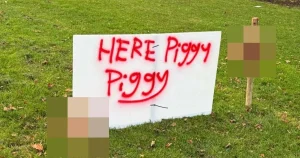



On the morning after Halloween, Kilbroney Park in Rostrevor, County Down, should have been returning to normal. The costumes were put away, the pumpkins were beginning to soften, and families were looking forward to a quiet Saturday after the excitement of tricks and treats. But for one dog-walker, that routine morning turned into something else entirely. While walking through the picturesque park in the Shore Road area, they came upon a sight so jarring that it would have stopped anyone in their tracks: two decapitated pig heads arranged on either side of a sign. One of them had been impaled on a wooden stake and driven into the ground, like something out of a dark ritual rather than a holiday prank. Above them, in fresh red spray paint, were the words “Here, piggy, piggy.” The image was captured in a photograph and posted to a local Facebook group at 7.55am. It did not take long for the picture to spread, stirring disbelief, anger, and unease across the community. For those who saw it, the immediate question was not just who had done this, but why. The dog-walker, who shared the photo, later described the scene as completely unacceptable, especially because the park is used every day by families, young children, and people walking their dogs. It was, they said, a public space that should never have been turned into a display of animal remains. The shock was not only about the graphic image itself, but about the place where it happened—a place meant for laughter, exercise, and calm, not horror.
Within a matter of hours, the photograph had become the subject of heated conversation across social media, and the responses were far from unified. Some locals and council officials suggested that this was nothing more than a Halloween-themed prank, albeit one that had gone badly wrong. They argued that the holiday encourages people to push boundaries, to embrace the macabre, and to play with the darker side of imagination. But even in that light, the pig heads felt different. They were not inflatable decorations or fake spiders; they were the remains of once-living animals, deliberately placed in a public space where children play. The social media user who shared the image offered a straightforward and powerful response: “This is a public space used daily by families, young children and people walking their dogs. Whatever the intention behind it, leaving animal remains on display like this is completely unacceptable.” That sentence seemed to capture the mood of many local people. The word “intention” was central, because no matter what the person behind this was thinking, the effect on the community was the same: fear, disgust, and sadness. Parents began to wonder whether their children had walked past the scene before it was discovered. Dog walkers questioned whether they would feel safe returning to the park. People who had lived in the area for years suddenly found themselves looking at a familiar landscape with new eyes, uncertain whether they had missed something unsettling beneath its beauty. The idea that this was just a prank felt, to many, like an attempt to minimise something genuinely distressing.
To understand why this incident has struck such a nerve, it helps to know something about Kilbroney Park itself. It is not just any open space; it is one of the jewels of County Down, a lush and scenic park nestled beneath the Mourne Mountains, with a history and atmosphere that have inspired writers and artists for generations. The park has been linked to Charles Dickens, who was among the distinguished visitors drawn to the area’s stunning landscape. It is a place where people come to escape the noise of modern life, to wander among ancient trees, to listen to the river, and to let children run free. It has walking paths, play areas, and spots that seem to hold their own quiet magic. The idea that someone would choose such a place to stage a crude and violent display is deeply painful to those who love it. There is a contradiction at the heart of the scene that the dog-walker stumbled upon: a place of peace, used as a backdrop for something so deliberately ugly. The red-painted words “Here, piggy, piggy” only added to the sense of mockery. It was as if someone wanted to turn the park into a stage, to make a spectacle that would be noticed, photographed, and talked about. And in that, they succeeded. But the conversation has not been the one they might have expected. Instead of admiration or amusement, they have been met with widespread revulsion, and a community has come together to condemn what happened.
The official response was swift and unequivocal. The local council issued a statement on Facebook saying it was aware of the incident and was working with the police. The heads, thankfully, were removed from the park, but their removal did little to erase the unease they had created. Mark Gibbons, an independent councillor for the Crotlieve area, was among the first to speak out publicly. His words were blunt, and they carried the anger and hurt of a man who knows his community well. He described the staked pig heads as “vile, sickening and utterly disgraceful,” and said that Halloween was no excuse for such a revolting act. He reminded people that this was a public space used by families and children, and that whoever was responsible should be ashamed. He said he would not share the disturbing image, because he did not want to give it more attention than it deserved, and because he understood the harm that could come from circulating such a graphic photograph. “Imagine a child seeing this?” he asked. That single question seemed to sum up the problem. Children walk through that park. They go there with their parents, their grandparents, their friends. They run along the paths and climb on the play equipment. They should never have to come across something so grotesque, and their parents should never have to explain it. Gibbons also told the BBC that he doubted children were behind the prank, pointing out that the stake driven into the ground was “huge.” This was not the work of a couple of teenagers being silly; it had required effort, planning, and a willingness to handle something deeply unpleasant.
Perhaps the most unsettling aspect of the whole affair is how quickly it became tangled up in broader social ugliness. Gibbons revealed that his Facebook post about the incident had been flooded with “race-hate-filled comments,” which he said he had to delete and block the users responsible. This revelation cast the pig heads in a different light. In Northern Ireland, where symbols and gestures can carry heavy historical weight, an act like this can never be seen in isolation. Even if the person who placed the pig heads did not intend them as a message aimed at any particular group, the reaction they provoked among certain corners of the internet suggests that there are those who understood it in exactly those terms. The police, meanwhile, had already taken the matter seriously enough to launch an investigation. By the time the local council confirmed the heads had been removed, the area was being treated as a crime scene of sorts. The Police Service of Northern Ireland was approached for comment, but no further details were immediately available. The investigation will likely focus on where the pig heads came from, who brought them to the park, and whether this was an isolated act or part of something larger. But even if the person responsible is never found, the damage has already been done. The incident has left a community feeling violated, and it has reminded people that even in quiet, beautiful places, there are those who seem determined to spread fear and division.
In the end, this story is about more than a few pig heads and a can of paint. It is about the kind of world we want to live in, and the kind of messages we want to send to our children. Halloween is meant to be a time for harmless scares, for dressing up and telling ghost stories and eating too much candy. It is not meant to be an excuse for cruelty, or for turning public spaces into scenes of distress. The people of Rostrevor have responded to this incident with the right kind of outrage—outrage rooted not in vengeance but in a shared belief that community spaces deserve respect. The councillor’s refusal to share the image, even as he condemned it, set an important example. There is a difference between raising awareness and spreading shock value, and the most responsible voices have chosen the former. As the investigation continues, there will be questions about whether the law has been broken, and what punishment, if any, the perpetrator deserves. But beyond the legal process, there is a deeper need: for those responsible to understand the impact of their actions, and for the community to heal. The park will reopen, the grass will grow, and in time the memory of this gruesome discovery may fade. But the lesson should not. Public parks are shared treasures, and they are only as safe and welcoming as the people who use them. On this Halloween, a small part of County Down was tainted by an act of senseless cruelty. In the days and weeks ahead, the good people of Rostrevor have a chance to reclaim their park—not with outrage, but with care, with kindness, and with the quiet determination that something like this never happens again.