

1. The Sky Turns Hostile in Jersey
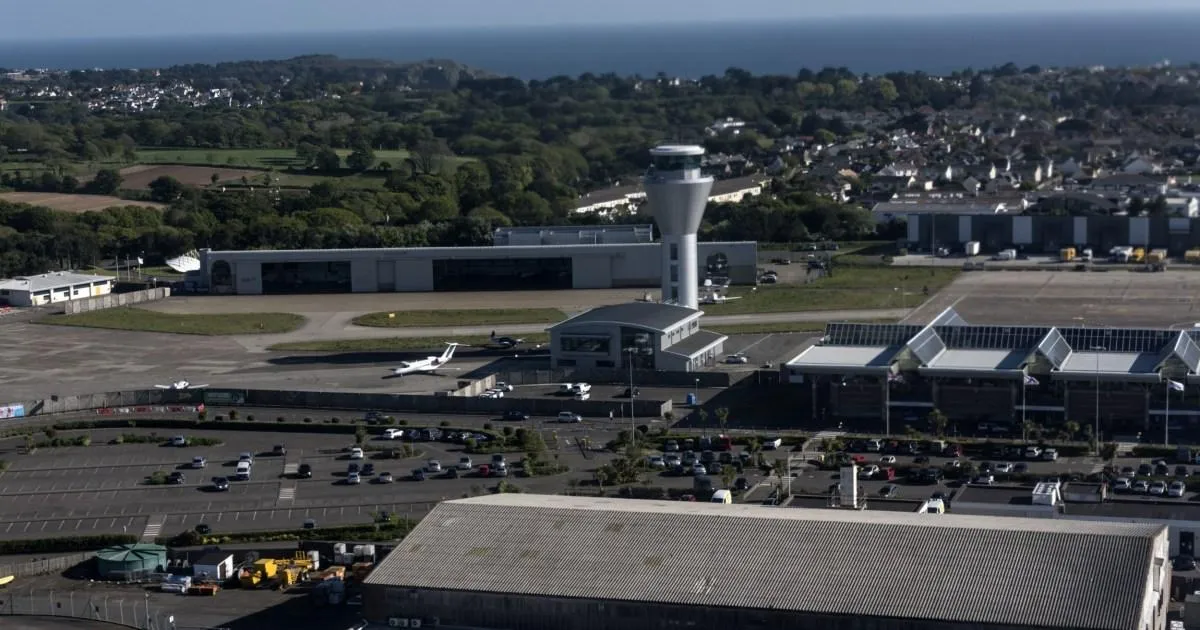
On an ordinary evening, Jersey Airport hums with the reassuring rhythm of a small but vital island gateway. The terminal lights glow against the Channel darkness, luggage carousels turn, taxis line up outside, and inbound aircraft make their final descent over the water with practiced ease. For the people who live in Jersey, this airport is more than a transport hub—it is a lifeline. There is no bridge to the mainland and no train line beneath the sea; flying is the fastest and often the only way to connect with family, work, and the wider world. So when the sky above that runway became a place of uncertainty and danger, the disruption cut deep. On Friday and Saturday evenings, illegal drone sightings near the airfield forced arriving flights to be held back, diverted, or cancelled. The quiet predictability of the island’s main threshold was shattered by a reckless act that could have ended in catastrophe. Passengers who had been strapped into their seats for hours, watching the little map on the seatback screen inch toward Jersey, suddenly learned that they could not land. Some were told to turn around and fly all the way back to Heathrow. Others were rerouted to Paris. A Loganair flight from Southampton was simply cancelled. In the terminal, families stared at departure boards, hoping for news. Outside, on the apron, the airport had become a place of stillness where planes were expected but did not come. What made it worse was the nature of the incident: this was not weather, not a mechanical fault, not an air traffic control delay. It was people flying drones—deliberately, persistently, and illegally—around an active airport, showing a breathtaking disregard for everyone below.
2. Passengers Left Stranded in a Web of Chaos
The names and numbers of the disrupted flights tell a story of human inconvenience spiraling into real distress. British Airways flight BA1356 from Heathrow was already en route when the situation became clear. Instead of continuing to Jersey, the aircraft was forced to turn back to London, no doubt leaving passengers exhausted, confused, and staring at a return journey they had never planned to take. ASL Airlines, arriving from Funchal in Madeira, was diverted to Paris—a place that, however beautiful, was not home to the passengers on board. A Loganair service from Southampton was cancelled outright, meaning that many travellers never even got off the ground. Jersey Airport confirmed that four flights were unable to land as scheduled on Saturday evening alone, and the knock-on effects were felt for hours: missed connections, disrupted plans for work and holidays, and the emotional toll of being stuck in an unknown city with no clear way forward. For one Jersey resident, the nightmare was especially personal. She had boarded her flight after a long trip, looking forward to the comfort of her own home and the joy of being reunited with her two dogs. Instead, her flight was diverted back to Heathrow. She took to social media with a mixture of anger and disbelief, writing that her flight had been sent back because “some imbeciles” were flying four drones near Jersey airport. It was a raw, human reaction that resonated with hundreds of others who understood exactly how she felt. The dogs, likely waiting at home unaware, became a poignant symbol of the hidden costs of this selfish act. It was not just a matter of flight schedules; it was a matter of people’s lives being pulled out of shape, of promises broken, of loved ones waiting in vain at arrivals.
3. Official Fury and the Search for Answers
Jersey Airport did not mince words. In a statement, officials described the situation as “illegal and persistent drone activity” and said that airlines were now making alternative travel arrangements directly with passengers, trying to get them to Jersey as quickly as possible. The phrase “as quickly as possible” was a small reassurance but also an admission that there was no magic solution. For travellers scattered across London and Paris, the practical path home would be slow and uncertain. The airport reminded passengers due to fly in the coming days to check with their airlines, adding another layer of stress to what should have been a straightforward trip. The anger in official circles was unmistakable, and no one voiced it more clearly than Jersey’s chief minister, Senator Lyndon Farnham. He praised the swift and professional response of Ports of Jersey, the States of Jersey Police, air traffic control, and emergency services, and he made clear that the safety of the travelling public and aircrew had been the first priority. But his words were also a warning. He described the deliberate and unlawful operation of drones as causing significant disruption to passengers, airlines, and airport operations, and he called for those responsible to face the full consequences of the law. “Operating a drone close to an airport is not a prank or a harmless hobby,” he said. “It puts public safety at risk, disrupts critical transport infrastructure and can have significant consequences for hundreds of travellers and businesses.” His tone carried the weight of someone who had watched his island being held hostage by a few reckless individuals, and who was determined not to let it happen again.
4. A Modern Threat with Dangerous Consequences
The drone incidents in Jersey are far from isolated. Across the world, airports have become increasingly vulnerable to small, difficult-to-detect drones that can slip into protected airspace and create chaos out of all proportion to their size. A drone striking an aircraft windshield, being sucked into an engine, or colliding with a wing could have catastrophic consequences. Even without a physical collision, the mere presence of a drone near a runway forces pilots and air traffic controllers into a painfully difficult calculation: can we risk landing, or do we turn away? Aviation safety rules are rightly conservative. One unmanned aircraft in the approach path is enough to shut down an airport for hours. In recent years, major airports from London to Dubai have experienced similar disruptions, with flights holding, diverting, and occasionally cancelling at enormous cost. The economic damage is real—airlines lose money, airports lose slots, passengers lose time and money on hotels, taxis, and rebooked tickets. But the deeper cost is less easily measured. There is a psychological toll on travellers who lose confidence in the reliability of their journeys. And there is a deeper moral question about why anyone would think it acceptable to endanger dozens, if not hundreds, of lives just to fly a drone. Jersey’s chief minister called it what it was: not a prank, not harmless fun, but a public safety risk. For the passengers aboard those diverted flights, the abstract issue suddenly became very concrete. They were the ones staring out at the Channel, turning back to Heathrow, landing in Paris against their will, and wondering how such a thing could be allowed to happen.
5. Investigation, Counter-Drone Technology, and the Legal Net Tightens
Behind the scenes, a significant operation was already underway. The States of Jersey Police launched an investigation, and officials began exploring options with United Kingdom authorities for additional operational support, enhanced detection capability, and counter-drone technology. This is not a small step. Identifying the operators of drones in difficult terrain, especially around an airport, requires sophisticated tools—radio frequency scanners, radar systems designed to pick up small objects, thermal imaging, and electronic countermeasures that can disrupt the signal between the drone and its pilot. It also requires cooperation across jurisdictions, since the airspace around Jersey is international and aviation regulation is shared with the UK and European bodies. The promise of “ramped-up detection capability” and counter-drone technology was a clear signal that the authorities were treating this not as a one-off nuisance but as a serious crime with grave implications. The chief minister’s statement also served as a direct challenge to those responsible: “To those responsible, the message is clear: if you are identified, you should expect to face the full consequences of the law.” The law, in the UK and Crown Dependencies, already treats endangering an aircraft as a serious offense. In many cases, flying a drone near an airport can lead to prosecution, heavy fines, and even imprisonment. But the key challenge is always identification. Drones are small, quiet, and often operated from hidden locations. Without witnesses, radar data, and forensic examination of the drones’ flight paths, finding the culprits can be painstaking work. The authorities’ determination to invest in counter-drone technology suggests they are prepared for a longer battle, one that protects Jersey’s skies from anyone who imagines that a drone is just a toy.
6. A Lasting Reminder of Fragility and the Need for Respect
As the next days dawn over Jersey, passengers are being advised to keep checking with their airlines, and the airport is presumably returning to something closer to normal. But the incident leaves behind a lingering unease. For the travellers who were turned away, the memory of staring at their destination but being unable to reach it will not fade easily. For the islanders, there is a new awareness of how fragile their connection to the outside world really is. A place like Jersey depends on the steady rhythm of flights, carrying tourists, deliveries, medical supplies, and the daily flow of people who make the island work. When that rhythm is disrupted intentionally, it is more than an inconvenience; it is an attack on the community’s basic functioning. The response from officials has been robust, and the promise of counter-drone technology offers hope that future incidents can be prevented or, at the very least, brought to a swift end. But technology alone cannot solve the underlying problem. Drones have brought tremendous benefits to photography, agriculture, emergency response, and many other fields. Their presence in our skies is now part of modern life. What is not acceptable, and never will be, is using them in ways that endanger public safety. The people of Jersey have shown resilience, patience, and a willingness to speak out. They have also shown that they expect justice. The police investigation continues, and the search for those responsible goes on. In the meantime, the skies over Jersey are likely to be watched a little more carefully, protected a little more tightly, and appreciated by everyone who understands just how much they carry. It is a lesson that reaches far beyond this tiny island in the Channel: our links to the world, so often taken for granted, are precious and vulnerable. The hope is that those who flew their drones into the night air thought about that, too—and that they will be held accountable for the fear and chaos they caused.