

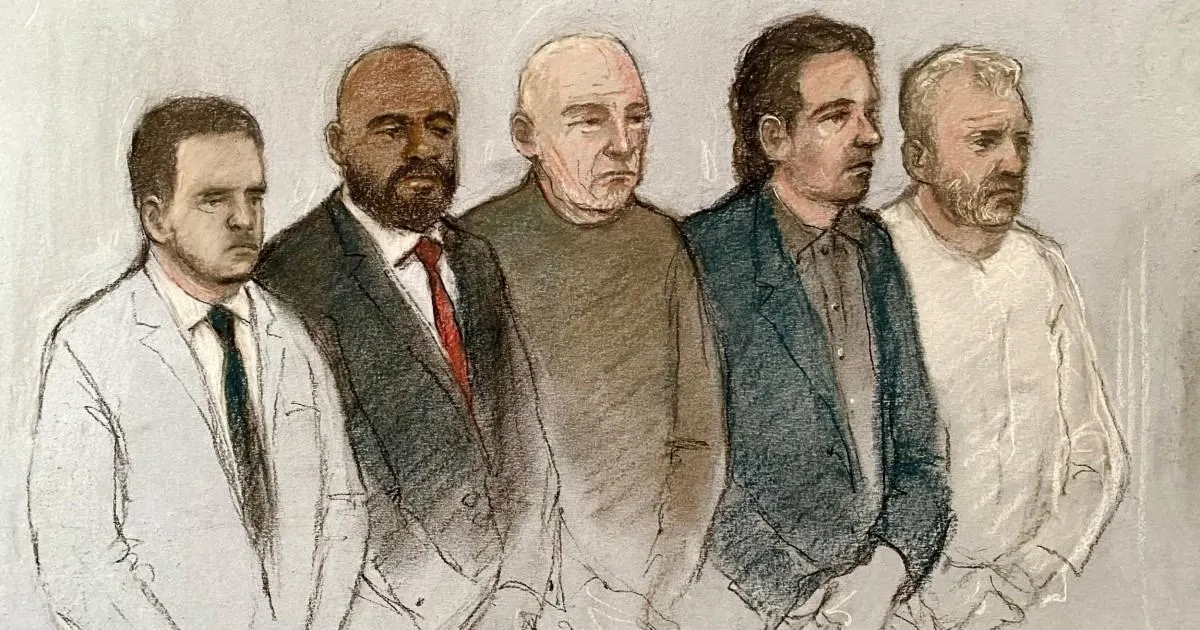
At the heart of this trial is Joanne Young, a woman whose decision to lift the legal shield of anonymity has turned a private horror into a public reckoning. She sat in court as the details of her own abuse were read aloud, the years of her life that were stolen by the man she married and by strangers who answered his invitations. Her husband, Philip Young, 50, a former Conservative councillor from Swindon, Wiltshire, has already pleaded guilty to 56 charges involving drugging and sexually abusing her over 13 years. It is a scale of offending that suggests not a single lapse but an organised, repeated pattern of betrayal. The trial at Winchester Crown Court is not about whether Joanne was abused; that much is admitted. It is about whether four other men, who each encountered Joanne under circumstances engineered by her husband, bear criminal responsibility for their actions. They are Connor Sanderson-Doyle, 32; Norman Macksoni, 48; Richard Wilkins, 62; and Mohammed Hassan, 38. Each denies the charges against him, offering accounts in which they believed Joanne was consenting, aware, or somehow part of an arrangement. The prosecution, however, paints a different picture: a woman drugged, blindfolded, and unable to truly agree to anything that was done to her. Joanne has waived her right to anonymity, and in doing so she has chosen to be known not as a hidden victim but as a named survivor. That choice changes the atmosphere of the courtroom; it reminds everyone that behind the legal arguments and police interviews is a person whose home was turned into a place of danger by the very person who should have protected her. As the trial continues, the jury must navigate a web of websites, messages, and phone calls, listening carefully to the words of men who now say they were naïve, confused, or simply inexperienced. But Joanne’s presence, and her name, serve as a powerful counterweight to those claims. This is not a story about misunderstood signals or awkward encounters. It is a story about exploitation, and about how a husband weaponised his wife’s vulnerability for years.
The first defendant to feature prominently in the evidence is Connor Sanderson-Doyle, 32, from Swindon, who denies sexual assault by penetration and sexual touching in relation to an incident in June 2016. The court heard that when police arrested him at his home on May 22, 2025, he initially insisted he had not had sex with Joanne Young, saying, “I remember this vividly, Jesus Christ.” But in a subsequent police interview, he gave a more detailed account. He said he had responded to an advert on Craigslist that he believed had been posted by Philip Young. The advert described a scenario involving a woman who was tied up and blindfolded. When Sanderson-Doyle arrived at the house, he said he was led into a room where Joanne was exactly as advertised: tied up and blindfolded. He told police he was nervous and began to undress, adding, “Maybe I touched her body a bit.” He wore a balaclava from his motorcycle helmet because he did not want to be identified in a video that Philip Young was recording. Then, as he began to perform a sexual act on Joanne, something shifted. Sanderson-Doyle said he got a “vibe she wasn’t enjoying it or was not comfortable.” He said he stopped, dressed, and left. He told Philip Young, “I don’t think she’s feeling it.” If that were all, his account might sound like a young man who recognised discomfort and withdrew. But his later explanations to police are far less reassuring. He said, “I just thought I was young and maybe not reading the room right. I thought I had her consent, I didn’t know she was drugged, I just thought I was doing a s*** job.” That last phrase is chilling: he thought he was doing a poor job, not that he was abusing a woman who was unable to consent. He acknowledged hearing Joanne say “No” at one point, but claimed he believed she wanted him to do something different rather than stop altogether. He said she “just seemed relaxed,” and because of his communication with Philip Young, he believed he had the consent of both husband and wife. He told officers: “It’s upsetting this man has done this and involved me in it.” Sanderson-Doyle’s narrative shows a man who saw a tied-up, blindfolded woman, heard her say no, sensed her discomfort, and still convinced himself that everything was fine. The prosecution will ask the jury to consider whether this amounts to a reasonable belief in consent. The defence will likely point to his decision to stop and leave as evidence of his good faith. But for many observers, the image of a woman bound and blindfolded, in a video recorded by her husband, is not an invitation to interpret “No” as “try something else.” It is a scene of possible violation, and the law requires more than a passing thought before proceeding.
Sanderson-Doyle’s words to police capture something central to this trial: the gap between what the defendants say they believed and what a reasonable person should have known. He told officers he was “just a young guy trying out new things.” That self-description attempts to reduce a serious criminal charge to youthful inexperience, as though sexual curiosity excused his failure to see the obvious. Yet the circumstances he described were not ordinary. He went to the home of a married couple he met online. He entered a room where a woman was tied up and blindfolded. A video camera was rolling, and he wore a balaclava to conceal his identity. He heard the woman say no. He sensed she was uncomfortable. He continued anyway until his own discomfort grew. The law has long held that consent must be freely given, and that a person cannot be said to consent if they are drugged, asleep, or otherwise incapacitated. Joanne Young, according to the prosecution, was all three. The jury must decide whether Sanderson-Doyle knew enough to make his belief in consent unreasonable. His own statement that he “didn’t know she was drugged” does not necessarily exculpate him; ignorance can be culpable when the signs of vulnerability are apparent. This is not an easy case, and the court will hear expert evidence, digital communications, and testimony from Philip Young’s recorded video. But the human dimension is unavoidable: Joanne was not a willing actress in a fantasy. She was a wife whose husband betrayed her, and who may have been entirely unaware that strangers were being invited to use her body. The fact that Sanderson-Doyle stopped midway through the encounter is perhaps the one mitigating detail in his account, but it also raises a question: why did he need to see and feel her discomfort before stopping? Why did the word “No” not stop him immediately? His explanation—that he thought she wanted a different action—requires a leap of logic that the prosecution will argue is both self-serving and dangerous. In a just society, a person who sees a blindfolded woman bound on a bed must do more than rely on the assurances of the man who seems to be directing the scene. They must consider whether the woman herself is able to consent. The trial is not just about Sanderson-Doyle, though; he is one of several defendants whose stories reveal a shared pattern: men who encountered Joanne through websites or adverts, who dealt primarily with her husband, and who later claimed they believed everything was consensual. The repetition of that defence may make it easier for the jury to see it as a convenient story rather than a genuine misunderstanding. But each defendant must be judged on his own evidence, and the court will take its time.
The next defendant to feature in the evidence is Norman Macksoni, 48, a logistics manager from Sharnbrook, Bedfordshire, who denies one charge of rape. Macksoni told police that he contacted Philip Young through a website called Fab Swingers. According to Macksoni, Philip told him that he and Joanne both wanted to take part and that it was “one of their fantasies.” When he entered the bedroom, he said, Philip was sitting next to his wife and announced: “He’s here, he’s ready for you.” Macksoni claimed that the sex was consensual. He told officers: “I wouldn’t be sleeping with someone who wasn’t coherent, I wouldn’t do that. That’s not what Fab Swingers is about.” The phrase “coherent” is significant. It suggests that Macksoni understood that consent requires an awake, aware, capable partner. But the prosecution will test his claim that Joanne was coherent. If she was drugged and incapacitated, as the charges allege, then Macksoni’s assertion that he would not sleep with someone who wasn’t coherent may actually undermine his defence: perhaps she was not coherent, and he either knew or ignored it. His account also relies heavily on what Philip Young told him, as though the husband’s word could substitute for the wife’s actual agreement. The court will have to consider whether Macksoni’s experience that day was genuinely one of mutual fantasy, or whether he was another man who allowed himself to be fooled—or who chose not to look too closely. Alongside him in the dock are Richard Wilkins, 62, of Swindon, who denies one count of rape and one count of assault by penetration, and Mohammed Hassan, 38, also of Swindon, who denies one count of sexual touching. Their alleged offences are less detailed in the reporting, but they are part of the same web of exploitation. The sixth man, Dean Hamilton, 47, of Street, Somerset, has already admitted one charge of assault by penetration, two counts of sexual assault, and one count of rape. His guilty pleas may be seen as recognition of the strength of the evidence, or as a decision to spare Joanne Young further trauma. Either way, they stand in stark contrast to the denials of the others. In the background, Philip Young’s own guilty pleas to 56 charges underline the scale of what Joanne endured. This was not a single incident but a prolonged campaign of abuse, carried out in the home she shared with her husband. The internet allowed strangers to be invited into that home, and Philip Young acted as gatekeeper, controlling the narrative and the conditions. The defendants who are now on trial argue that they trusted Philip. But trusting a man who would drug and abuse his own wife is, the prosecution may argue, not a defence. It is a warning sign.
While the trial necessarily focuses on the actions and statements of the accused, it is important to remember the person at the centre of this case. Joanne Young has spent years of her life being drugged and sexually abused by her own husband, in her own home, under the guise of a “lifestyle” that she never truly chose. The psychological impact of such betrayal cannot be overstated. The person who should have been her protector became her abuser. The home that should have been her sanctuary became a place where strangers could be brought in to use her while she was incapacitated. The fact that she has waived her anonymity means that she is willing to be identified publicly, to have her name printed in newspapers, to walk into court and face the men who did this. That is an act of extraordinary strength. It also means that every detail of her abuse is being scrutinised in public, potentially re-traumatising her. But by allowing her name to be used, Joanne has reclaimed something: she is not just “the wife of a former councillor” or “the victim of a Craigslist advert.” She is Joanne Young, a woman who survived an unimaginable ordeal and is now demanding justice. The case also raises uncomfortable questions about how consent is understood in online sexual encounters, about the responsibility of people who engage in fantasy roleplay, and about the danger of relying on a third party’s assurances. A husband who arranges a sexual encounter for his wife is not automatically committing a crime; many couples engage in consensual non-monogamy or swinging. But the difference here is that Philip Young drugged Joanne and was able to do so for 13 years. The men who answered his adverts may have believed they were entering a consensual arrangement, but the law does not allow a man to hide behind his own assumptions when the evidence of incapacity is clear. A woman tied up and blindfolded cannot see who is entering the room. If she is drugged, she cannot consent. If she says “No,” that must be respected. The trial is a painful reminder that sexual autonomy is not something that can be transferred or gifted by a spouse. It belongs to the individual alone. And when that individual is unable to express her wishes, any sexual contact is a potential crime. The jury will have to weigh all of this as they consider the evidence against each defendant.
As the case continues at Winchester Crown Court, the jury is being asked to make difficult distinctions. Each defendant must be considered separately, on his own actions and state of mind. Philip Young, the orchestrator, has admitted his guilt and will be sentenced at the end of the trial. Dean Hamilton has also admitted his involvement. The four remaining defendants—Sanderson-Doyle, Macksoni, Wilkins, and Hassan—maintain their innocence. Their lawyers will no doubt argue that the prosecution cannot prove they knew Joanne was drugged or unable to consent. They will point to the statements of Philip Young, who presented the situation as a consensual fantasy. But the counter-argument is strong: a blindfolded, bound woman who says “No” is not consenting; a woman who is silent because she is incapacitated is not consenting; and a man who chooses to proceed because he is “young” or “not reading the room right” is not exercising reasonable care. The case has already generated significant public interest, not only because of the shocking details but because it touches on broader issues of sexual violence, the exploitation of vulnerable people, and the ways in which the internet can be used to facilitate abuse. For Joanne Young, the trial is one more stage in a long journey. She has survived years of abuse, the collapse of her marriage, and the public revelation of deeply intimate violations. She has chosen to be named, and in doing so she has shown a resilience that demands respect. Whatever the verdicts, the criminal justice system has at least allowed her story to be heard. The court has heard how men arrived at her home, engaged in sexual acts, and left, leaving her to wake to the aftermath of something she may not even recall. The full sentencing of Philip Young and Dean Hamilton will come later. For the remaining defendants, the outcome hangs in the balance. But the image of Joanne Young, in her decision to face this publicly, will linger long after the trial ends. This is not a story about a woman who was broken. It is about a woman who refused to be silenced, and about a legal system that is trying to hold accountable not only the man who engineered her abuse, but also the men who chose to take part. The case continues.