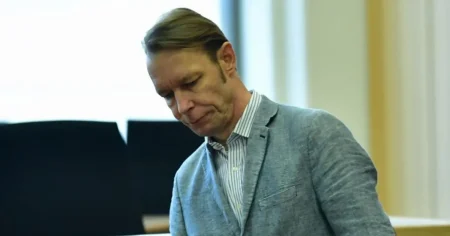




The cramped, windowless world of a prison cell is rarely a place of peace. Sleep, when it comes, is often fragile, and any disturbance can feel unbearable. But for one man, the ordinary sound of his cellmate snoring became the spark that ignited a violent explosion. David McLaughlin, a 47-year-old inmate with a long history of aggression, snapped in the early hours of February 27, 2024. What followed was not a quick, reflexive shove or a shouted complaint, but a sustained, brutal assault that left his cellmate bleeding and broken on the floor. Durham Crown Court heard that the attack was “well over the top,” a phrase that barely captures the savagery of the injuries inflicted. McLaughlin took exception to the loud snoring and responded with a level of violence that shocked even seasoned legal observers. By the time it was over, the victim was covered in blood, his face and head marked by a series of wounds, his body battered and his sense of safety shattered. This was not a moment of fleeting irritation; it was a prolonged, targeted beating that would change the course of two lives forever.
The physical toll on the victim was severe and lasting. His forehead, the back of his head, the area behind his ear, and his chin all bore open wounds from the assault. His own tooth had cut into his mouth, adding to the grotesque inventory of injuries. More alarming still, he suffered a broken arm that required surgery, along with two suspected fractured ribs. The medical treatment would be long and painful, but the emotional wounds proved even more enduring. In a victim statement read to the court, he described the attack as “the worst experience of my life,” a phrase that resonates with a harrowing weight. He spoke of being badly scarred, not just physically but psychologically. Nightmares haunted him, PTSD took hold, and he endured months of constant pain. Even within the confines of prison, where he had to continue living among other inmates, there was no refuge. He was threatened by fellow prisoners for being “a grass,” a chilling reminder that victimhood in prison often comes with its own punitive social consequences. Instead of receiving support and safety, he was isolated, stigmatized, and made to feel that the attack was somehow his fault. His ordeal did not end when the beating stopped; it became a shadow that followed him through every waking hour.
In court, McLaughlin’s defense was built on a claim of self-defense. He denied the charge of wounding with intent, insisting that he had only acted to protect himself. But the jury was not convinced by this narrative. They cleared him of the more serious charge, perhaps accepting that there was some ambiguity about how the confrontation began, but they found him guilty of the alternative charge of unlawful wounding. This verdict acknowledged that even if McLaughlin had felt threatened, his response was wildly disproportionate. The court heard that his criminal record was deeply concerning: 85 previous offences, including 14 assaults. His most recent conviction, for putting someone in fear of violence, had come just months earlier, in June 2024, for which he had served ten months in prison. This pattern of behavior painted a portrait of a man repeatedly drawn into violent confrontations, unable or unwilling to control his rage. The prosecution argued that his history showed a clear disregard for the safety of others, and that this latest incident was not an isolated lapse but part of a broader and troubling trend.
In mitigation, Rachel Kelly, representing McLaughlin, offered a nuanced explanation. She noted that the victim himself believed a weapon had been used during the attack, but that McLaughlin was never charged with a weapon offence. This, she suggested, pointed to a case of “excessive self-defence,” a legal concept that acknowledges a person may have had a genuine fear but responded with force that went beyond what was reasonable. She also spoke of McLaughlin’s attempts to find stability after his release from a previous sentence in March of the previous year. He had secured housing, was steering clear of alcohol and drugs, and had seemingly been making an effort to rebuild his life. But that stability had been fragile, and the pressures of prison life, combined with his own demons, had ultimately overwhelmed him. Since his conviction on September 17, he had been back in prison on remand, awaiting sentence. It was a familiar environment, one that had shaped much of his adult life, but also one that seemed to bring out the worst in him.
Judge Tom Mitchell, presiding over the case, was unsparing in his assessment. He observed that whatever the jury thought about how the confrontation originally began, it had ended in “grossly disproportionate violence.” His words carried a grim authority as he described McLaughlin as appearing to “reek of violence” throughout the trial. This was not a man who had made a single, terrible mistake; this was someone whose very presence seemed steeped in aggression and menace. The judge noted that McLaughlin had clearly gone “well over the top,” causing his cellmate “grave injuries.” The sentence was three years in prison, with the judge emphasizing that the assault was so serious that only immediate custody was justified. For a man already familiar with prison life, three years may seem like just another chapter in a long and troubled story, but for the victim, it was a verdict that affirmed the severity of what he had endured. It was a recognition that his suffering mattered, that the attack was not something to be excused or minimized, and that the justice system, however imperfect, had taken his pain seriously.
This case is more than a disturbing news item; it is a stark reminder of how easily human beings can lose control, especially in environments where stress, confinement, and fear are constant companions. Snoring is an ordinary, almost comical irritation in the outside world, something people complain about with a pillow over their head or a good-natured nudge. But inside a prison cell, where personal space is measured in inches and there is nowhere to retreat, that same sound can become a trigger for profound violence. The story of David McLaughlin is not just about one man’s rage; it is about the cycle of violence that prison can perpetuate. It is about a victim who will carry physical scars and emotional trauma for years. It is about a perpetrator whose own life has been defined by aggression, and whose latest outburst has only deepened his entanglement with the criminal justice system. And it is about the rest of us, who are left to ponder the terrifying fragility of restraint. How many of us, stripped of sleep, space, and dignity, might also snap under the right pressure? The answer is uncomfortable, but it is one worth considering. In the end, the sound of snoring was just noise. The harm that followed was the result of choices, histories, and a system that too often fails to address the root causes of violence. As the courtroom fell silent and McLaughlin was led away, one could only hope that three years behind bars might offer him the opportunity to reflect, to change, and to break the cycle that has consumed so much of his life. For the victim, the fight for healing continues far beyond the gates of the courtroom, a long and lonely road toward reclaiming a sense of safety that was stolen on an ordinary night, by an extraordinary act of cruelty.