

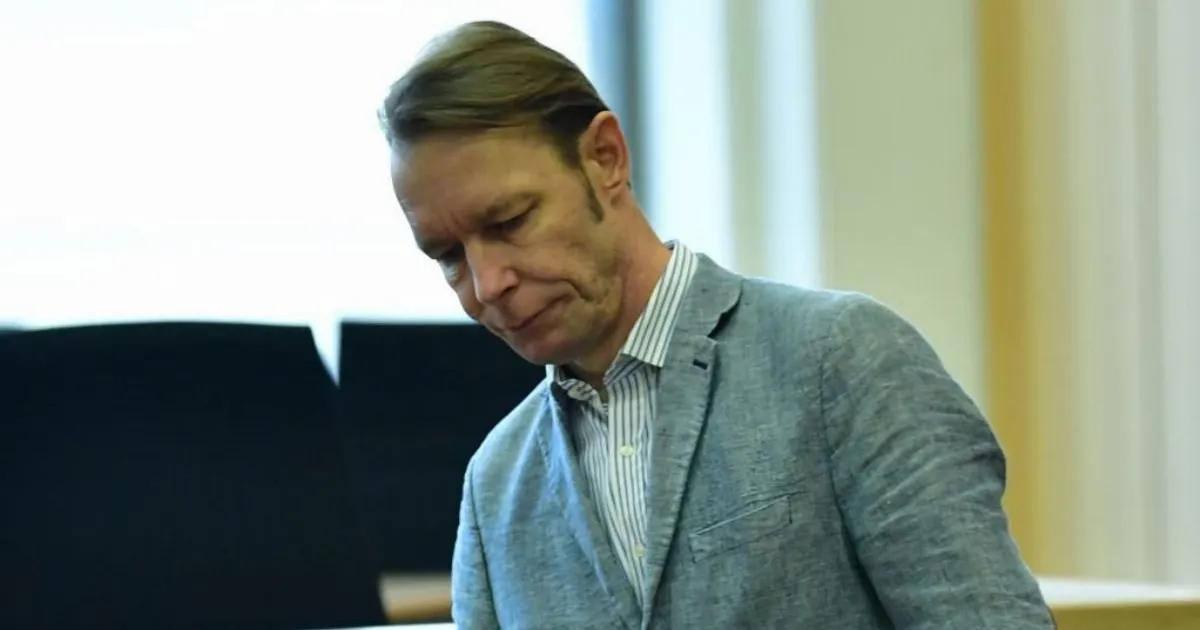
After more than a year of living with the quiet, constant presence of police officers at every turn, Christian Brueckner can finally experience something he has not had since his release from prison: the sensation of being alone. The man who has long been described as the prime suspect in the disappearance of Madeleine McCann has learned that the round-the-clock police surveillance that has followed his every step for thirteen months will end tonight. His lawyer, Philipp Marquort, says Brueckner is “very happy” with the development, and it is not hard to see why. To be watched continuously, day and night, by officers who document your movements and interactions is a form of psychological pressure that few can imagine. It is also, according to a German court, no longer justified. Brueckner, a convicted rapist and paedophile, was released from prison in September last year after completing a seven-year sentence for the rape of an elderly woman in Praia da Luz, Portugal, in 2005. That case had already marked him as a dangerous offender. But it is his suspected connection to Madeleine’s disappearance—the little girl who vanished from the same Portuguese resort two years later—that turned him into a figure of international infamy. Because German investigators believe he may have been involved in taking Madeleine, and because they assessed him as being at high risk of reoffending, police applied to keep him under constant observation after his sentence ended. Now, however, a new psychological and psychiatric assessment has reached a different conclusion: Brueckner poses an average risk of reoffending, not a high one. The court accepted that assessment and dismissed the police application. He will still wear an electronic ankle tag and must comply with other restrictions, but the all-seeing eye of the state will finally turn away.
The backdrop to this legal fight is one of the most heartbreaking episodes in modern criminal history. On the evening of May 3, 2007, three-year-old Madeleine McCann was sleeping in a holiday apartment in Praia da Luz while her parents, Kate and Gerry McCann, had dinner at a restaurant just a short distance away. When Kate returned to check on the children, she found the apartment’s door open and Madeleine gone. The image of Madeleine—with her distinctive eye and her favourite toy—was beamed across the world. What followed was a global campaign, a media frenzy, and nearly two decades of pain for her family. Despite an enormous investigation involving British, Portuguese, and German authorities, Madeleine has never been found, and no one has ever been convicted of taking her. The case remains open, and it remains a source of agonizing uncertainty. Brueckner came under suspicion because of his presence in the area and because of his previous convictions for sexual violence. He lived in the Algarve between 2000 and 2017, and investigators found that he had been near the McCanns’ holiday apartment around the time of Madeleine’s disappearance. German prosecutors have publicly identified him as a prime suspect, though they were careful to note that he had not been charged. For the McCanns, the naming of a suspect who had already been in prison for other crimes brought a mix of hope and horror: hope that answers might finally emerge, and horror at the thought that a known predator could have been responsible all along. Two years later, those answers still have not come. Brueckner has never faced trial for Madeleine’s disappearance, and he continues to maintain his innocence. But the shadow of that night in Praia da Luz has followed him longer than any police officer ever did, and for the family at the centre of the mystery, the pain remains as sharp as ever.
At the heart of Brueckner’s legal situation lies a fundamental tension between suspicion and freedom. He is, in the eyes of the law, an innocent man when it comes to Madeleine—not because he is believed to be innocent, but because he has never been charged and therefore never had the chance to clear his name in court. German prosecutors have at various points suggested they believe Madeleine is dead and that Brueckner is the person responsible, but they have not been able to gather enough evidence to prosecute him. That inability is not an academic detail. It matters because a legal system that allows a person to be punished indefinitely on the basis of suspicion alone is no longer a system of justice; it is a system of arbitrary detention. This is the principle that animated Brueckner’s lawyer when he spoke of the need to allow his client to rebuild his life. “Anyone who has served their sentence in full must be given the chance to rebuild a life in freedom,” Philipp Marquort said. “For thirteen months, that was impossible with police officers following his every step. Now my client can begin.” The court’s decision also rests on a practical, clinical judgment. A new psychological and psychiatric assessment has concluded that Brueckner is no longer at the high risk of reoffending that once justified round-the-clock surveillance; he is now judged to pose an average risk. That does not mean he is safe, and it does not mean he will be left entirely to his own devices. The electronic tag will allow authorities to track his movements. There are other conditions, too, which have not been fully disclosed but likely include reporting requirements and restrictions on contact with minors. The point, however, is that the state’s power over him has been limited. Brueckner may have lived a life that many find repulsive, and he may be suspected of one of the worst crimes imaginable, but under the law he has served his debt for the crimes for which he was actually convicted. The court has now said, in effect, that the extra punishment of constant surveillance cannot continue. It is a decision that protects an important principle, even if it feels uneasy in practice.
The investigation into Madeleine’s disappearance, meanwhile, is far from closed. British, German, and Portuguese authorities have continued to work on the case, and every so often new searches are carried out. The most recent came in June, when investigators searched areas near the Portuguese municipality of Lagos. That followed a wave of renewed attention in 2023, when authorities turned to the Barragem do Arade reservoir, about thirty miles from Praia da Luz. The reservoir had been a focus before, but investigators discovered that Brueckner had spent time in the area and had photographs and videos of himself near the water. The possibility that Madeleine’s remains could be hidden in the reservoir, or somewhere around it, was one of the most plausible leads to emerge in years. The searches were large and intensive, but they did not lead to any public breakthrough. No remains were found, and no charges were brought. Brueckner has repeatedly refused to cooperate with the investigation. When he was released from prison last year, Metropolitan Police officers sent an international letter requesting an interview, but he declined to speak to them. Reports in the German media have also suggested that he refused to undergo therapy while in custody, and that one psychiatric report concluded he was likely to commit further crimes. That report, however, has apparently been superseded by the more recent assessment that downgraded his risk level. The discrepancy raises uncomfortable questions about how much confidence we can place in any prediction of future behaviour, especially when the person involved is someone as complicated and disturbing as Brueckner. Separately, he has had to appear at the Landgericht Braunschweig state court in Germany, where the final days of a trial on sex-crime allegations played out. In October last year, he was cleared of unrelated sexual offences alleged to have taken place in Portugal between 2000 and 2017. Those cases, too, added to the public image of a man facing repeated accusations, but they did not result in convictions. What is certain is that the end of constant surveillance does not mean the end of the McCann investigation. It simply means that Brueckner will no longer be the subject of the same kind of intensive observation. He remains a suspect, and he remains a person of enormous interest to prosecutors in three countries.
For many people, the news that Brueckner will no longer be followed by police will feel deeply uncomfortable. This is a man with proven convictions for rape and child sexual abuse, a man who was described by authorities as a high risk to the public. The thought that such a person can regain a degree of freedom is unsettling, and no amount of legal reasoning can entirely remove that discomfort. But the legal system is designed to protect not only the public but also the rights of individuals, even those accused of terrible things. The idea that punishment must have an endpoint is fundamental to a civilised society. When someone completes a prison sentence, they are supposed to be released back into the community, and the community is supposed to accept them, within reason, as someone who has paid their debt. If the state could simply continue to find new reasons to restrict a person’s liberty—through surveillance, tagging, or other measures—then the sentence would not truly end. It would morph into an indefinite punishment based on suspicion rather than proof. That is why the German court’s decision to reject the police application is so important. It reaffirms a principle that is easy to forget when the suspect in question is personally repugnant. At the same time, the system has tried to strike a balance. The electronic tag and the other restrictions are not a complete restoration of freedom. They are a form of managed liberty, allowing Brueckner to live in the community while acknowledging that there are risks. This compromise is far from perfect. It may leave Brueckner feeling watched and restricted, and it may leave the public feeling unprotected. But it is an attempt to reconcile two powerful values: the safety of society and the rights of the individual. For the McCann family, however, no legal abstraction can capture the reality of their loss. They have spent nearly two decades waiting for news, hoping for answers, and trying to keep Madeleine’s memory alive. A legal ruling about the surveillance of a suspect does not change any of that. It only adds another layer to a story that has already contained too many twists and too little resolution.
What happens now? For Brueckner, the immediate challenge will be to adjust to a life without constant police officers beside him. The electronic tag will still be there, a silent reminder that he is not entirely free. He will have to report to authorities and abide by the conditions imposed by the court. His lawyer says he wants to begin rebuilding his life—finding a place to live, perhaps work, and some semblance of normal routine after more than a year of having every step observed. Whether the public will allow him that peace is another question. The name Christian Brueckner is now synonymous with the Madeleine McCann case, and wherever he goes, he may face suspicion and hostility. For Kate and Gerry McCann, the latest development is both a legal matter and another emotional blow. They have lived through countless false leads, dead ends, and frustrated hopes. They have watched suspects come and go, and they have endured the terrible ambiguity of not knowing whether their daughter is alive or dead. The case is still being investigated, and there is always the possibility that new evidence will emerge—a witness statement re-evaluated, a piece of forensic science advanced, a memory resurfaced. But there is also the possibility that the case will never be solved. That is a heartbreaking thought, but it is one the McCanns have had to live with for a very long time. In the end, the end of Brueckner’s constant surveillance is a story about justice and its limits. It is about a system trying to balance compassion for a suspect with protection for the public. It is about a man who believes he deserves a second chance, and a family who feel they will never have the closure they desperately need. The police may no longer be watching, but the search for Madeleine goes on.