
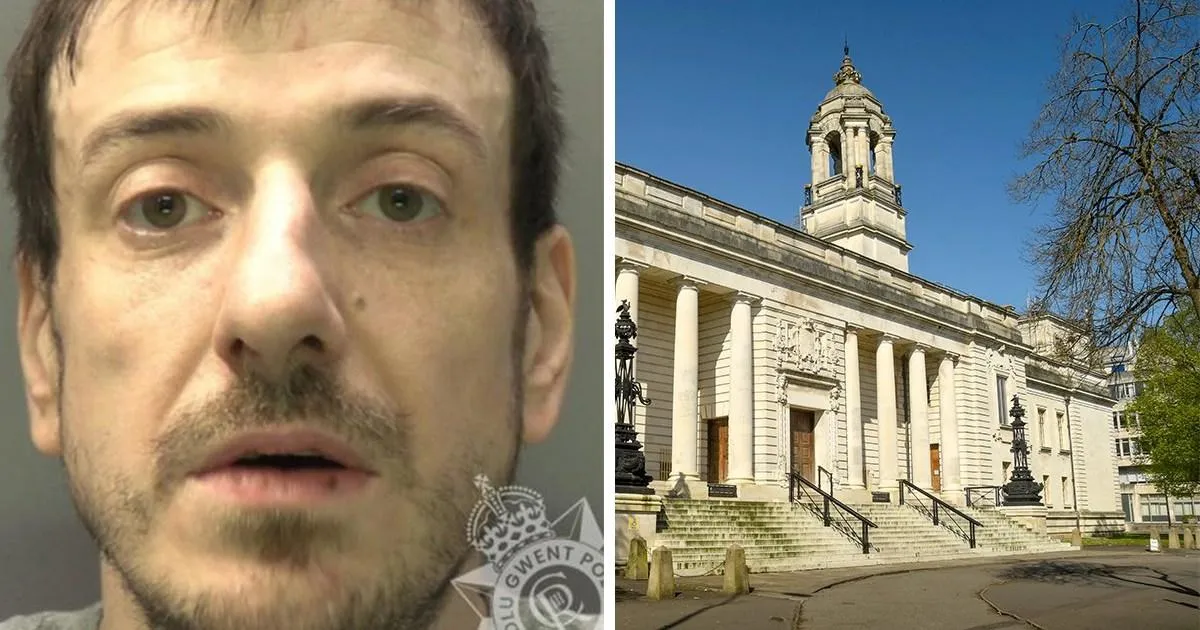
It is hard to imagine a more ordinary backdrop for such a terrifying sequence of events. A block of flats in Cwmbran, South Wales, is the kind of place where people greet each other in stairwells, where the sound of a baby crying drifts through thin walls, and where the daily rhythm of work, meals, and rest is meant to feel safe. Yet for one young couple and their child, this familiar setting became a source of dread because of the man who lived just next door. Paul Foster, 39, is not a figure from a horror film or a cautionary tale from a distant place; he is the neighbor you might nod to in passing, the person whose footsteps you hear on the landing. But inside that ordinary frame lived a rage so violent that it spilled out in words designed to destroy a family’s sense of security. Cardiff Crown Court heard how Foster made a series of chilling threats against the couple, threats that went far beyond the usual complaints about noise or parking. These were not impulsive mutterings; they were calculated, repeated pronouncements of violence aimed at the most vulnerable people imaginable. The case forces us to confront an uncomfortable truth: that the place we call home can become a prison, and the people closest to us in distance can become the source of our deepest fear. When a neighbor becomes a menace, the very walls we rely on for privacy and comfort can feel like they are closing in, and the sound of a key in a lock can make a family hold its breath.
The first shock came during an ordinary argument, the kind of disagreement that should have ended with a slammed door or a few angry words. Instead, Foster turned to the mother of the baby and issued a threat so grotesque that it seems impossible to repeat without feeling sick. He told her that he was going to slice her baby in half. There is no language adequate to describe the terror that such a statement must have inspired in a parent. A baby is not just a child; it is the embodiment of hope, the most fragile human being in a family’s life, utterly dependent on the people who love it. To hear a grown man, a neighbor, calmly articulate a plan to hurt an infant is to step into a nightmare where the rules of civilization have collapsed. The mother, already dealing with the exhausting realities of caring for a newborn, had to process the fact that the man living a few feet away had imagined the unthinkable. She had to wonder whether she could protect her child in the one place that was supposed to be a sanctuary. Every nap, every feeding, every quiet moment was now poisoned by the memory of those words. The threat was not just physical; it was psychological warfare of the most vicious kind, designed to keep a family in a state of perpetual vigilance and fear. No mother should have to hear such a thing, and no child should have to live in the shadow of a man who sees them as an object of cruelty. The fact that Foster said these words in the heat of an argument does not lessen their impact; it only deepens the sense that his anger was always simmering beneath the surface, ready to target whoever was closest to him.
When police arrived to arrest Foster, his behavior did not improve. Instead of showing remorse or attempting to explain himself, he launched into a fresh rant, this time directed at the mother’s partner. He claimed that the partner had been intimidating him for months, a statement that the court would have to weigh against the overwhelming evidence of Foster’s own aggression. But even if there had been a history of tension, nothing could justify what came next. Foster said that one day he was going to smash the man in the face. Then he went further, describing how he would decapitate him. These are not the words of a man who is simply venting frustration; they are the language of someone who has imagined the act in detail, who has found satisfaction in the power that such threats give him. The mention of decapitation, a method of violence so extreme that it is almost never part of real conflict, suggests a mind that has slipped into a dark and dangerous place. The partner, who had presumably been trying to protect his family, now found himself named as the target of a gruesome fantasy. He was being told, in front of police, that his neighbor intended to end his life in the most brutal way possible. The fact that Foster said all of this while being arrested shows a shocking lack of inhibition, a willingness to say exactly what he was thinking regardless of consequences. It is deeply disturbing that his anger had been building for months, as he claimed, and that he had apparently seen the partner’s behavior as justification for violence. In his mind, he was the victim; in reality, he was the one spreading terror through a family home late into the night.
If the earlier threats were not enough, Foster saved perhaps the most alarming words for last. He added that as soon as he was released, he was going to go on a killing spree. He repeated his intention to chop the partner’s head off, but this time the threat was not just aimed at one person; it was aimed at the wider world. The phrase “killing spree” conjures images of public violence, random victims, and a complete break from sanity. For the family who had already heard him threaten their infant and their partner, these words must have felt like a sentence hanging over their heads. They now had to live with the knowledge that the man who terrorized them was promising more violence, not less, and that even his arrest could not fully protect them. The criminal justice system was involved, but the emotional damage had already been done. The mother and father had to lie awake at night replaying his words, wondering if he meant what he said, wondering if they should move, wondering if there was anywhere they could go where they would not have to see his face in the hallway. The threat of a killing spree also raises the stakes for the entire community: if Foster was serious, then everyone in that block of flats was at risk. The neighbor who had once been an unwelcome presence had now become a potential mass casualty event. The court would have to decide how seriously to take these words, but for the victims, the terror was real and immediate. They had no way of knowing whether Foster was bluffing, whether he was merely trying to frighten them, or whether he was actually planning something unspeakable. They could not afford to assume the best, because the worst possible outcome was too terrible to contemplate. And so they waited, in fear, for the system to do its job.
In a courtroom, these words took on a formal, almost clinical weight. Cardiff Crown Court heard the details of Foster’s threats, and it was up to the judge and jury to determine what should happen next. The justice system is built on the belief that words matter, that threats are not harmless expressions of frustration but can be crimes in themselves, especially when they target vulnerable people. The courage of the young couple in coming forward should not be underestimated. Many victims of neighbor harassment never report it, afraid that the situation will get worse, afraid that no one will believe them, afraid that the authorities will treat it as a civil dispute rather than a criminal one. But these two people, with a baby to protect, did not stay silent. They told their story, endured the stress of the investigation, and faced the ordeal of giving evidence in front of a judge. Their testimony was not just about seeking punishment for Foster; it was about drawing a line in the sand, saying that no one has the right to threaten a family in their own home. Foster’s own words, his admitted intention to kill and his fantasies of decapitation, were brought into the light. Whether or not he ever intended to carry them out, they had already served their purpose: they had caused terror. The law recognizes that terror is a real harm, that the victim of a credible threat suffers an injury that cannot be measured in bruises or broken bones. The mother who heard a man promise to slice her baby in half will carry that memory for the rest of her life. The father who was threatened with decapitation will never feel entirely safe in his own stairwell again. The court’s role, then, was not only to punish Foster but to affirm the family’s right to live without fear. It is a solemn responsibility, and one that requires the justice system to take every threat seriously, especially when the vulnerable are involved.
Ultimately, this story is about more than one man and one family. It is a reminder that the safety of our homes depends not only on locks and alarms but on the kindness and restraint of our neighbors. We choose our friends, but we do not choose our neighbors; we are thrown together by chance and geography, and usually that works well enough. Most people are decent, the noise is tolerable, and the occasional argument is forgotten. But every so often, a person like Paul Foster emerges from the ordinary background and reveals a capacity for cruelty that shakes a whole community. His threats against a baby, a partner, and the general public are extreme, but the underlying problem is familiar: anger left to fester, resentment left unchallenged, and a man who blamed others for his own rage. The family in Cwmbran did not deserve this, and neither did the baby who happened to be born into a home next to a man with such a dark mind. We should hope that the legal process brings a measure of justice, that Foster receives the help and supervision he clearly needs, and that the victims find some peace. We should also reflect on what we owe each other as neighbors: a willingness to watch out for the signs of trouble, to intervene before threats escalate, and to support those who find themselves trapped in a nightmare. The words “I’m going to slice your baby in half” should never be spoken by one human being to another, and when they are, society must respond with swift and unambiguous force. For now, the couple and their child have survived the vision of terror that Foster tried to impose on them. It will take time, but with support, they can rebuild their sense of safety. And if this case teaches us anything, it is that the ordinary is precious, that home is sacred, and that the people next door deserve our kindness—and our vigilance.