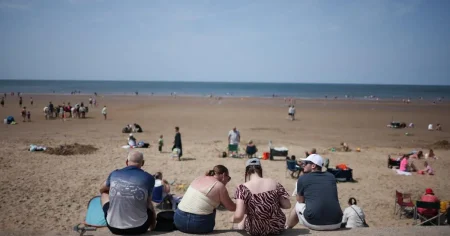

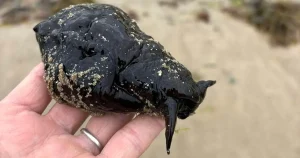

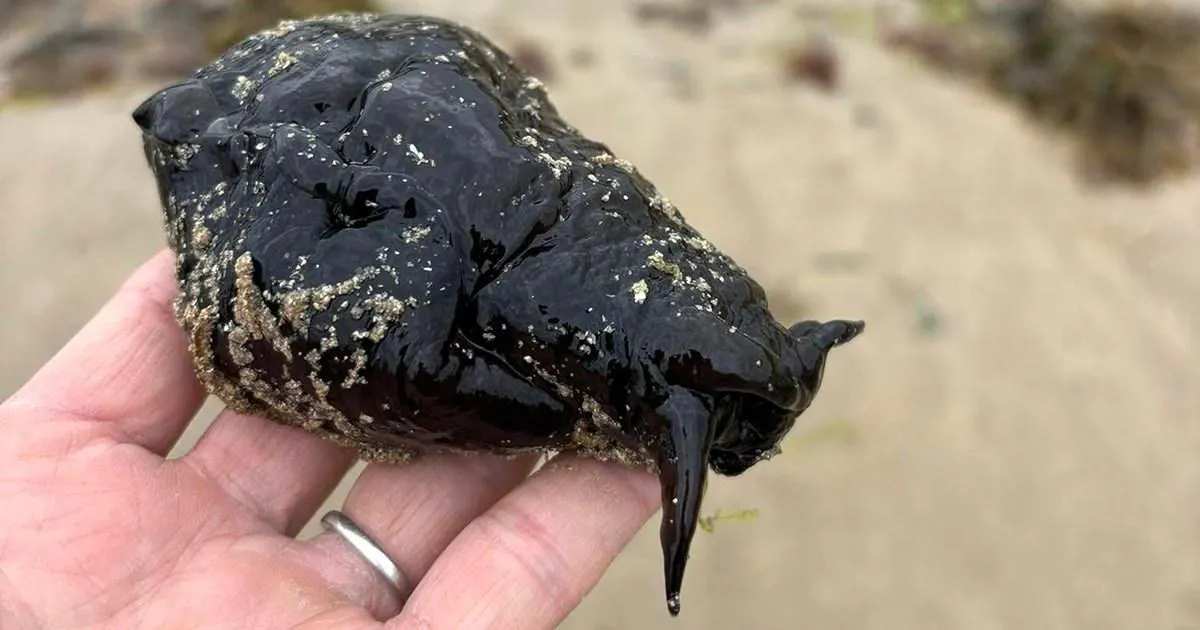
The recent discovery of a colossal, mysterious creature on a beach in Anglesey has sparked both curiosity and expert debate. While out walking her dog, a local resident named Emma Leese stumbled upon what appeared to be an alien-like visitor stranded some 20 meters from the shoreline at low tide. Though the creature was initially baffling to onlookers, it was later identified as a sea hare—a fascinating type of marine snail often referred to as a “sea slug.” Recognizing that these animals struggle to survive once separated from the ocean because they cannot breathe atmospheric oxygen, Emma acted quickly. With a gentle touch, she helped the creature back into the water, where she watched it unfold and begin to move with the distinct, rhythmic wriggling characteristic of its kind.
The scientific community has taken a keen interest in this sighting, as the creature appeared to be far larger and more physically distinct than the native sea hares typically found in the UK. Frankie Hobro, the director of the Anglesey Sea Zoo, suggests that this specific specimen is likely a “depilatory sea hare,” a species much more common to the warmer waters of the Mediterranean. While small numbers have been spotted as far north as Scotland or the Isle of Man, they are virtually unheard of in Wales. Experts believe this encounter may be a harbinger of things to come; as our global climate shifts and sea temperatures rise, these rare, southern-dwelling species are increasingly venturing into northern territories where they were previously absent.
To the untrained eye, a sea hare might look like a gelatinous, uninspiring blob, but they are actually marvels of biological adaptation. As molluscs, they are distant cousins to the common garden snail, though they have evolved away from the traditional, heavy external shell in favor of a thin, transparent internal one. Their fleshy mantles have evolved into wing-like flaps, allowing them to swim through the water column with a grace that contradicts their slug-like appearance. Furthermore, they possess a fascinating defense mechanism: when threatened or startled, they release a vibrant, dramatic cloud of purple ink. Derived from the red algae they consume, this ink serves as a clever decoy, clouding the water and confusing any predators that might be lurking nearby.
However, the size of this particular visitor was truly remarkable. While the “spotted” sea hares native to Britain usually peak at around 20 centimeters in length, the depilatory sea hare can grow to a staggering 40 centimeters. This makes the Anglesey specimen a true giant by local standards, dwarfing its British relatives in both length and bulk. This disparity in size is likely what caused so much confusion for those who happened upon it, as there simply wasn’t a local precedent for a mollusc of that scale appearing on a Welsh beach. It served as a stark reminder of how little we often understand about the wandering inhabitants of our own coastlines.
Despite the natural human inclination to help or touch such a peculiar animal, experts offer a stern word of caution. Frankie Hobro emphasizes that people should avoid handling these creatures without proper protection, such as gloves, as they store noxious chemicals derived from their diet within their skin. Touching them can be an unpleasant experience, and attempting to pull them from a rock can cause significant damage to the animal’s body due to their incredibly strong suction. In many ways, their defenses are designed specifically to discourage interference, serving as a reminder that even the most helpless-looking creatures have evolved complex ways to stay safe in the wild.
Ultimately, the story of the Anglesey sea hare invites us to pay closer attention to the shifting rhythms of our natural world. While it is heartening to see members of the public like Emma Leese acting with such empathy for marine life, it is equally important to respect the boundaries of the wild. As the oceans warm and species migrate into new habitats, we are likely to encounter more “strange” visitors on our shores. Whether they are rare migrants or local residents, these creatures represent the complex, ever-changing tapestry of the marine environment. The next time you find something out of the ordinary on the beach, it is best to observe from a respectful distance, ensuring that both you and the creature remain safe as they navigate their journey in our waters.