

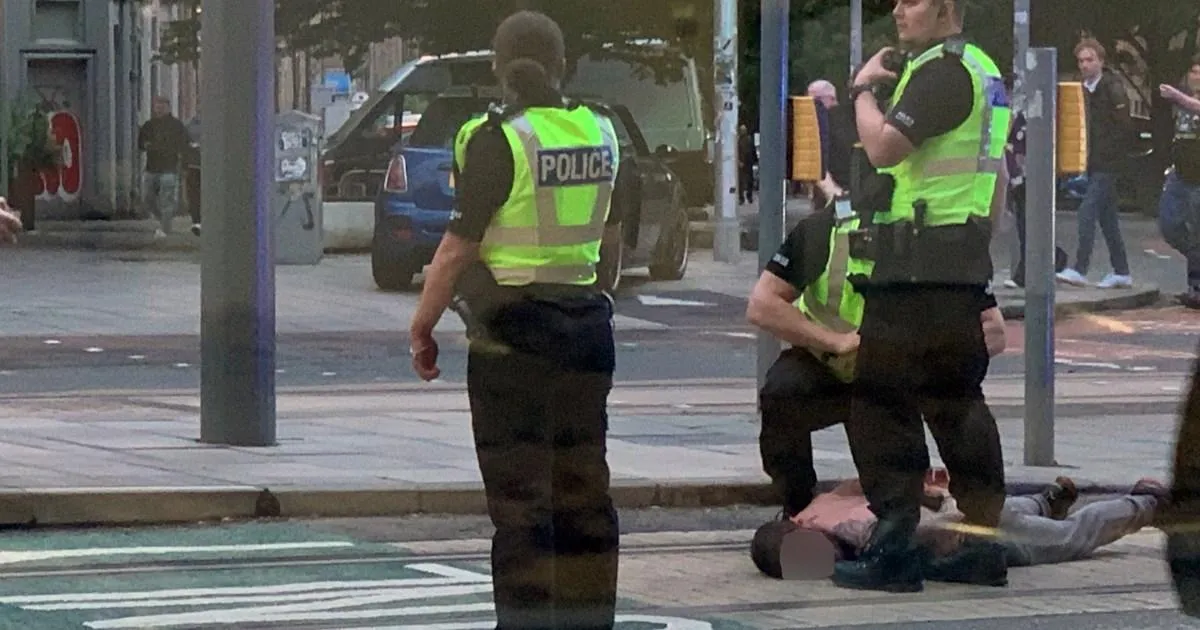
The recent wave of violence in Edinburgh has left a community shaken, casting a dark shadow over what should be the safety of our city streets. A series of deeply disturbing incidents unfolded as a man, reportedly topless and armed with two large knives, terrorized the public in an erratic, violent rampage. Among the harrowing accounts surfacing, one particularly chilling story involves a taxi driver who narrowly escaped death. As the suspect lunged forward, he hurled an axe through the driver’s window. It was only by mere instinct—a frantic, split-second movement of the car forward—that the driver avoided a fatal blow. This wasn’t merely a crime; it was an act of calculated chaos that sought to inflict terror on everyday people simply trying to go about their lives.
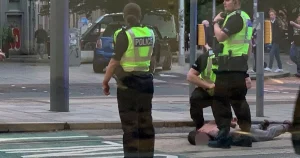
The brutality of the assault became even more apparent as details emerged about the victims. Two young men, who had only recently arrived in the city, were targeted shortly after leaving the Broomhouse mosque. As the suspect was finally subdued and pinned to the ground by police, witnesses heard him screaming vile, xenophobic rhetoric, claiming he was “protecting the country” while spewing hateful slurs against Muslims. This verbal aggression, coupled with the choice of victims, has left many to rightfully label this as a targeted act of hate. Police have confirmed that five men, ranging in age from 22 to 39, were injured during the spree, with three requiring hospital treatment. Thankfully, none of the injuries are believed to be life-threatening, but the psychological wounds inflicted on the community are likely to run much deeper.
In the aftermath, Daniel Gilius of MEND (Muslim Engagement & Development) highlighted the deep trauma now felt by local residents. He spoke not just of physical scars, but of the fear that now hangs over the city’s Muslim community. For those who had just arrived in Edinburgh or who have called the city home for years, these attacks feel like a direct assault on their sense of belonging. The incident stands as a stark reminder of the vulnerability of minority groups when extremist ideologies are allowed to fester in the shadows until they spill out into the streets, weaponized by individuals who believe they are acting on a twisted moral crusade.
Beyond the physical danger, a new front of hostility emerged online almost immediately. Shockingly, the horrific nature of the crime did not stop some social media users from hailing the perpetrator as a “hero.” This celebration of violence is perhaps the most sobering aspect of the entire affair. It speaks to a growing, toxic culture where far-right rhetoric is emboldened, and empathy is discarded in favor of radicalized echo chambers. The ease with which users can spew vitriol without consequence has become, in Gilius’s words, a tragic “part of daily life.” It highlights a systemic failure where social media platforms prioritize engagement and profit over the fundamental safety and dignity of the people they serve.
As the legal process begins—with a 36-year-old local man now charged—questions remain about how we allowed this strain of extremism to gain such momentum. Influential figures who frequently push anti-Muslim tropes are often quick to distance themselves once violent words manifest into real-world bloodshed, yet the connection is undeniable. We are watching a cycle where online radicalization inevitably bears fruit in our town squares and taxi cabs. The silence from some political corners, or the deliberate watering down of language when addressing far-right extremism, only serves to embolden those who feel justified in taking up axes and knives against their neighbors.
Ultimately, this tragedy in Edinburgh demands that we do more than just arrest the perpetrator. It requires a hard look at the social fabric of our society and the way we respond to hate both on the ground and on our screens. We cannot afford to become numb to these attacks, nor can we ignore the ideologies that drive them. As the community begins the slow process of healing and the victims continue their recovery, the city is left to grapple with a difficult reality: safety is not a passive state, but something that must be actively protected through our collective refusal to normalize hate, whether it is shouted in the street or typed behind an anonymous handle.