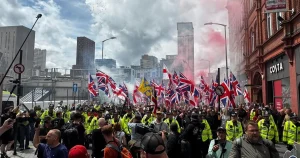

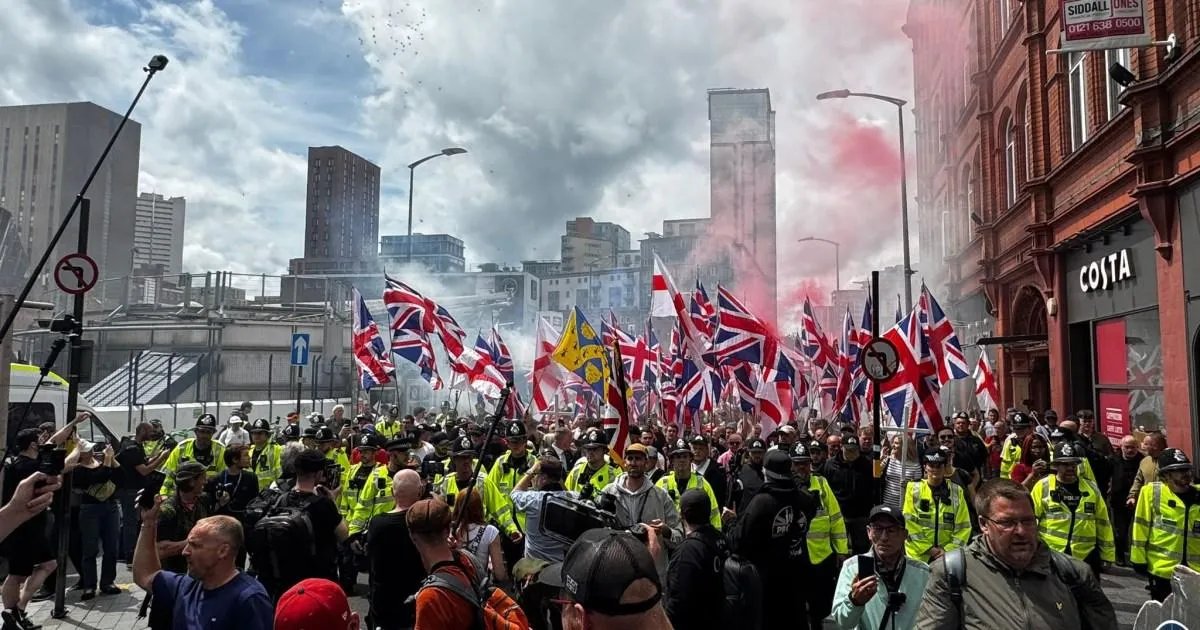
The quiet rhythm of a typical weekend in Birmingham was sharply interrupted yesterday as hundreds of Britain First supporters descended upon the city centre. With flares illuminating the sky and a sea of Union and St George flags rippling through the streets, the group made a pointed display of their presence. Their chants of “Engerland” echoed against the city’s historic architecture, creating a tense atmosphere that drew immediate attention from onlookers. As the marchers navigated the busy thoroughfares, the stark contrast between their nationalist slogans and the city’s usual atmosphere of bustling, multicultural life became a flashpoint for public disruption.
The scene grew increasingly volatile as the group attempted to move toward Victoria Square, only to be met by a formidable barrier of police officers. As they were diverted toward the Hill Street area, their movement triggered a fierce reaction from a large counter-protest that had been lying in wait. Members of the counter-demonstration, armed with placards, did not mince their words; they held signs explicitly accusing the Britain First marchers of cloaking racism in the guise of patriotism. For those caught in the city center, the air was thick with the friction of two fundamentally opposed visions of what Britain should represent.
At the heart of the march was Britain First leader Paul Golding, who used the platform to deliver an inflammatory message. Standing before his supporters, he claimed Birmingham as “our city” and voiced an aggressive call for the deportation of millions of foreign nationals. He framed his rhetoric around a narrative of grievance, insisting that his followers were “second-class citizens” who rightfully wanted to “take their country back.” These comments, broadcast to the crowd and eventually to the wider public, served as the primary catalyst for the day’s confrontations, further polarizing an already agitated crowd.
While the primary conflict remained between the two ideological camps, the city’s law enforcement faced the difficult task of preserving order. Assistant Chief Constable Sarah Burton, who oversaw the operation, played the role of the steady hand in a chaotic environment. In her post-protest assessment, she noted the delicate balance required to uphold the democratic right to dissent while maintaining public safety. By facilitating the march while preventing a complete breakdown of order, the police acted as a necessary buffer, though the images of the standoff served as a sobering reminder of the deep divisions currently testing the resilience of British society.
The political response from Birmingham’s leadership was swift and unambiguous. West Midlands Mayor Richard Parker did not hesitate to draw a line in the sand, declaring Britain First entirely unwelcome in the city. He argued that the group’s divisive and dangerous rhetoric stood in stark opposition to the core values held by the vast majority of Birmingham’s residents. His sentiments were echoed in a joint statement from the Liberal Democrats, the Green Party, and the Better Birmingham Independents, all of whom championed the city’s diversity as its greatest asset. For these officials, the day was not just a protest, but a test of Birmingham’s identity as a place where diverse communities live and work side by side.
Ultimately, the events of the day left a complicated imprint on the city. While the shouting has faded and the streets have returned to their normal routine, the underlying questions raised by the clash remain pertinent. Are these public displays a legitimate expression of political opinion, or an unwelcome assault on the multicultural fabric of our communities? As Birmingham reconciles the day’s events, the consensus among its leadership seems clear: the strength of the city lies not in the exclusion of others, but in the harmony of its many parts. For the residents of Birmingham, yesterday was a reminder that the conversation about who “belongs” in Britain is far from settled.