



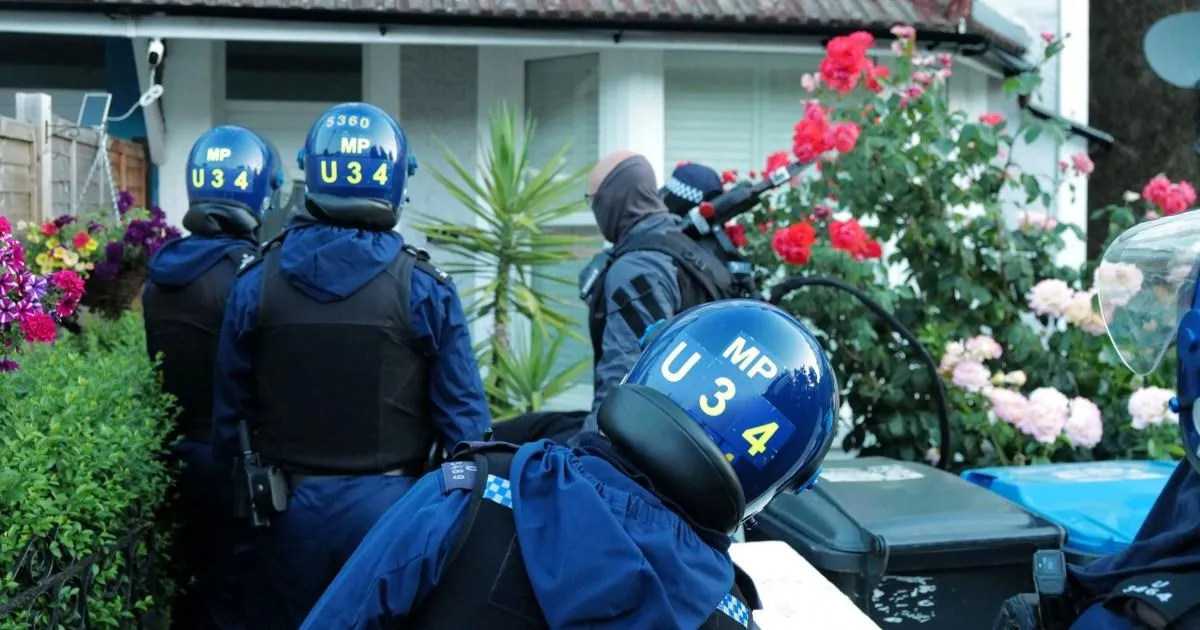
The early morning air in Mitcham, Merton, was thick with a tense, unnatural silence when the Metropolitan Police launched a series of coordinated dawn raids under the banner of Operation Haldor. As the clock struck 5 a.m., nearly 20 officers in full tactical gear—equipped with heavy-duty door rammers and glass cutters—surrounded a quiet suburban home. With its rose-lined garden and freshly painted white picket fence, the house looked like the epitome of peaceful domesticity. However, the scene quickly shifted from a quiet neighborhood tableau to a jarring reality. While the officers had braced for a forced entry, the door stood unlocked, allowing them to sweep inside with unsettling ease. The mission was clear: apprehend individuals suspected of supplying Class-A drugs, but the atmosphere was immediately complicated by the heart-wrenching sound of a child crying out for their mother from an upstairs window—a stark, human reminder of the collateral impact inherent in these high-stakes police operations.
The rationale behind such overwhelming force is not merely to handle petty street-level crime; it is a calculated, preventive measure aimed at preserving public safety during major capital events, specifically the upcoming Notting Hill Carnival. Inspector Kevin Chambers, who led the operation, emphasized that this was not a sweep for teenagers in possession of small amounts of cannabis. Instead, the focus was firmly on the “exploiters”—the entrenched, senior figures deep within London’s gang networks. By pulling these individuals off the streets before the festivities begin, the police hope to preemptively drain the violence that often plagues large public gatherings. As Inspector Chambers noted, the success of the morning is measured in the chaos they prevent, rather than just the number of handcuffs clicked shut.
Beyond the front-line arrests, the raids exposed the grim, everyday reality of life within these criminal circles. At a nearby property, a search revealed a blade as long as a forearm—a brutal “zombie knife”—tucked between the pillows of a futon where someone had been sleeping only moments before. Beside it lay a flick knife, brazenly left in plain sight. In total, officers recovered 16 weapons across multiple locations, including machetes and custom-modified knives designed with hidden compartments for smuggling drugs. The discovery of these makeshift armories highlights the dangerous, high-stakes environment in which these gang members operate, far removed from the safe, ordinary streets that surround them.
Perhaps the most tragic dimension of the morning was the revelation of how deeply gang culture infiltrates families. At one location, officers arrested both a mother and her son, underscoring the cyclical, generational trap of the criminal underworld. Inspector Chambers observed that this is a depressingly common pattern; many who begin their lives as victims of exploitation inevitably grow up to become the exploiters themselves. This cycle is not gender-specific, and the police are keenly aware that women are frequently drawn into the same web of criminality as their male relatives. Seeing a mother led away in handcuffs while the operation unfolded served as a sobering illustration of the human cost of these systemic gang issues.
The material haul from the operation was significant, with authorities seizing Class-A and Class-B substances valued at an estimated £27,000. However, for the police, the primary metric of success for Operation Haldor remains public safety. By securing strict bail conditions for those caught with weaponry—essentially barring them from attending the Notting Hill Carnival—the Metropolitan Police hope to create a bubble of security for the hundreds of thousands of people expected to celebrate in the streets. As Inspector Chambers put it, if their morning of work managed to keep these specific individuals away from the crowds, then the operation fulfilled its most vital objective, regardless of how complex the legal aftermath might be.
Ultimately, these raids serve as a window into the darker side of a city that prioritizes “peace for tomorrow” through “raid for today.” While the visuals of tactical teams and seized weaponry carry a certain intensity, the underlying narrative is one of a desperate attempt to curb violence by targeting the roots of criminal influence. It is a grueling, often messy task that inevitably impacts families, children, and quiet neighborhoods at the dawn of every day. In the end, the police are left to reconcile the immediate necessity of these arrests with the enduring struggle to break the cycles of exploitation that continue to define a segment of London life, aiming for a celebration that is defined by music and community rather than the presence of hidden blades.