



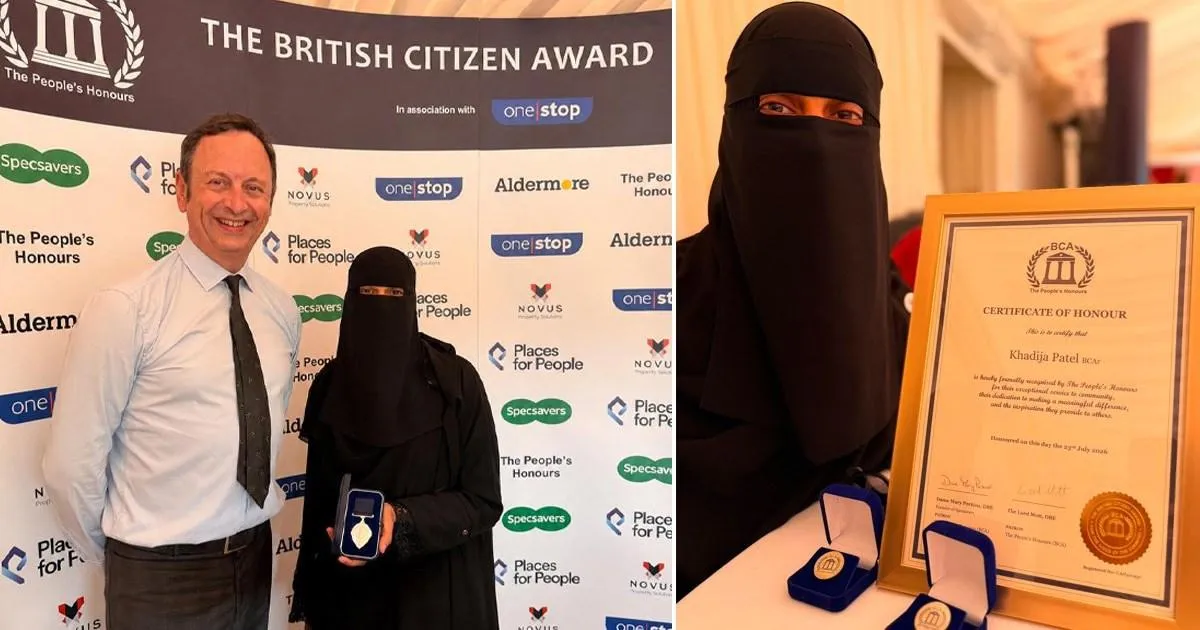
Khadija Patel, a dedicated 39-year-old volunteer from Bolton, recently found herself in the national spotlight after receiving the prestigious British Citizen Award at the Palace of Westminster. Honored for her tireless efforts in founding the KRIMMZ Youth Club, Khadija was celebrated for providing essential sports and emotional wellbeing programming to young people from ethnically diverse and underrepresented backgrounds. Throughout her career, she has been a pillar of her community, ensuring that youth who might otherwise be marginalized have a safe, inclusive space to thrive and grow. This award was meant to be a high point in a life dedicated to service, yet it quickly became the catalyst for an alarming and undeserved surge of vitriol directed at her personal life and religious choices.
The controversy erupted after photographs of the ceremony—showing Khadija wearing a niqab—began circulating on social media. Despite her long record of selfless service and her clear impact on the lives of local children, the focus of many online commentators shifted aggressively toward her clothing. Influential online voices and far-right activists used the image to launch a wave of Islamophobic attacks, baselessly arguing that a Muslim woman who chooses to veil cannot possibly be an agent of women’s empowerment. For these critics, the garment became a shield behind which they could hide their prejudice, choosing to fixate on her appearance rather than engaging with the tangible, positive work she has done on the ground in Bolton.
For Khadija, the backlash has been both deeply “upsetting” and enlightening regarding the state of public discourse. She has spoken out with grace, emphasizing that the niqab is a personal expression of her faith and identity that in no way hinders her ability to lead, mentor, or serve. She invites her detractors to look past the surface—to visit the youth club, witness the camaraderie during her sports sessions, and see the tangible confidence she fosters in the young girls she serves. Her message is one of resilience: she refuses to let the noise of online intolerance strip her of her agency or deter her from the work that truly matters. To her, her actions are the only metric that should define her success.
The criticism, however, went beyond her clothing to target the very nature of her work. Some skeptics attacked KRIMMZ Youth Club for hosting gender-specific sports sessions, which are a cornerstone of the club’s inclusivity strategy. These critics attempted to paint the practice of single-sex sports as an affront to British values. In response, Khadija has stood firm, explaining that the goal isn’t segregation, but rather creating an environment of comfort and accessibility. By providing female-only spaces, she has been able to bring in girls from various backgrounds—including many non-Muslims—who otherwise might not have felt safe or empowered to participate in physical activity. For these young people, the environment is not a barrier; it is an open door.
The chorus of hate has been met with strong support from those who recognize the genuine impact of her contributions. Lord Mott, the patron of the British Citizen Award, publicly condemned the abuse, affirming that Khadija’s work in building resilience and a sense of belonging is a textbook example of the community commitment the award was created to honor. He stressed that there is absolutely no place for harassment based on faith or clothing choices. His defense highlights a vital truth: that those who work in the trenches of social service, creating opportunities for the next generation, deserve to be judged by the lives they improve rather than by the personal choices they make regarding their attire.
Ultimately, Khadija’s story is a sobering reflection of the challenges faced by diversity in modern Britain. Despite the hate, she remains committed to her vision of a community that celebrates differences rather than weaponizing them. She continues to advocate for a society where one can be unapologetically themselves while relentlessly serving those in need. By refusing to retreat, she is teaching the young women in her care a far more powerful lesson than any lecture on confidence: that their identity, their faith, and their choices belong to them alone, and that true empowerment comes from the courage to continue doing good in the face of fear and prejudice.