


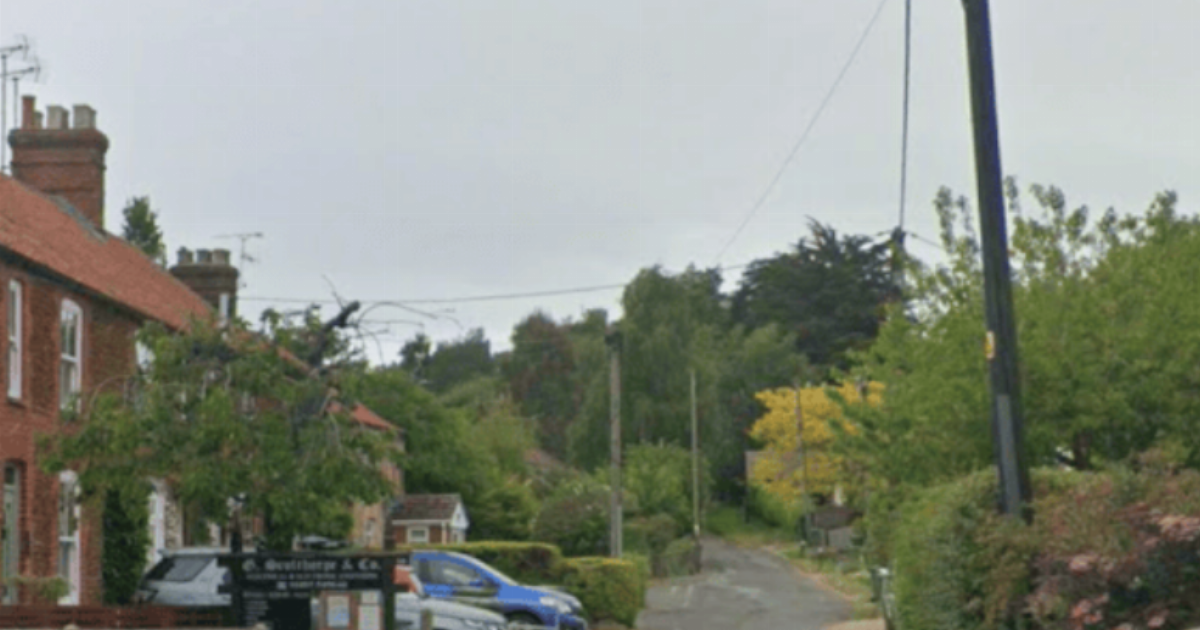
Fern Hill, Dersingham, is not the kind of address that normally appears in news bulletins. It sits on the quieter edge of the Sandringham Estate, a corner of rural Norfolk where the days are measured in small, unhurried rhythms: the delivery van making its rounds, the postman nodding at a familiar face, the light fading early over flat fields and frosty gardens. This is a place where people choose to live for the calm, for the space, for the sense that the world is a little slower and a little safer than the one they left behind. But in the early hours of Sunday morning, that safety was shattered. A home on Fern Hill became the scene of something no one in the village could have prepared for. Paramedics were called after concerns were raised for the welfare of a woman inside the property. The call was urgent, but what they found was worse than they could have feared. A woman in her 40s lay critically injured. The ambulance crew, trained for emergencies, knew immediately that this was no ordinary medical episode. The police were called, and, soon after, a man in his 40s was arrested on suspicion of murder. The woman’s life could not be saved. By daylight, where there had once been a quiet family home, there was a cordon, a police presence, and a community reeling from the knowledge that something unspeakable had happened just a few doors away.
The details released so far have been deliberately sparse, as they always are in the early hours of a major investigation. What is known is that the emergency services were called to the property on Fern Hill in the early hours of Sunday. The ambulance service, having found the woman gravely injured, alerted the police, who took the scene seriously from the very beginning. A man in his 40s was quickly arrested on suspicion of murder and taken to King’s Lynn Police Investigation Centre, where he was held for questioning. He remains in custody as the investigation moves forward, and a police cordon is still in place around the property. This is not a scene that can be cleared quickly. The house is now a forensic site, every surface, every object, every trace of movement being examined by specialists who are trying to reconstruct the final moments of a life. A Home Office post-mortem will be carried out on Monday to determine the woman’s exact cause of death. For her family, those hours between the discovery and the formal identification will be almost unbearable. For the investigators, they will be crucial. The woman was found in a place where she should have been safest, in the small hours when the rest of the world was asleep. Whatever happened within those walls, it has left a mark not only on a household but on the entire village.
The official language of a police investigation can feel cold, but beneath it lies a very human story. Detective Inspector Alix Wright, of the Norfolk and Suffolk major investigation team, has spoken publicly in that careful, measured way that detectives use when a case is still forming. “We are in the very early stages of this investigation working to establish the exact circumstances surrounding the woman’s death,” she said. “I’d ask anyone who believes they may have information that could help our investigation to please share this with us.” The appeal is simple, but it carries a quiet urgency. Somewhere in Dersingham, or perhaps further afield, there is someone who saw something, heard something, or has a piece of information that could unlock this case. It might be a split-second glimpse of a car leaving the street too quickly. It might be an overheard argument that did not seem significant at the time. It might be a worry that a friend or neighbour had shared in recent days. The police are asking people to sift through their own memories and come forward with anything that could matter. They are not looking for certainty or for people to make judgments; they are looking for fragments that, pieced together, might explain how a woman in her 40s ended up dead in her own home on a Sunday morning.
For the residents of Dersingham, the shock will not be easily absorbed. This is a village that has watched the seasons turn without much drama, famous mainly for its proximity to the royal estate and for the kind of peace that city dwellers dream about. When something like this happens, it does not just disrupt the immediate street; it unsettles the whole idea of the place. People who have lived there for years will look at the house behind the police tape and remember that they had waved to someone in that garden, or passed someone on the pavement, without ever knowing what was really happening behind closed doors. That is part of the horror of such events: not simply the violence itself, but the reminder that our neighbours’ lives are mysteries to us. The woman was in her 40s, an age at which life is supposed to be full and complicated in ordinary ways, full of work, family, plans, small problems, and quiet hopes. She was somebody’s child, perhaps somebody’s parent, somebody’s friend, somebody’s reason to get up in the morning. The police have not released her name, and until they do, she remains anonymous to the public. But anonymity is not the same as absence. Her loss is already being felt in ways the public will never fully see, in phone calls that are being made, in doors that will not open again, in a place at a table that will be empty.
There will be a natural temptation to speculate about what happened inside that house. Was this a sudden act of violence, an argument that spiralled out of control, or something more calculated and cold? The truth is that none of that is known yet. What can be said, without any speculation at all, is that this is another sobering reminder of a wider tragedy. Every year, in towns and villages across the country, women are killed in their own homes, often by men they knew, often in circumstances that left family and friends stunned. The statistics are grim and familiar, but each case is not a statistic; it is a woman with a name, a history, and people who loved her. It is a house that will stand silent, a street that will carry the memory, a community that will struggle to make sense of something senseless. The investigators will spend weeks, perhaps months, piecing together the events of that night. They will examine phone records, digital footprints, any previous reports of distress, and the evidence found in the home itself. They will speak to witnesses and reconstruct the woman’s last days, not because that will bring her back, but because the truth matters. It matters to her family, who deserve more than a closed file. It matters to the public, who need to trust that justice is being pursued. And it matters even to the man in custody, who remains, for now, innocent until proven otherwise.
In the meantime, the village is left to hold its breath. Police cordons do not come down quickly. The forensic examinations will continue, the post-mortem will be completed, and the legal process will begin to move through its own slow and careful stages. For now, the practical appeal is straightforward. Anyone with information is asked to contact Norfolk Police on 101, and the detective inspector’s words hang in the air as a quiet plea. A small detail that might seem irrelevant could turn out to be the one that matters. That is the strange alchemy of an investigation like this: a stranger’s half-remembered observation can become the key to a family’s understanding of how their loved one died. But beyond the police work, there is something more human required too. There is the need to grieve, to support the people closest to the woman, and to resist the urge to turn her death into gossip or cold news. She was not just a body found in a village near the Sandringham Estate. She was a person who deserved to grow old, to laugh, to make memories, and to live out whatever ordinary life she had been building. Instead, her life ended in the early hours of a Sunday, in a place where she should have been safe. The road outside her home will return to normal eventually. The police tape will be taken down, the officers will leave, and Fern Hill will look much as it always did. But the quiet will feel different now. It will be the quiet of a place that has lost something irreparable, a silence that carries the weight of an unanswered question. Until that question is answered, the community, and the family, can only wait.