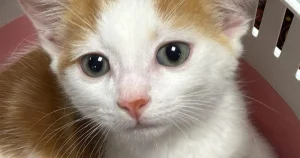


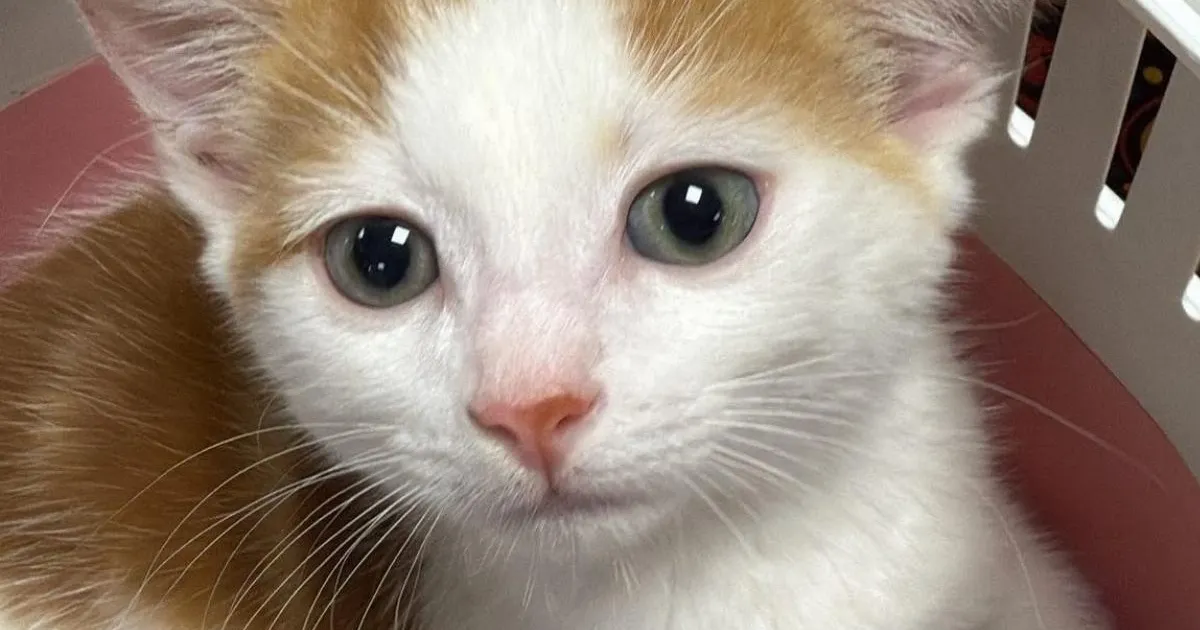
The evening rush at Camden Town Underground station was a blur of hurried footsteps, rumbling trains and the low thunder of London traffic. Commuters streamed past street traders and buskers, heads down, eager to get home after another long day. Then a voice cut through the noise. “Free kitten,” someone called out, almost casually, as if offering a free sample or a lost umbrella. It was an odd phrase to hear in such a place, and it stopped Chloe Eves in her tracks. A 29-year-old voice actor from Birmingham, Chloe had been working in London for the day and was making her way back to her hotel when she spotted the scene. There, on the pavement outside the station, was a small cardboard box. Inside sat a tiny ginger-and-white kitten, no more than two months old, blinking up at the world with wide, uncertain eyes. The man beside the box seemed indifferent, and passers-by mostly ignored the animal or paused for only a moment before walking on. No one was asking where the kitten had come from, whether it had been fed, or who would take responsibility for it. For Chloe, the sight was a collision of opposites: the cold, chaotic energy of a city station and the small, fragile warmth of a creature that clearly deserved better. She had not planned to adopt a cat. Her life, split between cities and jobs, was not arranged around pet ownership. But as she stood there, she felt a sudden surge of protectiveness. Her mind, she later said, was racing with fear that the kitten would be abandoned or taken in by the wrong person. In that moment, a decision formed. “I’ll take him to a vet and pay any fee,” she told herself, “if it means he goes to a good home.” It was an impulsive act of compassion, and perhaps the only rational response to a situation that felt deeply wrong. The kitten mewled softly, unaware that its fate was hanging in the balance. Around them, the station continued to churn, indifferent and noisy. But for one stranger, this tiny animal’s story was about to change.
With the kitten cradled against her chest, Chloe left Camden Town. She could feel its heart hammering beneath her fingers, a rapid, panicked beat that quickened whenever a bus roared past or the station doors hissed open. There was no time to worry about hotel pet policies or the practicalities of carrying a stray cat through London. All that mattered was finding help. She found a veterinary practice willing to see the little animal, and she paid for the consultation herself. The vet examined the kitten and confirmed what Chloe had hoped: he was young and surprisingly healthy, perhaps a little underweight, but without obvious injury or disease. He was estimated to be about eight weeks old. It was still a precarious start in life, but now he had a chance. Chloe named him Camden, after the place where he had been found, as a way of honouring the strange and stark beginning of his story. The name also felt like a small gesture of permanence for a cat who had, until that afternoon, belonged to no one. From the vet’s office, she contacted the Blue Cross, a charity with a hospital in Victoria that could take him in and prepare him for adoption. They had space, and they had expert care. So Chloe carried Camden through the evening streets, talking to him in a low, soothing voice, telling him he would be all right. Later, she remembered how sweet, friendly and adorable he was. She knew the Blue Cross team would look after him and find him a loving home. At the hospital, she handed him over with a mixture of relief and reluctance, like someone passing a fragile package to a courier and hoping it would reach its destination safely. Then she stood for a moment and watched him disappear into a brighter future. She had done what she could. Now it was up to the charity to finish the rescue.
Inside the Blue Cross hospital in Victoria, Camden was welcomed into a world of clean kennels, warm blankets and patient, experienced caregivers. The staff gave him another thorough examination, this time looking for the kind of hidden issues that may not be obvious to a rescuer’s untrained eye. He was not microchipped, which was unsurprising for a kitten given away on a street corner, but it meant there was no way to trace his origins. His previous owners, whoever they were, had either never bothered to protect him or had deliberately cut all connection. The charity began the routine process of flea and worming treatment, ensuring he was free of parasites and strong enough to meet potential adopters. Slowly, Camden began to relax. The little cat who had been displayed like an unwanted object was now being treated as a life worth saving. Staff noted his affectionate nature, the way he would rub against their hands and purr when spoken to. He had a habit of watching the door, as if waiting for someone, and then he would curl up on a soft blanket and sleep the deep, easy sleep of an animal who no longer needed to be on guard. His story could have ended very differently. But because a stranger chose to act, he had been given a second chance. The Blue Cross has spent more than a century helping sick, injured and homeless pets, and its hospital in Victoria is one of the places where those second chances become real. The charity would now search for a home where Camden would never again be left at a busy station for anyone to claim. In the meantime, his presence served as a small reminder of the many animals who arrive in similar circumstances. Every kitten taken in means a bed filled, a fund stretched, and an uncertain wait for an adopter. But the staff saw in Camden something worth fighting for.
Camden’s rescue comes at a deeply troubling time for animal welfare. The Blue Cross has reported a stark increase in abandoned kittens, with the number handed to the charity this year already 15 per cent higher than the same period last year. Behind that statistic are thousands of tiny lives being surrendered in carrier boxes, left in hedgerows, or given away outside train stations. The cost-of-living crisis has changed the landscape of pet ownership. Every aspect of caring for an animal, from food and litter to insurance and veterinary bills, has become harder for families already struggling to heat their homes and put food on the table. The Blue Cross warns that some owners are so pressed for money that they are skipping neutering procedures altogether, a short-term saving with long-term consequences. Unneutered cats produce accidental litters, and those litters then become a burden no one can afford. In a cruel twist, some people have turned to breeding cats deliberately, hoping to sell the kittens for extra cash. But with fewer buyers willing or able to spend, these kittens often end up unwanted. They are advertised online, passed from hand to hand, or simply abandoned. The “free kitten” outside Camden Town station was not an isolated incident but a symptom of a wider crisis. Every rescue organization in the country is feeling the pressure, and the animals are the ones who pay the price. When owners cannot or will not take responsibility, it falls on charities like the Blue Cross to pick up the pieces, often with limited resources and endless demand. The charity’s message is clear: neutering is not optional, and help is available for those who ask. But too often, people wait until it is too late, and another litter of kittens is born into a world that no longer has room for them. Camden was lucky. Many are not.
Amanda Rumball, London welfare officer at Blue Cross, spoke of the rescue with gratitude and sadness. “We’re so grateful to Chloe for bringing little Camden to us, as who knows what might have happened to him,” she said. “Sadly there are many more out there who may not be so fortunate. We are urging anyone who is struggling to care for any animal, or who has an unwanted litter, to seek help as soon as possible from a charity like Blue Cross.” Her words carry an undercurrent of grief for all the animals who never reach a vet or a shelter. They are the kittens left too long in cold weather, the cats abandoned in locked flats, the litters dumped at the side of a road. The Blue Cross cannot save them all, but with every call from someone who is struggling, every surrendered litter, and every rescued stray, it can change one story at a time. The charity would rather receive a difficult phone call than find an animal in a bin. It would rather help a family reduce costs than see the family pet abandoned. The message is simple: ask for help early, and do not judge. For Chloe, the memory of Camden’s tiny paws and trusting eyes will not fade soon. She gave him a day of kindness, and in doing so she may have given him a lifetime. Her own life went back to normal the next morning, back to voice-over work and train journeys. But somewhere in London, a ginger-and-white kitten was sleeping safely, because she had paused when no one else did. That is the quiet heroism of animal rescue: not a grand gesture, but a single decision to stop and care. It is the kind of courage that often goes unseen, but it changes the world for one small creature at a time.
Now Camden is waiting. The two-month-old kitten, named after the north London neighbourhood that was almost his undoing, has been given a clean bill of health and is being prepared for adoption. The Blue Cross will look for a family that can offer him a stable and loving home, with an understanding of the responsibility that comes with a living creature. They will ask questions, run checks and match him carefully, so that he never again ends up on a street corner. When the right people come along, Camden will leave the hospital in Victoria and begin the rest of his life. He will probably never remember the noise and confusion of Camden Town station, or the stranger who picked him up. To him, it will simply be the day his luck turned. But for everyone who hears his story, it is a reminder of how fragile an animal’s existence can be. It is also a reminder that compassion is contagious. Chloe’s decision to intervene changed one kitten’s fate, and her story might inspire others to act when they see an animal in danger. The Blue Cross hopes that the public will continue to support its work, whether through donations, adoption, or simply spreading the word. And for those who can no longer care for their pets, the message is to reach out before desperation takes over. There is no shame in asking for help. The shame lies in leaving a creature to fend for itself. Camden will soon know warmth, love and safety. That is the ending this story deserves. But the crisis does not end with him. There are more kittens, more cats, more animals in need of a second chance. Perhaps the next one will be found by someone who, like Chloe, decides not to walk away.