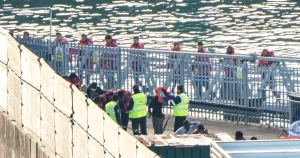

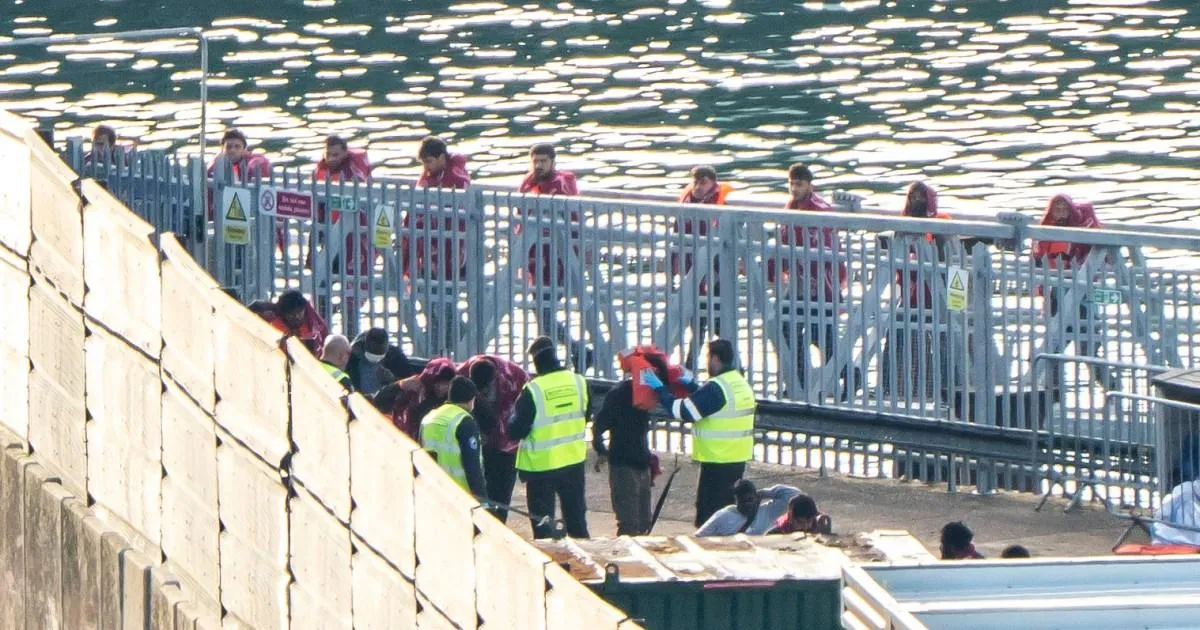
The evening air along the Hampshire coast was thick with tension and the bitter taste of salt. At Gosport docks, a crowd had gathered, their faces set in hard lines of anger, their voices rising in ugly, rhythmic chants. Among them were children, small figures clutching flags that read “Stop the boats,” their presence a jarring and heartbreaking contrast to the fury swirling around them. As ambulances approached with lights flashing, the crowd surged forward, forming a human blockade. They were trying to stop a rescue operation—trying to prevent a dinghy carrying around 120 people from landing on British soil. Those on board had crossed the English Channel from France, setting off from near Utah Beach in Normandy that morning, a journey that for many would be the final leg of a desperate flight from war, poverty, or persecution. But here on the dock, there was little thought of their stories, only of stopping them. Police moved in to clear a path, and scuffles broke out. Shouts of fury rang out, mixing with the wail of sirens. The protesters filmed themselves, proud of their blockade, while the dinghy remained out at sea, shadowed by French coastguard and rescue vessels, slowly moving toward the Channel boundary line. It was a scene that captured the bitter divide at the heart of Britain’s migration debate—a confrontation not between nations, but between neighbours, with the lives of vulnerable people hanging in the balance.
To understand the weight of that evening, one has to imagine the people on the boat. They were not statistics or political symbols; they were human beings, likely exhausted, cold, and terrified after hours at sea. The dinghy was reported to have set off from the Normandy coast near Utah Beach, a place forever associated with D-Day and the fight for freedom, yet now the starting point for a different kind of perilous journey. French media said around 120 people were crammed aboard, a fragile vessel bobbing in the dark waters of the English Channel. HM Coastguard said it was liaising with French authorities about the small boat within French waters, south of the UK central south coast. Ship tracking data showed the dinghy being shadowed by rescue vessels, moving slowly toward the boundary line between French and British waters. Departures as far west as Normandy have been rare in recent years, but this was the third such crossing in the space of a month—a sign that smugglers are adapting, finding new routes, and pushing people to take even greater risks. The previous September, British rescue boats had collected the passengers of a migrant dinghy that had spent around 30 hours at sea after setting off from Normandy. Fifty-one people, who had refused help from the French coastguard, arrived in Dover after being transferred to Border Security Command boats. Thirty hours. Imagine being packed into a small inflatable boat for thirty hours, with no certainty of rescue, no safe harbour, only the endless grey sea and the hope that someone, somewhere, might let you in.
Back in Gosport, Hampshire Police were caught between two impossible duties: protecting the safety of local communities and facilitating peaceful protest. As the crowd grew, officers deployed to the area to support partner agencies in the event of an emergency at sea. They made six arrests on Sunday evening, using a variety of police powers, including the authority to arrest protesters wearing masks or trying to leave the car park that had been established as the protest area. A spokesman said they were aware of the group gathering and were working to ensure safety, while also making clear that failure to comply with conditions was a criminal offence and could result in arrest. The government’s Border Security Command, meanwhile, was said to be working around the clock to monitor the Channel and protect the border, with a spokesperson insisting it was vital to continue to detain, check, and process every small boat arrival. But on the ground, the situation was messier and more human than any official statement. Hampshire Reform UK councillor George Madgwick shared images of coaches and police on social media, saying they were in the Fareham area, ready for a small boat due to land locally. His posts framed the arrival as an invasion to be managed, not a crisis of humanity to be met with compassion. The protesters, some calling themselves patriots, saw themselves as defenders of the nation. But what does it mean to defend a nation by blocking ambulances? What message does it send to the children standing in that crowd, watching adults scream obscenities at rescue workers and police? They were learning a lesson that day—not about borders, but about cruelty, and about how fear can twist love of country into something unrecognisable.
The hostility was not confined to the English coast. Activists were also seen in Normandy, telling migrants waiting on the beaches that they were not wanted in the UK. A group of British men were seen backing away when they were pelted with sand—a strange, almost absurd image of self-appointed guardians of the border retreating from the very people they had crossed the sea to confront. There is a deep irony in travelling to another country to tell desperate people they are unwelcome, only to find yourself driven back by their anger. But the moment also reveals the ugliness of the broader movement: it is not just about policy or security, but about making people feel hated. The migrants waiting on those beaches had already endured so much—journeys across continents, exploitation, violence, the loss of everything they owned. To be met with more hostility, not only in France but also across the water, must have been devastating. Yet they kept trying. They boarded flimsy boats, risked drowning, and faced the cold indifference of the sea because the alternative—staying where they were—was even worse. That is the reality that often gets lost in the shouting and the flags. These are not faceless intruders; they are people with names, families, dreams, and traumas. They are fleeing wars that our own governments have sometimes helped to fuel, and seeking safety in a world that increasingly tells them there is no room. The children in Gosport, waving their “Stop the boats” flags, may grow up to see those same faces on the news and feel nothing. But the children on the boats, if they survive, will grow up with the memory of being treated as less than human.
The statistics are stark, and they frame the scale of the challenge. The provisional total for Channel crossings this year is 19,451. That is down 43% on the same time last year and 23% below the figure at this stage in 2024. On paper, that looks like progress, a sign that deterrence and enforcement are working. But every number is a person. Nineteen thousand four hundred and fifty-one people have made it across one of the busiest shipping lanes in the world in small boats, often in appalling conditions. Thousands more have been intercepted, returned, or lost. The decrease is real, but so is the desperation that drives people to keep coming. The government’s Border Security Command says it works around the clock to monitor the Channel and protect the border, and there is no doubt that the work is difficult and necessary. But a border is not just a line on a map; it is a symbol of a society’s values. When we see a boat of 120 people approaching our shores, we can choose to see a threat, or we can choose to see a group of human beings who have risked everything for a chance at life. The protesters in Gosport chose the former. The police, to their credit, tried to maintain order while allowing peaceful protest, but the atmosphere was charged with a hostility that no amount of policing could fully contain. The ambulances were eventually able to get through, but the emotional damage was done. Images of children screaming at rescue workers, of adults forming blockades to stop people from being saved, will linger long after the boats have been processed and the headlines have faded.
What does it mean to be human in the face of such division? Perhaps it means pausing before we judge, and remembering that the migrants on those boats are not so different from us. They love their children, fear death, and hope for a better tomorrow. They are not asking for special treatment; they are asking for safety. The protesters, too, are human—frightened by change, anxious about resources, worried about the future of their communities. But fear does not justify cruelty, and frustration does not excuse blocking ambulances. The real solution lies not in shouting matches on the docks or in hostile patrols on foreign beaches, but in addressing the root causes of migration—conflict, poverty, climate change, and inequality—while creating safe, legal, and humane routes for those who need protection. It lies in treating every person with dignity, even when we disagree about policy. The children in Gosport deserve to grow up in a country that is proud of its compassion, not one that celebrates the humiliation of the vulnerable. The migrants on the boats deserve to be met with kindness, not sand and screams. And the society we build together will be judged by how we treat the stranger at the gate. The sea does not discriminate; it does not care about flags or politics. It only offers a choice: we can let fear drown our humanity, or we can reach out a hand and pull each other ashore. On that Sunday evening in Gosport, too many chose fear. But it is not too late to choose differently—to remember that every boat carries a human story, and every story deserves to be heard.