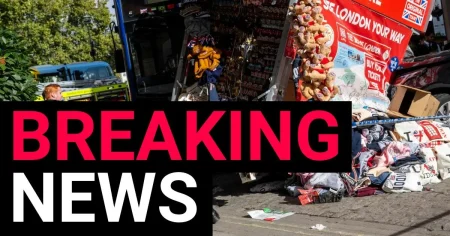

In the quiet, pre-dawn hours of what seemed like an ordinary morning, the familiar hum of the A66 near South Bank in Middlesbrough was shattered by a catastrophic event. It was around 3:39 a.m. when a police vehicle and a Volkswagen Passat collided on the westbound carriageway, a stretch of road normally busy with commuters and freight traffic later in the day but eerily still at that hour. The impact was severe enough to claim multiple lives, leaving a community in shock and emergency services scrambling to respond to an incident that would close a major artery in both directions for hours. The news broke quickly, but with it came the agonizing reality that several families were about to receive the worst possible news. For those living nearby, the sight of flashing lights and the sound of sirens in the dead of night was a jarring reminder of how fragile life is, and how a routine journey can turn tragic in an instant. The A66, a critical route connecting the region, was suddenly transformed into a crime scene and a place of mourning, with authorities blocking off access between Normanby Road and Church Lane in Eston as they began the painstaking work of piecing together what happened. No names had been released, no official confirmation of the victims’ identities, leaving a void of uncertainty that hangs heavily over the community. For now, the only facts are stark: a collision involving a police car and a Volkswagen Passat, multiple fatalities, and a road that remains closed as investigations unfold. The silence of the early morning has been replaced by a collective gasp of grief, as residents wake up to the news and try to comprehend the scale of the loss.
Cleveland Police, the force responsible for the area, swiftly issued a statement that confirmed the worst fears of anyone hearing the news. A spokesperson described the scene in sobering terms: “Around 3.39am this morning, a collision took place involving a police vehicle and a Volkswagen Passat on the A66 in South Bank. Sadly, the collision has resulted in multiple fatalities. There are significant emergency vehicles on the scene, and the road will remain closed for some time. The public are asked to use alternative routes.” The language is clinical, as it must be in the immediate aftermath of a tragedy, but the weight behind those words is immense. Multiple fatalities means more than one life lost, more than one family shattered, more than one future erased. The spokesperson went on to say, “We are working to identify the victims and contact their families. This is a quickly evolving incident and we ask that members of the public respectfully avoid speculation.” That final plea is crucial, because in the age of social media, rumors and conjecture can spread faster than facts, causing additional pain to grieving families and complicating the work of investigators. The police are not just managing a scene; they are managing the delicate process of informing loved ones, coordinating with coroners, and ensuring that every detail is handled with care. For the officers involved, this is also a deeply personal and traumatic event, as they are part of the same force as the police vehicle that was involved. The emotional toll on first responders, who must continue working while processing their own shock, cannot be overstated. They are trained to handle emergencies, but nothing fully prepares anyone for the aftermath of a fatal crash, especially one involving their own colleagues.
Meanwhile, the Cleveland Fire Brigade also responded to the scene, issuing its own advisory to the public. “Cleveland Fire Brigade are currently attending a road traffic collision on the westbound carriageway of the A66 south bank area. Please avoid the area if you can,” the service said. Their presence, along with paramedics and police, underscored the seriousness of the incident. Fire crews are often the first to arrive at severe collisions, working to extricate trapped individuals and make the scene safe for others. Their involvement suggests that the crash was not a minor fender-bender but a high-impact event that required specialist equipment and coordinated rescue efforts. The decision to close the A66 in both directions, not just the westbound carriageway where the collision occurred, indicates the need for a thorough forensic investigation. Accident investigators would have been called in to measure skid marks, photograph debris fields, examine vehicle damage, and reconstruct the sequence of events leading up to the crash. It is meticulous, slow work, and it requires the road to remain sealed off, causing significant disruption to commuters and local businesses. But that disruption is a small price to pay for answers, especially when lives have been lost. The closure also allows emergency services to operate without the added danger of passing traffic, a critical factor when firefighters and police are working in close proximity to a hazardous scene. News of the crash quickly spread beyond the immediate area, and the Independent Office for Police Conduct (IOPC) was contacted for comment, as is standard protocol in any incident involving a police vehicle and a fatality. The IOPC’s involvement signals that the investigation will be independent and transparent, ensuring that the public can have confidence in the findings, whatever they may be.
At the heart of this tragedy are the victims, whose identities have not yet been publicly confirmed. That confirmation process is a delicate and deeply emotional one. Before any name is released to the media, police must be absolutely certain of the identification, usually through formal procedures involving family members, fingerprints, dental records, or other means. They must also find the next of kin and inform them in person, a task that no officer ever wants to undertake but one that is done with as much compassion as possible. For the families, the period of waiting is a kind of purgatory. Some may already have a sinking feeling, a sense that something is terribly wrong when their loved one does not answer the phone or come home. Others may still be blissfully unaware, living a few more hours of normalcy before their world collapses. The police appeal for the public to avoid speculation is especially important during this time. Unconfirmed names and photographs often circulate online within minutes of a tragedy, and if those are wrong, they can cause immense harm. A family might see a stranger’s name attached to the crash and briefly believe it is their son or daughter, only to later learn the truth. Or worse, they might see the correct name but have to find out through social media rather than from the officers who are trying so hard to reach them. The coming days will bring more clarity, but they will also bring the unbearable task of mourning. Funerals will be planned, eulogies written, and memories shared. For the community of South Bank and the wider Teesside area, there will be a shared sense of sorrow, as the loss of even one person in a crash is felt by many, but the loss of multiple people resonates even more deeply. The victims were someone’s parents, children, partners, friends, and colleagues. They had lives filled with dreams, routines, and relationships that are now forever altered.
This collision also raises broader questions about road safety and the inherent dangers of emergency vehicles responding to incidents. Police cars, like all vehicles, can be involved in accidents, but when they are, the scrutiny is intense. The public rightly expects the highest standards from those who are tasked with protecting them, and when something goes wrong, there is a demand for accountability. The IOPC will examine whether the police vehicle was responding to an emergency, whether its speed was appropriate for the conditions, whether the driver had received proper training, and whether any policies were breached. But it would be premature to draw any conclusions before the investigation is complete. What is clear is that this is not a statistic or a headline; it is a human tragedy. Every year, hundreds of people lose their lives on UK roads, and each one is a devastating loss. This particular incident is made more complex by the involvement of emergency services, but the grief is the same. The families of the victims are not just dealing with the sudden absence of a loved one; they are dealing with a legal process, media attention, and questions that may never be fully answered. They will need support, not just in the coming days but in the months and years ahead. Grief is not linear, and the shock of a sudden, violent death can leave scars that never fully heal. Counselling services, support groups, and the kindness of friends and strangers will be essential. The wider community, too, will need to come to terms with what happened, especially those who live near the A66 and may have heard the crash or seen the aftermath. Trauma can be collective, and the sight of emergency vehicles and closed roads can linger in the mind.
As the investigation continues, the road itself will eventually reopen, and traffic will flow again as if nothing happened. But for the people affected, life will never be the same. The coming days will bring more details, perhaps a statement from the families or a candle-lit vigil in memory of the victims. The police will continue their work, and the IOPC will release its findings in due course. In the meantime, all we can do is hold space for those who are suffering, resist the urge to speculate, and trust that the authorities are doing everything they can. This is also a moment for reflection on our own mortality and the preciousness of every moment. We get into our cars, drive to work, run errands, and assume we will return home safely. Most of the time, we do. But occasionally, fate intervenes, and we are reminded of how little control we truly have. For the families of the victims, that reminder has come in the most brutal way possible. They will spend the rest of their lives wondering what might have been, wishing they had one more conversation, one more hug, one more ordinary day together. No investigation can bring back the loved ones they have lost, no findings can undo the pain. But perhaps the best outcome of this tragedy is that it brings us closer together, as a community and as a society. We can learn to be more patient with one another, more aware of the risks we take, and more grateful for the people in our lives. We can honor the memory of those who died by living with greater kindness and compassion. And we can keep their families in our thoughts, offering whatever support we can, whether that is a word of comfort, a donation to a memorial fund, or simply the respect of giving them space to grieve. The A66 in South Bank will always be associated with this tragedy, but it can also be a place where a community came together, where strangers offered comfort to strangers, and where the loss of life was met with an outpouring of love. That is the human response, and it is the one that matters most.