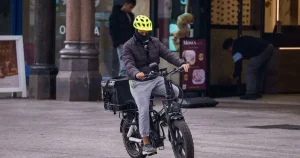


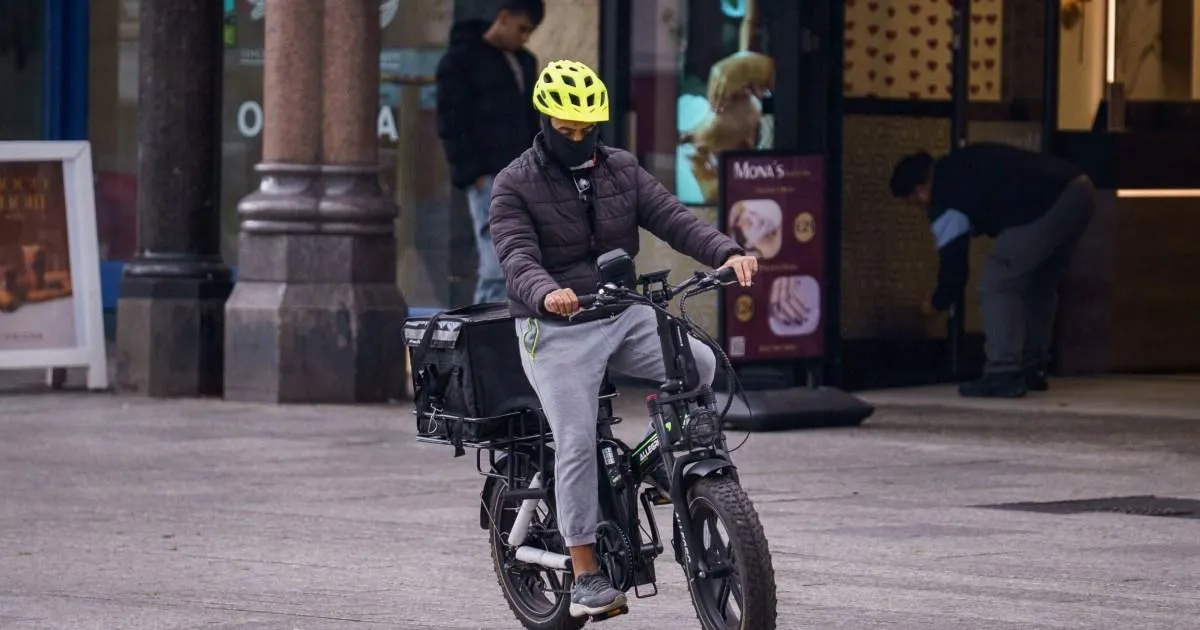
On a crisp Tuesday morning in Nottingham, the city’s Market Square began to fill with the familiar sounds of daily life: the rumble of delivery vans, the chatter of early commuters, and the clatter of café shutters being raised. But this was no ordinary day. Hours earlier, a pioneering new law had quietly come into force, making Nottingham the first major UK city to introduce specific powers aimed at banning balaclavas and other face coverings in the fight against crime and anti-social behaviour. The mood was cautiously hopeful. Council leaders had spent months listening to residents, tabulating responses, and promising that something would finally be done. Yet almost as soon as the rules went live, reality delivered a sharp, mocking twist. Photographers captured several men on bicycles riding through the very heart of the city, their faces still hidden beneath dark balaclavas, their movements casual and unbothered. The images spread quickly, prompting a mixture of frustration, cynicism and even dark amusement. Here was a measure designed to reclaim the streets, and within hours the streets seemed to answer back. The cyclists were not necessarily committing a crime by simply wearing the balaclavas, but their presence in the public eye, in the immediate aftermath of the ban, felt like a deliberate challenge to the entire premise of the new regulation. For many observers, it perfectly illustrated the gap between political promise and on-the-ground reality: the law had been written, approved and launched, but the messy, complicated and defiant pulse of the city was not quite ready to obey a press release. The square, with its historic architecture and buzzing atmosphere, suddenly seemed like a stage for a quiet collision between order and indifference, and no one was entirely sure which side would blink first.
The new powers are carefully designed, though they stop short of an absolute prohibition on wearing face coverings. Under the regulations, police officers and council Community Protection Officers can order an individual to remove a face covering if they reasonably believe it is being used to conceal identity in connection with crime, anti-social behaviour or intimidating conduct. It is a narrowly targeted piece of legislation, aimed not at the ordinary pedestrian who might pull up a scarf against a biting wind, but at those who use anonymity as a shield while engaging in threatening or illegal activity. If someone refuses to comply, the consequences escalate quickly: a £70 fine, the confiscation of the face covering, or referral to an immediate justice programme involving unpaid community work. In more serious cases, continued defiance could lead to a criminal behaviour order that bans the offender from the city centre altogether. The ban was not dreamed up in a committee room without public input. On the contrary, Nottingham City Council launched a consultation that drew more than 2,200 responses, and more than 90 percent supported decisive action. The message from the community was unmistakable: people were tired of feeling uneasy in their own city centre, tired of encountering masked figures whose presence seemed designed to intimidate, and tired of explanations that made the problem seem unsolvable. For supporters, the ban represented a long-overdue acknowledgment that visible face coverings had become a symbol of a wider problem, one that made ordinary people feel unsafe and unwelcome in a space that should belong to everyone. The consultation gave the measure democratic legitimacy, but it also raised expectations, and the sight of masked cyclists on the very first day placed that legitimacy under immediate stress.
Behind the policy are deeply personal stories of fear and community erosion. Nottinghamshire Police city commander Superintendent Chris Pearson did not mince words when asked why the ban mattered. He spoke of young men in balaclavas who were, in his experience, “sadly” all too often connected to drug dealing and weapons. He described particularly nasty incidents involving serious violence where perpetrators had kept their faces covered, using the anonymity to embolden themselves and to terrorize others. The effect on victims and witnesses, he suggested, went far beyond the immediate moment of danger. It was the kind of fear that lingers, that changes behaviour, that makes a family decide not to come into town for dinner, that makes parents keep their children close and their eyes down. “That is really intimidating, isn’t it?” Pearson said. “It would scare you to the point that you don’t want to come into Nottingham city and that cannot happen.” His words captured the heart of the matter: this was never really about fabric or fashion. It was about the psychological weight of a covered face, the way it dehumanized the wearer and heightened the anxiety of everyone around them. Police evidence identified more than 180 city centre incidents involving face coverings or balaclavas between June 2025 and June 2026, a staggeringly high number for a single urban area. Each of those incidents was not just a statistic but an interruption of daily life, a moment when someone felt threatened, stolen from, or humiliated. The ban, in this context, was not just a policy; it was an attempt to restore a basic sense of safety and to say publicly that intimidation would no longer be tolerated as an inevitable part of city life.
Yet enforcement is far more nuanced than a simple slogan. The law only applies when an officer reasonably believes the covering is connected to crime, anti-social behaviour or intimidation. It is not a blanket ban, and there are important exemptions for religious, medical, health and work-related reasons. That means an officer on the street must make a fast, judgment-based decision about intent and context. Is a cyclist wearing a balaclava just trying to keep warm, or are they deliberately hiding their identity? Is a group of teenagers engaging in harmless bravado, or are they laying the groundwork for something more serious? These are not easy questions, especially in the heat of a patrol or a call-out. The images from Market Square on Tuesday highlighted this ambiguity. The men on bikes did not appear to be doing anything illegal at that exact moment; they were simply present, visible, and masked. Under the new rules, officers would need grounds beyond mere suspicion of potential future wrongdoing. That is a high bar in practice, and it underscores the fact that the ban is a tool, not a magic wand. Its success depends on how skilled and willing officers are at reading situations, how confident the public feels in reporting concerns, and how consistently the rules are applied across different communities. There is also the question of civil liberties: in a country that values anonymity and individual expression, any measure targeting what people wear on their faces will inevitably stir debate. Some worry about over-policing, racial profiling, or the slow erosion of personal freedoms, especially if the powers are used in ways that feel heavy-handed or selective. The exemptions offer some reassurance, but they also create room for confusion and challenge, meaning that every disputed encounter could become a legal and public relations headache.
Nottingham is not acting alone, and the city’s move may mark the beginning of a wider shift in how Britain confronts face coverings. Wolverhampton has already introduced similar powers, and Stafford Borough Council is expected to bring in comparable measures in December. The fact that these are local initiatives, rather than a single national directive, gives them a grassroots character, but it also means that different towns and cities may adopt different standards, interpretations and enforcement practices. For proponents, that is a strength: local leaders know their own streets best, and a flexible, targeted approach can be more effective than a clumsy one-size-fits-all law. For critics, it risks creating a patchwork of inconsistent rules, where the same balaclava might be acceptable in one shopping street and illegal a few miles down the road. The danger is that this inconsistency breeds confusion and resentment, especially among young people who already feel stigmatised by policing strategies. The broader social context is also important. Balaclavas have moved in and out of fashion for decades, from soldiers and skiers to protesters and streetwear enthusiasts. But the real-world association with drug dealing, knife crime and anti-social behaviour has made them politically toxic in certain areas. Nottingham’s consultation showed overwhelming public support, but it also reflected a town that had reached the end of its patience. People did not want a philosophical debate about the meaning of anonymity; they wanted to walk down the street without feeling a knot in their stomachs. The challenge for the city, and for others watching closely, is to prove that this kind of targeted intervention can actually reduce harm without alienating the very communities it is meant to protect.
The true test of Nottingham’s ban will not come in a single day, a single photograph, or a single confrontation. It will play out over months and years, in the small rituals of daily life: a woman walking home after dark, a shopkeeper closing up, a teenager deciding whether to wear a hooded jacket. The images of masked cyclists on Tuesday were a sobering reminder that laws, no matter how well intentioned, do not automatically transform behaviour. But they also do not automatically fail. Sometimes the first few days of a new regulation are the most awkward, as enforcement agencies learn the ropes, and as the public tests boundaries to see what is real and what is merely symbolic. The real work lies in the follow-through: consistent training for officers, clear communication with residents, and a willingness to adjust the approach when it falls short. It also lies in addressing the deeper inequalities and opportunities that lead young men to pick up masks in the first place. A fine or a community order can change a person’s immediate choices, but it cannot by itself heal the sense of exclusion, hopelessness or fear of retaliation that may be driving them. Nottingham’s leaders have framed this ban as an act of care, a way of saying that the city centre belongs to everyone and that no one should be forced to share it with intimidation. If the policy is executed with wisdom and humanity, it could become a model for other places wrestling with the same problems. If it is implemented narrowly or vindictively, it could deepen divisions and produce only a temporary illusion of safety. The cyclists in Market Square may have been a bad omen, or they may have been merely the first awkward wrinkle in a long-overdue effort. Either way, the world is watching, and the people of Nottingham, the ones who spoke so powerfully in favour of action, will be the ultimate judges of whether this bold step makes their city feel more like home again.