

Today, on Remembrance Sunday, the nation will come together in a way that is at once public and deeply private. Across towns, cities and villages, people will gather to honour the men and women who laid down their lives in conflicts around the world, and in London the focus will fall on Whitehall and the Cenotaph, where the official parade and service take place. Remembrance Day is held annually on 11 November, marking the moment in 1918 when the First World War came to an end; Remembrance Sunday, by contrast, is the second Sunday of November and has become the official day of commemoration. The distinction matters because it gives the country a fixed opportunity to pause, rather than relying on a date that may fall on a workday. Over the years, the meaning of the day has grown wider. It began as a way of mourning the dead of the Great War, that conflict which was supposed to end all wars, and it has evolved into a broader recognition of every soldier, sailor, airwoman and medic who has died in service since. For many, this is a time of reflection steeped in personal loss. There are families who still feel the absence of parents, grandparents, siblings and friends lost during the First and Second World Wars, and there are those who remember more recent deployments, in places like the Falklands, Northern Ireland, Iraq and Afghanistan. The scale of the sacrifice is almost impossible to grasp: millions of people, each with their own story, their own hopes, their own loved ones. But remembrance is not only about counting the dead. It is about acknowledging that every casualty of war was a human being, and that the peace and freedom we often take for granted were bought at a terrible price. The poppy, the silence, the wreaths and the parade all serve as symbols of that understanding, binding generations together in a shared act of gratitude. By coming together in this way, the nation makes a simple but profound promise: that those who gave everything will live on in memory, not as names on stone, but as part of the country’s continuing story.
At 11am, the nation will stop. The two-minute silence is the beating heart of Remembrance Sunday, and its beginning is traditionally signalled by the firing of guns from the King’s Troop on Horse Guards Parade. That single sharp report cuts through the morning air and commands attention; for two minutes, the normal rhythms of life are suspended. The timing is deliberate. It is the exact hour in 1918 when the guns of the Western Front finally fell silent, bringing the First World War to an end after more than four years of destruction. The sound of the firing squad is therefore not merely ceremonial; it is a reminder that the silence was earned through unimaginable noise and violence. To stand still at that precise moment is to place oneself in the same stream of time as the soldiers who heard that silence for the first time, and the families who heard the news with a mixture of relief and grief. The silence is not a passive act. It is a space in which memory becomes tangible. Some people close their eyes and picture a relative they never met. Others think of the photographs on the walls of their local church hall, the names on a war memorial, the rows of white headstones in a foreign field. Children, standing beside their parents, may not fully understand what is happening, but they feel the weight of it in the way the adults around them suddenly become still. That memory of the silence can stay with them for life, shaping how they understand war and peace. In London, the silence is shared by thousands of people packed around the Cenotaph, by the Royal Family, by veterans wearing medals that once belonged to fathers or grandfathers. It is also shared by millions across the country, in schools, offices, hospitals, and homes, who stop whatever they are doing. In those two minutes, the distance between generations collapses, and the world becomes quieter, softer, and more aware of what war truly costs.
After the silence, the parade and service unfold according to a tradition that has remained largely unchanged for a century. For those who want to attend in person, no tickets or passes are needed. The parade belongs to everyone, and the area around Whitehall and Parliament Street is open to the public from 8am. But the organisers are clear that space will be limited, and entry will eventually be restricted if the streets become full. This is why the advice to arrive early is so important. Waiting in the cold is part of the experience, and many people would not have it any other way. There is a particular atmosphere in the crowd before the ceremony begins: neighbours talk in hushed voices, children sit on shoulders, old soldiers shake hands with strangers. Everyone has come for the same reason, and the shared purpose creates a kind of quiet intimacy. Security checks mean that everyone should allow extra time, and the official guidance warns that patience is essential. Once inside, there is no bad place to stand, because video screens are set up at strategic points around the Cenotaph. They can be found near the Green in front of the statue of Field Marshal Montgomery, outside Dover House, close to the junction of Whitehall Place, and on the corner of King Charles Street. These screens make sure that the ceremony is visible to as many people as possible, even those at the back of the crowd. By 10.30am, the military begin to form up on the Cenotaph, and the parade takes shape. At 10.50am, participants process out towards the memorial. The crowd grows quieter, the atmosphere more solemn. Then, just before 11, the guns fire, and the two-minute silence falls over Whitehall like a curtain. There is something almost sacred about the moment when an enormous crowd falls silent together; the only sounds are the wind and the distant hum of a city trying to hush itself.
For those who cannot be in London, the service can be watched live on BBC One, with catch-up available on iPlayer afterwards. This year’s ceremony is also being carried by Sky News across its television channel, website, app and YouTube channel, and ITV provides its own coverage, meaning that no matter where you are, you can be part of the morning. There is no single correct way to take part. Watching from home has its own power. The cameras bring the Cenotaph into the living room, but they also catch the details that a person standing in the crowd might miss: the expression on the face of a veteran as a song takes him back to a memory, the way a mother adjusts her child’s poppy, the slight tremble in the hands of a dignitary laying a wreath. For many people, the broadcast is an annual ritual. They prepare a drink, sit down in front of the television, and let the ceremony wash over them. It is a way of remembering without the physical journey, and for elderly veterans who can no longer travel to London, the television service is a lifeline. It allows them to see their comrades, to hear the hymns, and to feel that they are still part of the community of remembrance. It also gives parents a chance to explain to their children what the day means. The images are powerful, but they are not frightening; they speak of respect and sorrow, not violence. When the two-minute silence falls on the broadcast, it is observed in homes across the country, and the rooms become as still as the streets. There is something profoundly moving about that shared silence, even through a screen. It reminds us that remembrance does not depend on geography. It is carried in the heart, and wherever a person sits, the moment belongs to them too. In that way, the service becomes truly national, reaching beyond the streets of Westminster into the quiet corners of everyday life.
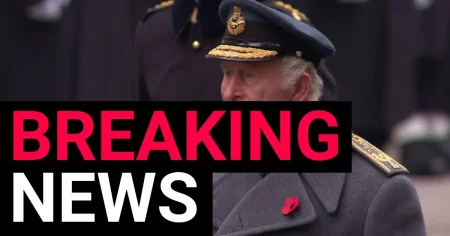
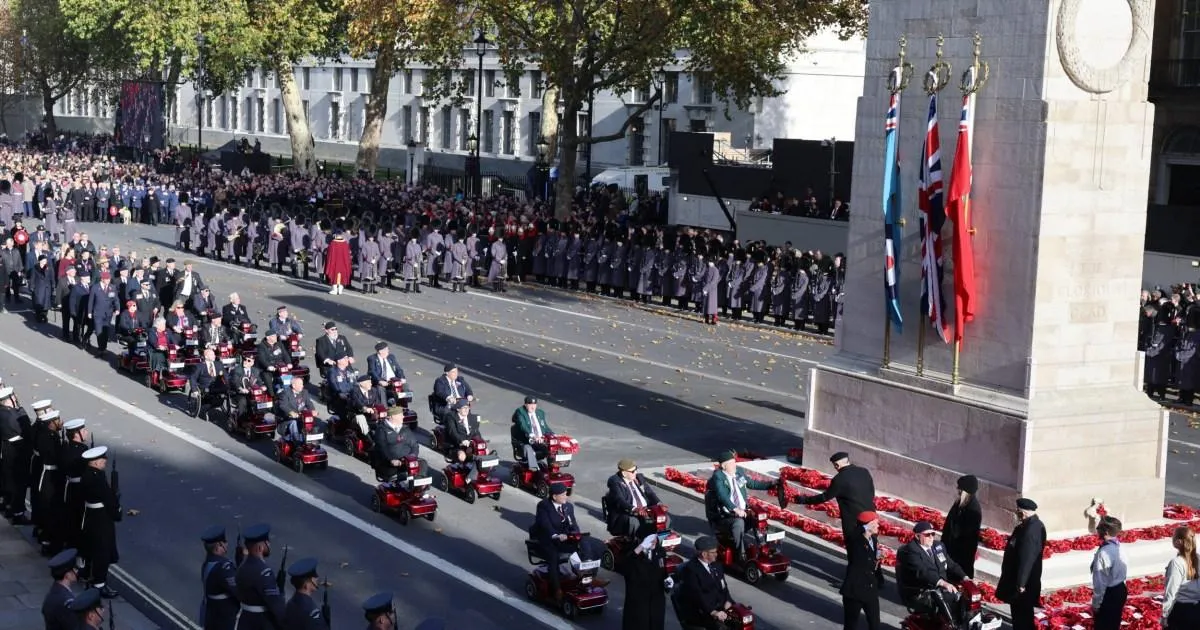
At the heart of the ceremony is the Cenotaph service, which begins immediately after the two-minute silence. Wreaths are laid at the foot of the memorial by members of the Royal Family, including King Charles, and by the Prime Minister, other MPs, religious leaders, and representatives of the armed forces. Each wreath is placed slowly, deliberately, and the silence around it is almost absolute. The service is a blend of military precision and Christian liturgy, but it manages to feel inclusive, because the act of laying a wreath is a human gesture that needs no explanation. Prayers are said, hymns are sung, and the Last Post is sounded, its notes carrying across Whitehall and into the hearts of all who listen. Around 11.25am, the formal service draws to a close, and then comes the march. The Royal British Legion detachments begin to disperse past the Cenotaph, and veterans and eligible participants start their march along the route. This is often the most emotional part of the morning. Youth cadets march smartly in uniform, but alongside them are elderly veterans with white hair and walking sticks, some supported by family members, some in wheelchairs pushed by nurses. They salute the memorial as they pass, and the crowd responds with applause that is both joyful and tearful. The march is not a display of martial pride; it is a statement of survival, memory and loyalty to those who never returned. Each face in the crowd knows someone, or represents someone, whose name is written into the national story. There are standards carrying the names of regiments that no longer exist, borne by descendants who remember the stories they were told as children. The procession takes time, and that is exactly as it should be. No one rushes. The morning stretches out, and for those few hours, the past feels as real as the present, and the dead feel close enough to touch.
Of course, an event of this size requires planning, and for those travelling to London, there are road closures to consider. Several roads in the immediate area will be closed for the parade, most notably Great George Street, which will be closed to the public. Access between Victoria Street and St James’s Park will be via Storey’s Gate, and pedestrians should follow the directions of police and stewards. These closures may cause inconvenience, but they also create a protected space in which the ceremony can breathe. The streets around the Cenotaph are not just traffic arteries; on this morning, they are transformed into a corridor of collective memory. The advice is clear: give yourself extra time, use public transport if you can, and expect security checks. The official guidance warns that space will be limited, so the early start is not optional if you want to be near the front. But even those who arrive later and stand behind the crowd will find themselves drawn into the same atmosphere, because the sound of the guns, the hymns and the applause travels far. London is used to busy parades and grand spectacle, but the Remembrance Sunday parade is different. It has no confetti, no floats, no celebration of victory. It is a solemn, dignified statement that the nation remembers. When the last marchers have passed and the barriers are removed, the ordinary world returns. Traffic moves again, shops open, and the noise of the city picks up. But the memory of the morning tends to linger. Those who attended will carry it with them as they go about their day, and those who watched at home will find themselves thinking about the faces they saw. That is the real purpose of Remembrance Sunday. It is not a single moment in November; it is a promise to keep remembering long after the crowds have gone home, in the quiet knowledge that every peaceful day we enjoy is built on the sacrifice of people who did not live to see it. So as the Cenotaph stands empty again until the next ceremony, its silence is not an ending. It is an invitation to remember, not just with a bowed head at 11am, but with every choice we make to cherish peace and each other.