


Here is the content summarized and humanized into 6 paragraphs, aiming for a deep, narrative-driven expansion of the original news report.
—
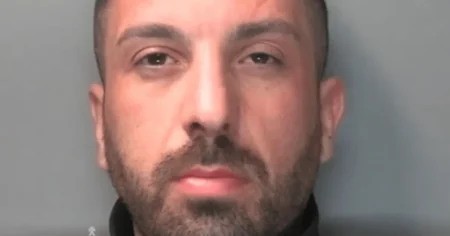
The salty breeze of Portsmouth harbour carried more than the smell of the sea on that tense Saturday afternoon; it carried the low, guttural rumble of a crowd gathered on the edges of a nation’s fracture. Amidst the shouting and the waving placards, a figure stood out not for his vociferousness, but for his apparent frailty. Timothy Justin Miller, a 76-year-old man from the quiet suburb of Hedge End in Southampton, found himself staring down the barrel of a police camera, his face obscured by a knot of black scarves. The image that circulated in the aftermath showed him in handcuffs, a stark and melancholic portrait of advanced age colliding with the rawest edges of public unrest. Miller was not just a face in the crowd that day; he was a focal point. The charge levied against him—wearing or using an item to conceal identity at a protest—was a direct application of a new, aggressive legal stance announced by Hampshire Police merely 24 hours prior. It was a swift, almost surgical execution of a policy designed to dismantle the anonymity that often fuels mob mentality, yet here it ensnared a man who could easily be mistaken for someone’s grandfather, a man whose walk to the local shop might typically be his most daring adventure of the week. The irony of the scene was palpable; the law had been sharpened to catch the shadowy agitators who thrive on chaos, but it had drawn blood on a pensioner whose motivations remain a quiet, troubling mystery.
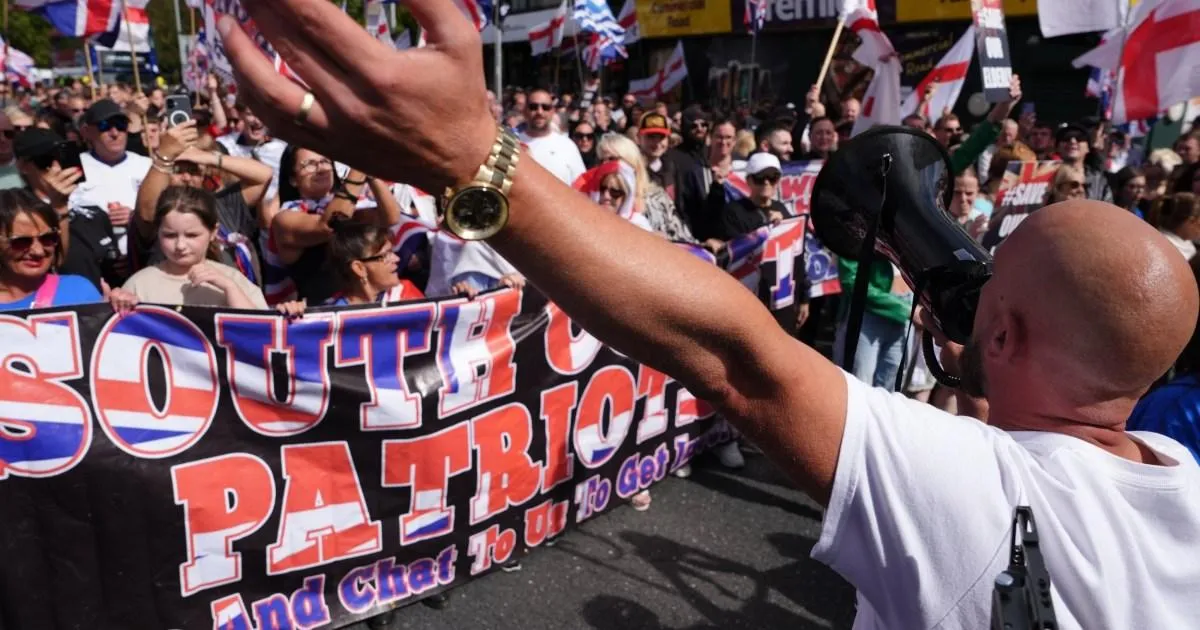
The decision by Hampshire Police to grant officers the power to arrest anyone concealing their identity was a calculated response to a summer of escalating unrest. For weeks, tensions over immigration had boiled over onto the streets of British seaside towns, transforming them into arenas of ideological warfare. The force’s announcement was a clear signal that they would no longer tolerate the use of balaclavas, scarves, or masks that allowed individuals to hurl abuse and incite violence without consequence. Yet, the application of this power to a man of Miller’s age forces a deeply human question: what drives a septuagenarian to such an act of defiance? Was it a profound sense of fear for his community, a lifetime of frustration reaching a breaking point, or the unfortunate susceptibility to the viral misinformation that has plagued these protests? Standing in that crowd, his face swaddled in fabric, he likely felt a sense of solidarity with the others around him, a belonging that masked the isolation of his generation in a rapidly changing world. The officers who cuffed him, however, were merely executing orders meant to de-escalate a volatile situation, and for them, the law is colourless; it does not register the wrinkles on a face hidden beneath a scarf, only the obstruction to the peace they are sworn to uphold. His appearance at Portsmouth Magistrates’ Court on Monday will be a lonely denouement to his Saturday afternoon, a stark transition from the adrenaline of the protest to the sterile silence of a courtroom dock.
The ripple effects of that single day extended far beyond Miller’s arrest. As the sun dipped lower over the harbour, casting long shadows across the cobbled streets, police officers were busy processing two other individuals who had been swept up in the protest’s undertow. David Kenny McNally, a 33-year-old resident of Winchester Road in Portsmouth, was charged with the wilful obstruction of a highway and attempted criminal damage. His alleged actions, presumably a physical attempt to blockade a route or damage property, speak to a more kinetic, aggressive form of protest than Miller’s masked presence. Yet, the most heartbreaking figure to emerge from the weekend’s events was a 16-year-old boy from Waterlooville. This teenager, whose life should be consumed by schoolwork, friendships, and the anxieties of adolescence, is now entangled in the heavy machinery of the criminal justice system. He was arrested on suspicion of violent disorder during a separate protest at Eastney Marina on September 6, a date that will now be a defining scar on his young psyche. The police released him on bail until December 12, granting him a temporary reprieve, but the looming court process will hang over his final months of childhood like a storm cloud. One wonders what he believed he was fighting for, and whether he truly understood the gravity of the words being shouted, or if he was simply swept away by the adrenaline and the allure of transgression that so often captures the young.
While the focus remained on the arrests, a parallel crisis was unfolding just a few miles down the coast, one that struck at the very heart of British decency. The Royal National Lifeboat Institution (RNLI), a charity synonymous with maritime rescue and selfless bravery, found itself under siege. In an unprecedented move, RNLI volunteers and staff were issued a stark warning: do not wear the charity’s branding while on duty. The reason was not a matter of public relations but of physical safety. These volunteers, who launch their lifeboats into treacherous waters to save lives regardless of nationality or circumstance, had become the targets of “unacceptable abuse” from anti-migrant protesters. The hatred was so palpable that simply wearing the iconic yellow and red logo had become a risk. Footage posted on social media during the recent protests in Dover and Portsmouth showed volunteers being branded as “traitors” merely for pulling a small dinghy carrying desperate souls to safety. The hypocrisy is staggering; these are the same men and women who would drop everything to save a British tourist swept out to sea, yet their humanitarian act of aiding a migrant is twisted into a political betrayal. Imagine the emotional whiplash of these volunteers—selfless heroes in their own small boats—being screamed at by their own neighbours for simply doing their jobs.
The institutional response from the RNLI has been one of wounded dignity and pragmatic caution. The charity’s leadership, acutely aware of the volatile temperature of the country, issued guidance that volunteers are now “empowered to make decisions to keep yourself, your team or crew safe” and that they are permitted to “go home or close for the day if you need to.” To instruct a volunteer—someone who routinely risks death in stormy seas for strangers—to retreat for their own mental or physical safety is a devastating admission of how far the societal fabric has frayed. Peter Sparkes, the charity’s chief executive, spoke out with a voice trembling with frustration, calling the abuse “wholly unacceptable in a civilised society.” He pointed to the root cause: a “deliberate misinformation and a misunderstanding about the RNLI – our purpose, our tasking, and particularly our lifesaving work in the Channel.” His words highlight a terrifying new reality where factual reality is secondary to viral narratives. The volunteers, now forced to hide the very insignia that symbolises their sacrifice, are effectively being punished for the cruelty of others. The sight of an RNLI lifeboat leaving a harbour without its livery is more than just a safety measure; it is a surrender of identity to the mob.
As Timothy Miller prepares to face the magistrate on Monday, and as the 16-year-old waits nervously for December, a heavy melancholy settles over the entirety of these events. Here we have a 76-year-old man, a generation that built the post-war consensus, facing a criminal record over a scarf. We have a charity, historically revered as one of Britain’s most trusted institutions, instructing its heroes to conceal their affiliation to avoid being spat on. We have a teenager risking his entire future for a fleeting moment of violent exhibitionism on a marina. The common thread weaving all of these disparate stories together is a profound, venomous polarization that has infected communities from Portsmouth to Poole. The law will do what it does—mete out charges, set bail dates, and issue fines—but it cannot stitch together the torn social contract. The true human cost lies not in the court documents but in the sleepless nights of a frightened pensioner, the tears of a mother whose son is now in the justice system, and the quiet, tearful resignation of an RNLI volunteer who wonders if saving a life is worth being called a traitor. Until the rhetoric cools and the misinformation is dismantled, the scarves will remain on the shelf, the lifeboat branding will stay in the closet, and the silence between neighbours will grow louder than any protest chant.