


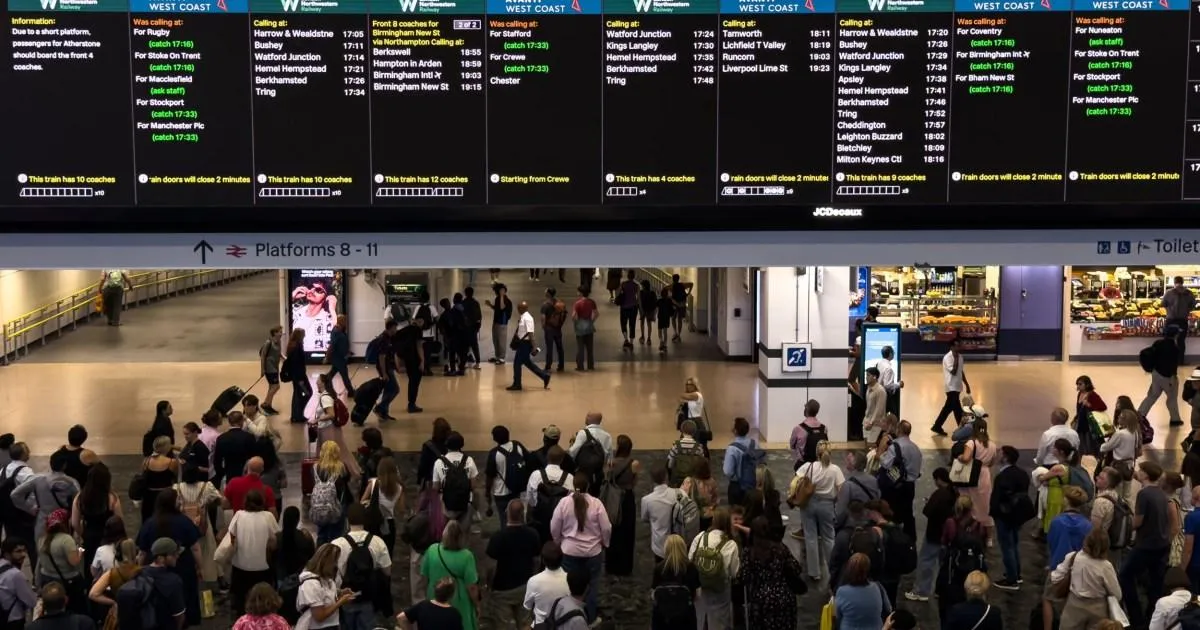
It has been one of those mornings that no commuter ever wants to wake up to. Two separate track defects were discovered on one of the busiest rail corridors in Britain, and the impact is rippling across the entire London Euston route. National Rail has confirmed that all Avanti West Coast and London Northwestern Railway services to and from Euston are affected, with speed restrictions imposed on crucial sections of the line. The first issue is near Tring, where a defective stretch of track between Berkhamsted and Cheddington means trains heading towards Milton Keynes Central have to slow down significantly. The second defect is even closer to the capital, sitting between London Euston and Watford Junction, which is one of the busiest stretches of commuter railway in the country. For anyone who relies on this route to get to work, to school, or to appointments in London, the news lands like a punch to the stomach. It is not just a small delay – National Rail has warned that disruption is expected to last until the end of the day, which means there is no quick fix coming. Trains running between London Euston and Milton Keynes Central may be cancelled, delayed by up to ten minutes, or revised at the last minute. In the grand scheme of rail delays, ten minutes might not sound huge, but when you add that to a train that doesn’t turn up at all, or a service that is suddenly terminated halfway, the morning quickly becomes a nightmare of rearranged plans and missed meetings. The atmosphere on platforms is likely to be tense, with families, students and professionals all staring at boards that keep changing.
The official warning from National Rail is enough to make any regular traveller wince. They have explained that a speed restriction has been put in place over a defective track between Berkhamsted and Cheddington, meaning trains have to run at a reduced speed on the line towards Milton Keynes Central. On top of that, a second track defect has been found between London Euston and Watford Junction. Together, these problems are causing chaos on one of the most heavily used routes in the country. The wording of these announcements often underplays the true impact – “trains may be cancelled, delayed by up to ten minutes or revised” sounds almost manageable until you are actually standing on a cold platform watching your train disappear from the departure board. Ten minutes of delay might be tolerable in normal circumstances, but when trains are held back at the same time, they start to bunch together, which means the whole timetable gets clogged. A delay of ten minutes can quickly become twenty or thirty by the time the knock-on effects are taken into account. One frustrated commuter from Watford summed it up perfectly on social media, commenting on the London Northwestern Railway services: “Another day more cancellations, every train cancelled from Hemel to Euston, what’s happening?” That question feels like the echo of every passenger who has ever been left helpless by the rail network. The answer, on this occasion, is a combination of failing infrastructure, reactive repairs and the sheer fragility of a line that carries so many people every single day.
If you are one of the unlucky passengers caught up in this disruption, the most important thing is to know your options before you panic. Avanti West Coast passengers are being given some flexibility: their tickets can be used on one of the two Avanti services immediately before or after their booked train. That means if you were supposed to be on the 8.15 and it has been cancelled, you may be able to hop on the 7.45 or the 8.30 instead, provided there is space. It is not a perfect solution, especially at rush hour when trains are already crowded, but it does at least offer a way forward without having to buy an entirely new ticket. London Northwestern Railway passengers also have a helpful option, at least for part of their journey. Their tickets can be used at no extra cost on the London Overground between Euston and Watford until midday. That is particularly useful for those who only need to get to Watford and can then make alternative plans from there, though it is less helpful for people travelling further north towards Milton Keynes, Hemel Hempstead or beyond. For anyone who has not yet left home, the advice is simple: check your operator’s website or app before you set off, because the situation may change at any moment. Travellers should also give themselves a much bigger buffer than usual if they absolutely have to be somewhere on time. A meeting that starts at nine in the morning may not be reachable if you are still sitting on a stalled train at twenty to nine. It might be worth rearranging early appointments or asking to work remotely for the morning, if that is at all possible. No one wants to be on the wrong end of a day that feels out of control from the moment they step onto the platform.
Compensation is another important part of the puzzle, even though it does absolutely nothing to ease the immediate stress. Passengers caught in this kind of disruption may be able to claim under the Delay Repay scheme, which usually kicks in after delays of more than fifteen minutes. It is worth remembering that Delay Repay is usually paid directly by the train company, not through a third party, so you need to go to the operator you were travelling with and submit a claim. That means if you were on an Avanti West Coast service, you claim from Avanti; if you were on a London Northwestern Railway service, you claim from them. The process is increasingly digital, with many operators allowing you to fill in an online form and attach a photo of your ticket. If you have a season ticket, you may still be eligible, and if you do not have a physical ticket because you used a mobile app or an electronic pass, it is still worth claiming – the train company can usually look up your journey and confirm that you were affected. It would be wise to take screenshots of the National Rail announcements, save your journey history, and note the times of any cancelled or delayed services. This evidence can make the claims process far smoother. Of course, money for a delayed journey is never going to replace the time you lost, the meeting you missed, or the childcare arrangements that collapsed under the pressure of an unpredictable commute. But if you are entitled to compensation, it is a small amount of justice, and it is worth claiming. The whole situation is a reminder that even the most well-planned day can be thrown off course by things far beyond your control, and that sometimes the best you can do is to look after yourself, stay calm, and try to find a way through the chaos.
The bigger picture behind today’s disruption is harder to ignore. The West Coast main line is not just any railway – it is a vital artery connecting London to Birmingham, Manchester, Liverpool, Glasgow and countless smaller towns in between. When it goes wrong, the effects are felt far beyond the platforms of Euston, Tring and Watford Junction. Businesses lose productivity, families miss important moments, and ordinary people arrive at work exhausted and frustrated before the day has even begun. Today’s two track defects are a reminder of just how much of the country’s rail infrastructure is old, overstretched and in need of serious investment. Network Rail has been asked for a comment, but at the time of writing, no public response has been issued, which only adds to the sense that passengers are often left in the dark. There is also a deeper emotional side to all of this. For many people, the daily commute is already a source of stress – a constant balancing act of timings, connections, and tiny margins for error. When the railway lets them down, it is not just an inconvenience. It feels like a betrayal, because they have done everything right: they bought their ticket, they got to the station on time, they checked the boards. And still, the trains refuse to cooperate. Days like today make people wonder whether they can continue to rely on the railway at all, or whether they should try to drive, even with traffic congestion and parking costs. It is a troubling thought, especially for those who want to believe in public transport as the greener, more sensible choice. But when the system is as fragile as this, it is no wonder that some commuters are losing patience. There are no easy answers, no quick engineering fixes, and no way to magic the tracks back into perfect working condition overnight.
So, if you are trying to travel to or from London Euston today, what should you actually do? First, take a deep breath. It sounds simple, but the worst thing you can do is let the frustration take over, because there is nothing you can personally do to fix defective track near Tring. Second, check the live departure boards and your operator’s social media accounts before you head to the station, if you have not already. If you can travel at a less busy time, or if you can work from home, that may be the easiest way to protect your own sanity. If you are already at the station, or already on a train that has stopped, try to stay informed rather than spiralling into anger. Look at the options available to you – whether that means using the London Overground between Euston and Watford if you are a London Northwestern passenger, or switching to an earlier or later Avanti service. Allow extra time for everything, because even a small delay can snowball into an even bigger one. And once you finally reach your destination, do not forget to look into compensation. You have earned that right by enduring the chaos, and you should not let it slide. Above all, remember that you are not alone. There are thousands of other people standing on those platforms, checking the same screens, feeling the same frustration. There is a strange solidarity in shared disruption, and sometimes that makes it a little easier to bear. You will eventually get to where you need to be. The trains will start moving normally again, the tracks will be fixed, and this particular day will become just another story to tell. But for now, it is completely okay to be annoyed, to complain, and to demand better, because that is exactly what passengers deserve.