



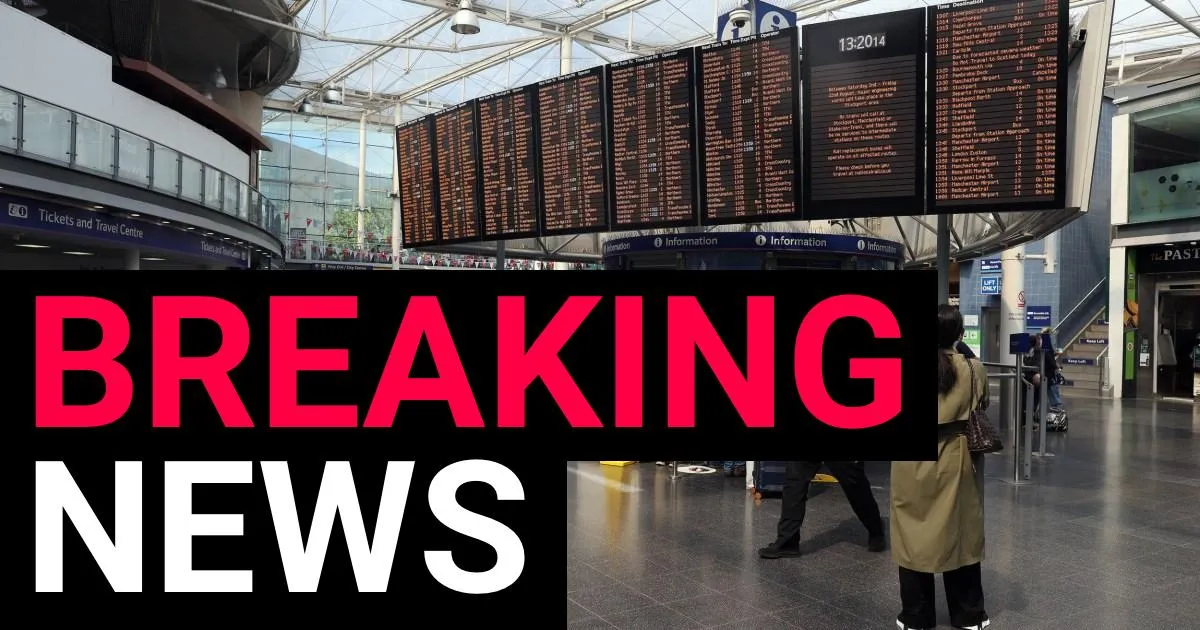
It is a familiar, sinking feeling for anyone who relies on the UK rail network: the announcement that your travel plans have been completely dismantled. Today, thousands of passengers across the North West, the Midlands, and Greater Manchester are experiencing that frustration firsthand following a catastrophic electricity failure at a critical rail communications centre. What began as a routine day of commuting or travel has descended into widespread mayhem, with major operators like Avanti West Coast, CrossCountry, Northern, and TransPennine Express all reporting significant issues. The scope of the failure is deep, affecting the very infrastructure that keeps trains running safely, leaving passengers stranded and confused as services across these busy corridors face cancellations and delays that are expected to ripple through the network until the day’s end.
The situation in the North is particularly grim, where Northern has issued the starkest possible advice: “do not travel.” This isn’t just a case of trains being delayed by a few minutes; it is a total breakdown of the system. For many, the most infuriating aspect of this disruption is the lack of alternatives. Northern has confirmed that it cannot provide replacement buses or trains, a consequence of the power outage affecting the essential control and communication hubs that manage personnel and logistics. Without these systems, the human side of the railway—the drivers and staff—cannot be coordinated or mobilized, leaving the company effectively paralyzed. It highlights the fragility of our modern rail network, where a single point of technical failure can bring an entire region to a grinding halt.
For those trapped in the middle of this chaos, the day has become an exercise in patience and endurance. With delays of up to an hour being reported and many routes completely severed, passengers are being urged to prepare for a very long day. Avanti West Coast has attempted to mitigate some of the misery by allowing customers to use their tickets on alternative services shortly before or after their original booking, offering a small lifeline to those desperately trying to reach their destinations. However, for many others, there is simply no way to move, and the reality of being stuck at a crowded station with limited information is a stressor that many workers and families could do without.
If you find yourself caught up in this mess, it is vital to remember that you are entitled to hold the operators accountable. While the immediate stress of the delay is the primary concern, the financial sting of a cancelled or heavily disrupted journey should not be ignored. The “Delay Repay” scheme exists specifically for days like today. If your journey is delayed by more than 15 minutes, you are generally eligible for compensation. It is a tedious process, but it is your right. Make sure to keep your tickets, note the exact length of your delay, and keep a record of your original travel time. Navigating these claims requires a bit of record-keeping, but the cumulative cost of these disruptions is something no passenger should have to bear alone.
Ultimately, incidents like this serve as a stark reminder of the vulnerability of our public transport infrastructure. While we often focus on the inconvenience of a late train or a missed connection, a total communications blackout brings the complexity and the stakes of the railway into sharp relief. Behind the delays are hundreds of staff members scrambling to fix the unfixable and passengers whose lives—from job interviews to medical appointments—are being put on hold. As the rail companies work to restore power and communication to their control centers, thousands of people are left navigating the uncertainty, forced to rely on each other and the limited updates available on social media.
As we look toward the remainder of the day, the outlook remains bleak for anyone planning to travel through the affected regions. While rail staff are undoubtedly doing their best to manage an impossible situation, the reality is that major outages like this cannot be “fixed” quickly. For those who are currently stranded, it is worth checking the National Rail website for the most recent updates on compensation and alternative routes, though expectations for a smooth journey should be kept low. This has been a difficult day for the UK rail network, and for the passengers caught in the middle of this electrical failure, it serves as a frustrating reminder of how dependent we are on systems that, when they fail, leave us completely in the dark.