


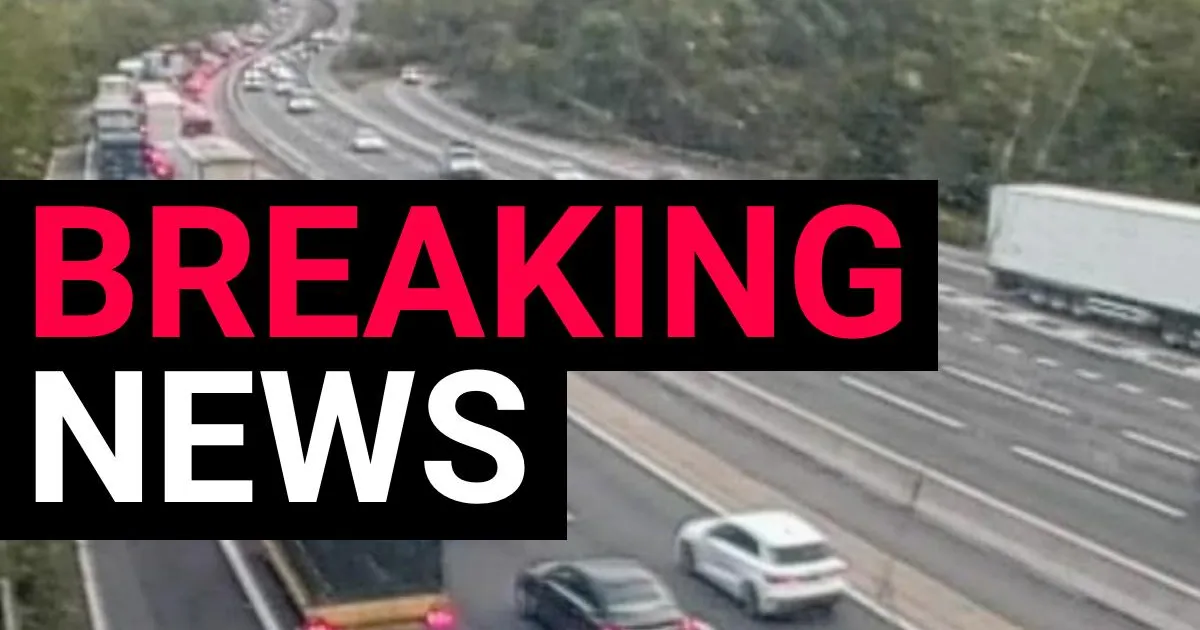
It was the kind of morning that makes even the most resilient commuter groan before they’ve barely finished their first sip of coffee. On the M3 in Hampshire, a busy artery that carries thousands of drivers toward Winchester, Basingstoke, Southampton and eventually into London, the eastbound carriageway was brought to a halt. The cause was an overnight lorry crash that left a chunk of the motorway closed and a thick, dangerous slick of diesel glistening across the tarmac. For everyone heading eastbound that morning, the journey turned into a frustrating crawl, with tailbacks snaking for miles and the promise of delays stretching far beyond the official estimates. Traffic cameras captured the scene: a long river of red tail lights, stationary cars, lorries queued in patient but anxious rows. It was, in every sense, traffic misery. National Highways was quick to warn drivers that they were facing around 35 minutes of delays, with at least four miles of congestion building up on the approach. But for many, those figures felt optimistic. The closure stretched between junction 9 at Winnal Interchange and the Popham Junction A303, cutting off a crucial stretch of the motorway at exactly the worst possible time — the morning rush hour. What should have been a straightforward commute became an exercise in uncertainty, rerouting and sheer patience.
Looking at the facts behind the disruption, there is something strangely ordinary about the cause. At roughly one o’clock in the morning, a Heavy Goods Vehicle struck the central reservation on the eastbound stretch of the M3. The impact was severe enough to rupture the lorry’s fuel tank, sending an estimated 300 litres of diesel spilling out across the carriageway. That might sound like a contained problem at first, but diesel is not something you can simply wash away with a hose. It seeps into the microscopic pores of the road surface, creating a slick, hazardous layer that can cause cars and lorries to lose traction long after the visible spill appears to have gone. The first priority was recovering the HGV itself, and that was done by around 3am. But that was only the beginning. Once the vehicle was removed, the extent of the mess became clear. National Highways explained in a statement that a full resurfacing of the road would be required, and because of that, the M3 was likely to remain closed through the entire morning peak period. For anyone who has ever sat in a motorway queue and wondered why nothing seems to be happening, this is why. Road crews cannot simply sprinkle sand over the diesel and call it a day. They have to dig up the old contaminated surface, lay down new tarmac, allow it to set and only then can the lane be reopened. It is slow, unglamorous work, but it is absolutely essential if the road is going to be safe for the hundreds of thousands of vehicles that will use it in the days and weeks ahead. The article noted that Metro had approached the emergency services for a comment, but the main message was already clear: this was not a minor bump, but a serious incident with significant consequences for the morning commute.
For the drivers caught up in the chaos, the human impact was felt long before the official announcements were fully understood. The M3 is not just a road. It is a lifeline for healthcare workers heading to hospital shifts, for teachers trying to reach classrooms, for parents doing the school run, for delivery drivers with schedules to keep and for businesses that depend on goods arriving on time. When a motorway closes, it does not simply add a few minutes to a journey. It ripples outward, affecting childcare arrangements, meeting schedules, appointment times and in some cases people’s livelihoods. National Highways may have said the delays were around 35 minutes, but that was likely to be the minimum for those who were already close to the queue. Drivers further back could expect much more, and many sat in stationary traffic, watching the minutes tick by, wondering whether to keep going or turn around and find another way. The advice to allow extra time was there, but for those already on the road it was too late. Suddenly, the car becomes a tiny island of frustration. Radios are switched on in search of travel updates. Phones are looked at with a mixture of hope and dread. The air fills with sighs. It is easy forget that behind every tail light there is a person with somewhere to be, someone they do not want to disappoint, a day they had carefully planned. And now, because of an accident that happened in the dead of night, all of that was thrown into uncertainty.
In situations like this, the diversion route becomes the only hope for drivers trying to get around the chaos. Fortunately, National Highways set up a signed route for motorists to follow, marked with a solid diamond symbol on local roads. Those travelling eastbound were instructed to exit at junction 9, the Winnal Interchange, and make their way to the roundabout. From there, drivers had to take the second exit and join the A34 heading towards Newbury. They would then stay on that road for around eight miles until reaching the A303 at Bullington Cross Interchange, where they could rejoin the wider road network and continue their journeys. It sounds straightforward on paper, but anyone who knows the area will understand that these local roads are not designed for a sudden influx of motorway traffic. Villages and side streets that normally see a handful of vehicles suddenly found themselves with queues of cars and lorries passing through. Roundabouts became bottlenecks. Quiet junctions turned into confusing tests of patience. The diversion was necessary, and it was better than being completely stranded, but it was by no means a pleasant alternative. Drivers were urged to follow the signs carefully, to look out for the diamond symbol and to be patient with others who were unfamiliar with the area. For those who did not need to travel, the message was simple: stay away if you can. For everyone else, the journey eastbound was going to require a good deal of understanding and a little extra fuel in the tank.
Beyond the immediate inconvenience, there is a wider story worth pausing over. A single lorry crossing into a central reservation in the middle of the night managed to close one of the most important roads in southern England for the better part of a day. It is a reminder, perhaps, of how fragile our transport infrastructure can be, and how much we depend on it every single day without even thinking. The crash also raised important safety and environmental questions. Three hundred litres of diesel is not a small amount. It is a significant pollution risk, capable of contaminating drainage systems and affecting nearby soil if not dealt with properly. The decision to resurface the road rather than simply clean it shows how seriously authorities take this kind of spillage. Diesel is a known hazard, not just because of its flammability, but because it creates an invisible, long-lasting slippery layer. Reopening the road too soon would have been reckless, putting motorists at risk of accidents and injuries. The road crews working through the morning were not just fixing a road; they were helping to prevent future crashes. There is no glamour in laying tarmac on an empty motorway, but it is essential work. The same can be said for the emergency services who attended the scene in the early hours, and for the recovery teams who removed the damaged lorry, often all while in the dark and dealing with a potentially hazardous environment. Their efforts rarely get the attention they deserve, mostly because by the time the road reopens, everyone just wants to move on.
For now, the best anyone can do is to stay informed and plan ahead. If you are travelling eastbound on the M3, check the traffic reports before setting out, look at live maps, and listen to local radio updates. Consider whether the journey is essential, whether alternative routes are possible, and whether public transport or flexible working could take the pressure off. If you are already on the road, caught in the queue, try to remember that anger and frustration will not make the traffic move any faster. Keep a safe distance, stay hydrated, have a snack within reach, and make sure your phone is charged. The people working in high-visibility jackets on the side of the road are not trying to make life difficult. They are trying to make the road safe again. It is entirely human to feel annoyed when plans are disrupted, especially on a busy morning when time feels precious. But it is also worth holding onto a sense of perspective. The M3 will reopen. The diesel will be cleaned up. The new surface will be in place. And eventually, the hundreds of thousands of drivers who use this road every week will be back to their normal routines. On mornings like this, the most human thing to do is take a deep breath, put on a favourite playlist, and accept that some things simply cannot be rushed. Whether we like it or not, we are all in this together, every one of us, waiting for the road ahead to clear.