


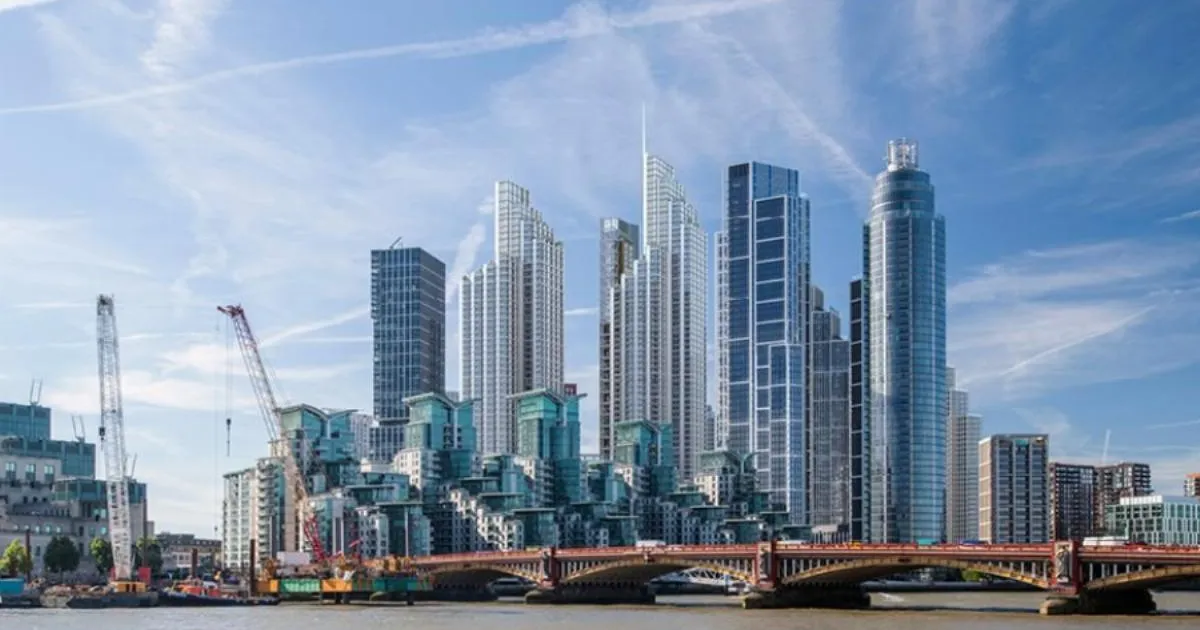
London has always been a city that reaches upward, a restless skyline constantly being redrawn by ambition, money, and the endless demand for space. The latest chapter in that story is being written in Vauxhall, a corner of south London that has spent the past few decades shedding its industrial past and slowly transforming into a vertical neighbourhood. Lambeth Council has just given the green light to a £2 billion redevelopment of Vauxhall Square, a vacant plot near the station that has sat waiting, almost patiently, for something to happen. And something is certainly happening: seven new buildings are planned, ranging from a modest two-storey structure to a towering 69-storey monster that will rise 230.5 metres into the London sky. That makes it the second-tallest residential building in the entire United Kingdom, trailing only Canary Wharf’s Landmark Pinnacle, which stands at 239 metres with 75 storeys. For a generation of Londoners who have watched cranes multiply across the city like migrating birds, this is both thrilling and slightly exhausting. But the developer behind the scheme, Bmor, alongside investors Cedarstone Capital Partners and Cheyne Capital, insists this isn’t just about breaking records. It’s about building a new kind of place on a patch of land that has been empty for years, a place where people can live, work, study, shop, swim, and even watch a film without travelling far from home. Whether that vision lands as a masterpiece or a cautionary tale will depend on how carefully it is woven into the fabric of a community that is still very much alive and watching.
At the heart of the scheme is an attempt to cater to almost every kind of urban life. The flagship 69-storey tower will provide more than a thousand new homes for sale and rent, and a quarter of those are classed as affordable. That is a promise that will be scrutinised closely in a city where the word “affordable” can mean different things, but on paper at least it is a significant commitment. The ground floor of that tower will be given over to retail units, making it a place where residents can step out of the lift and be greeted by the hum of shops and cafes rather than a deserted lobby. Just behind it, two 61-storey buildings will deliver 355 built-to-rent homes alongside 1,164 co-living units. Co-living is a concept that has generated plenty of debate over the years, with critics arguing it is just purpose-built flatshares with better marketing, while supporters claim it offers flexibility and community for people who cannot afford or do not want a traditional tenancy. Either way, these buildings will also include co-working spaces and ground-floor retail, designed to keep the streets busy from morning to night. For students, there is a dedicated 45-storey tower offering almost 700 rooms, 35% of which are labelled affordable. A 20-storey building will house 122 social rent homes, with healthcare facilities planned on the ground floor, which is a welcome acknowledgment that housing and health are deeply connected. Then there is a 17-storey building containing office and retail space, with a hotel occupying the upper floors. And finally, a small two-storey building will bring retail space and a cinema, while extra community facilities such as a gym, swimming pool, and play area are woven into the masterplan. In other words, this is not just a cluster of residential towers. It is an attempt to create a miniature city within a city, a place where the daily commute, the morning workout, the evening pint, and the weekend film can all happen without ever crossing a major road.
To understand why this project matters, you have to understand where it sits. Vauxhall is one of those London neighbourhoods that people pass through more often than they stop in. The station is a major transport hub, with the Victoria Line, National Rail services, and a bus station that sends people fanning out across the city. For years, the area was dominated by the brutalist architecture of the Vauxhall Cross interchange, the towering MI6 building, and a strange collection of nightclubs and tyre shops. But the last decade has seen enormous change, driven largely by the success of Battersea Power Station just along the river and the wider Nine Elms regeneration. Now, with the approval of Vauxhall Square, the area is set for another leap. This is all happening against a backdrop of an acute housing crisis, where the average London home costs more than a dozen times the average salary, and where renting is a scramble for decent, secure, and affordable accommodation. In that context, a scheme providing over a thousand homes, social rent, student accommodation, and co-living units might sound like a lifeline. The developers certainly want you to see it that way. Their website talks about creating a “vibrant environment” with a central garden at its heart, surrounded by a mix of uses and a diverse residential offering. They describe their vision as “a landmark destination in London” that supports and nurtures the local community as much as the new residents it attracts. It is a familiar sales pitch, delivered in the polished language of renderings and mood boards, but underneath it lies a simple and serious question: can a development this large actually be good for the people who already call Vauxhall home, or will it simply speed up the gentrification that has already reshaped so much of south London?
Not everyone is popping bottles of champagne about this decision. Kevin Brown, a councillor for Stockwell East, has been blunt about his concerns. He argues that the opinions of London residents have not been properly considered, and that these towers will “overshadow public space” in a way that changes the character of the whole area. Brown points out that the towers will be visible from Stockwell, which is his ward, and even from Brixton, which is a significant cultural and historical hub for Black British communities. He also warns that many housing estates in the local area and beyond, along with pubs and businesses around “Little Portugal,” the cluster of Portuguese restaurants and shops that gives this part of Vauxhall its distinctive identity, would be affected by the sheer scale of this development. His central demand is for a better Local Plan, one that actually accounts for how big buildings change the lives of people who live nearby, not just the people who will eventually live inside them. This kind of backlash is not unusual in London. Every major development faces some degree of opposition, and the tension between new housing and old neighbourhoods is a recurring story across the capital. But Brown’s comments touch on something deeper. When a development is large enough to be seen from miles away, it stops being a local matter and becomes a metropolitan one. The people who live in the shadow of these towers, who catch the bus past their construction sites, who worry about sunlight, noise, and the price of a pint at their local, will have to live with the result for decades. Their concerns deserve more than a nod in a planning committee meeting. They deserve to be taken seriously.
Historic England has also raised a red flag, and it is a significant one. The heritage body has warned that the development would harm the Westminster World Heritage Site, a UNESCO-recognised area that encompasses the Palace of Westminster, Westminster Abbey, and the surrounding streets. They claim that the new towers would have an impact on several protected London sightlines, those carefully guarded views of famous landmarks that are meant to remain visible and unspoiled across the city. For many people, the idea of glancing up from a park or a riverfront and seeing Big Ben silhouetted against the sky is a non-negotiable part of London’s character. Historic England’s job is to defend that character, and they have made clear that they think these towers would chip away at it. Lambeth Council, however, rejected that argument. They insisted that the towers would not harm protected views or any heritage assets. That is a bold claim, and it sets up a classic conflict between progress and preservation. On one side are the planners who argue that London must grow, that housing targets must be met, and that modern architecture should not be held hostage to a romanticised past. On the other side are those who believe that a city with centuries of history has an obligation to protect the things that make it distinct, rather than allowing them to disappear behind a wall of glass and steel. The developer, not surprisingly, is on the side of building. In a statement, Bmor said the project would create a vibrant environment and a landmark destination, while also acknowledging the importance of the local community. But words are easy. The proof will be in the shadows cast, the streets created, and the lives changed once the construction dust settles.
At the end of it all, this is a story about the future of London itself, and it is a story that is far from over. On the one hand, you have a city that needs hundreds of thousands of new homes, that needs to accommodate young people, families, students, key workers, and everyone else who makes the capital run. On the other hand, you have a city with a profound sense of history, where the view of Westminster from across the river is more than just a postcard image. It is a reminder of a deep and contested past. Vauxhall Square is not the first massive development to stir up this debate, and it will not be the last. Already, elsewhere in London, the City is preparing to welcome a brand new £1 billion skyscraper offering panoramic views and the “highest bar in London,” while the iconic BT Tower is being transformed into a luxury hotel with a rooftop swimming pool, a 360-degree revolving observation deck, and plenty of new retail space. These projects, like the towers in Vauxhall, are signs of a city that refuses to stand still. But they also raise questions that are not easily answered. How do you build enough homes without erasing the character of the places people love? How do you balance the need for density with the desire for open, sunlit streets? And who gets to decide what “progress” means anyway? The people who live in Vauxhall, who have watched their neighbourhood transform before their eyes, deserve to be more than spectators in that decision. They deserve to be participants. Whether they ultimately embrace this skyline or resent it, one thing is certain: when those seven towers finally rise above the railway lines and the river, they will not just change Vauxhall. They will change the way London looks and the way Londoners understand themselves. And that is exactly why the argument about them matters, and why it will continue long after the last crane has been dismantled and the first residents have moved in.