


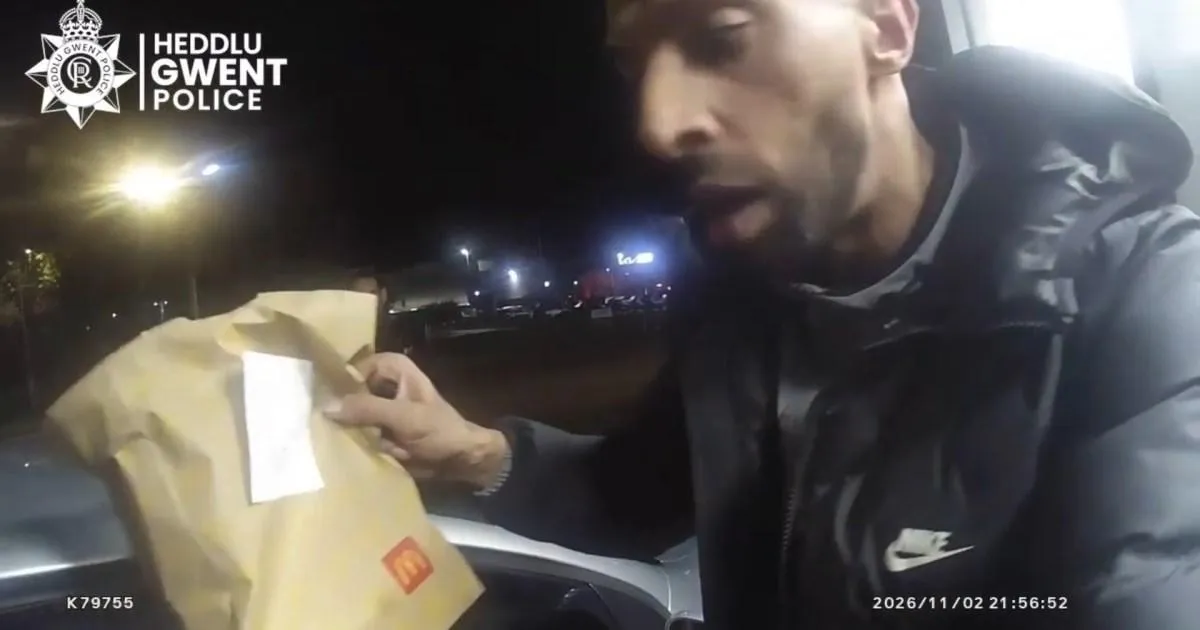
There is a kind of comedy that only real life can write. It begins with the smell of frying potatoes and the glow of a drive-through menu, and it ends with handcuffs, flashing lights, and a man bargaining for his chips. On the evening of 2 November, Imtiaz Ali pulled into a McDonald’s in Newport, Wales. The 46-year-old had no idea that he had already attracted the attention of Gwent Police. Officers from the force’s Community Action Team had seen him driving erratically, and their suspicions were strong enough that they followed him all the way into the restaurant’s car park. From the outside, Ali must have looked like any other customer: a middle-aged man looking for a late-night bite, perhaps a little tired, perhaps looking forward to the comfort of a bag of hot chips. But the police were not interested in his order. When they approached his vehicle, they made it clear that this was not a customer-service interaction. Ali, however, was not ready to let go of the idea that he could simply finish his food. “I want to eat it bro,” he said, his voice captured in a video released by Gwent Police. The officer’s reply was immediate and deadpan: “You’re not going to be chomping on chips while I’m searching you.” In the video, the moment is almost absurd. A grown man pleading for fast food while facing arrest sounds like a sketch, not a news story. Yet the seriousness of the situation was written all over the officers’ faces. Ali’s night had just taken a turn he never expected, and all he could think about was the food that was now out of reach. The footage, released after the case concluded, offers a strange window into human behaviour. It is tempting to laugh, and plenty of people did. But the laughter fades quickly when the rest of the story emerges, because Ali was not just a hungry man in the wrong place at the wrong time. He was, in the eyes of the law, a drug supplier whose activities had caught up with him. The chips, as it turned out, were the least important thing in his car.
The search began as a routine part of an arrest, but it did not take long to uncover evidence that elevated the stop from a traffic concern to a full drug investigation. Officers looked inside Ali’s car and found a hammer close to the driver’s seat. That alone was enough to raise serious concerns. Then they opened the boot and discovered seven boxes of nitrous oxide canisters. In total, there were 42 large, unopened canisters — a quantity far beyond anything that could be dismissed as a personal supply or a catering accident. There were also unopened balloons, the kind used to inhale the gas after it has been released from the canister. If the hammer was an indication of potential violence, the balloons and canisters were unmistakable signs of the drug trade. Police also seized a large amount of cash and a mobile phone from Ali while searching him at Newport Retail Park. Cash and phones are the currency and communication system of underground dealing. A single phone might be explained; a large stash of cash cannot be waved away. Later, at his address on Ebenezer Terrace in Newport, officers recovered cannabis and three more mobile phones. The evidence told a clear story: Ali was equipped to buy, sell, and deliver drugs. The car was a mobile supply unit, and his home served as a storage and communications hub. What had begun with a complaint about chips had turned into a carefully constructed case. The police had not only caught Ali in the moment; they had found the apparatus of an ongoing operation. Even before the house search, the investigators knew they had enough to charge him. But the additional discovery of cannabis and the extra phones strengthened their hand and made it difficult for Ali to claim that the items were not his. In the strange theatre of a police stop, the search was the moment when his fortunes changed. The chips lay forgotten. The hammer, the gas, the balloons, the cash, the phones — these were the new facts of his life. And none of them could be eaten.
Ali was charged and brought before Newport Magistrates’ Court, where he faced charges that carried a real possibility of prison. He pleaded guilty to possession of nitrous oxide with intent to supply it for wrongful inhalation, a class C drug offence. That charge reflected the seriousness with which the authorities now treat the recreational supply of laughing gas. He also pleaded guilty to possession of an offensive weapon in a public place, because of the hammer, and to possession of cannabis, a class B drug. The court did not need a trial. The evidence was overwhelming, and Ali’s legal team knew it. PC Sam Hall said as much in a statement after the case: “The evidence of Ali’s illegal dealing of nitrous oxide was overwhelming; he had little option but to plead guilty to the charges he faced in court.” But there was more to this case than the immediate charges. Hall also revealed that Ali was out on licence at the time of the offences. That means he was not someone who had simply made a single bad decision while on a fast-food run. He was a man who had already been through the criminal justice system, who had been released back into the community under supervision, and who had used that freedom to involve himself once again in the supply of drugs. The court was unlikely to look kindly on that context. In the end, Ali was sentenced to six months’ imprisonment. There was no option to finish his chips. There was no option to walk out of the courtroom and back to his car. He was taken into custody, leaving behind the McDonald’s, the Newport Retail Park, and whatever plans he had made for the weeks ahead. The sentence was not the longest the court could have imposed, but for a man who had already been out on licence, it was a decisive and humbling result. His appearance before the magistrates was brief in comparison to the months of investigation and the years of offending that may have come before. The legal process, once set in motion, tends to move quickly when the evidence is clear. Ali had no real defence, so the court’s job was to deliver consequences. Those consequences extend beyond the prison walls: a criminal record, lost employment, strained relationships, and the knowledge that the ordinary comfort of a meal in one’s own car is now a distant memory.
Nitrous oxide is not a drug that most people associate with serious crime. For years, it was sold in small silver canisters at corner shops and online, marketed as a way to make whipped cream and, unofficially, as a recreational high that evaporated quickly. But the law has caught up with the reality. Inhaling nitrous oxide from balloons produces a short-lived feeling of euphoria and light-headedness, but it also starves the brain of oxygen. It can cause sudden fainting, serious accidents, and long-term nerve damage when used repeatedly. It has been linked to tragic deaths, including among young people who saw it as harmless fun. Because of these dangers, nitrous oxide was classified as a class C drug in November 2023. This changed the legal landscape. Possession with intent to supply now carries serious penalties, and police services across the UK have made it a priority to disrupt the supply chain. Ali’s case illustrates exactly why. He had 42 large canisters, not a few small ones. He had balloons, the delivery method. He had cash and multiple phones, the business infrastructure. And he had a hammer, which suggested he was prepared to protect his trade. This was not a young person experimenting in a park. It was an adult businessman operating in a retail park, linking fast-food culture to the wider drugs economy. PC Sam Hall’s words after the sentencing made clear how the police saw it: “Ali was out on licence at this time of these offences and was profiting from the sale and supply of illegal drugs that cause fear, suffering and pain to vulnerable people and their families.” That phrase — “fear, suffering and pain” — is a reminder that the drugs trade is not victimless. The people who buy nitrous oxide in balloons may think they are simply having fun. But the wider network that supplies them is often tied to addiction, exploitation, and violence. Every dealer who gets caught is a small crack in that network. Ali’s arrest may have had a comic surface, but it had a serious core. The fact that nitrous oxide is used in hospitals and restaurants does not make it harmless. It is the context, quantity, and intent that separate a dental surgery from a drug operation. Ali’s operation was not about pain relief or culinary presentation. It was about profit. And the court recognised that.
Every arrest has a human story, and the oddest details are often the most telling. Ali’s request to eat his chips has become the defining image of this case. It is easy to laugh at him, and many people did when the footage was shared online. But if you look closer, the moment reveals something more uncomfortable. Ali was a 46-year-old man, old enough to understand consequences. He was out on licence, which means he already knew what prison was like. He had been given a second chance, and he had wasted it. Still, when the officers approached, he did not try to run, did not become aggressive, did not make excuses. He asked for food. It was a small, almost childlike appeal for something familiar in a terrifying moment. The chips represented everything that was about to be taken from him: freedom, choice, the simple ability to eat a meal in his own car. The officer’s refusal was not cruel; it was procedure. You cannot safely search someone while they are eating, and the law does not pause for hunger. But in that refusal, there is a hard truth about the consequences of illegal behaviour. Once the police have decided to act, your plans no longer matter. The chips become a symbol of a life that Ali was not ready to give up. There is also something strangely human about the fact that he said “bro” to a police officer. It suggests a man who saw the officers not just as authority figures, but as people he could reason with. As if they might understand. As if they might let him finish his meal and then talk about the 42 canisters in the boot. This combination of foolishness and vulnerability makes Ali neither a villain nor a hero, but a person. And the most disturbing part is that people like him are not rare. They are the foot soldiers of the drugs trade, caught between profit and peril, living normal lives until the moment they are not. Ali was not a hardened gang leader directing operations from a safe distance. He was the man in the car with the hammer and the balloons, doing the dirty work and taking the risk. He may have thought he was clever enough to avoid attention, but he was stopped for erratic driving — a basic mistake. In the end, it was not an elaborate undercover operation that brought him down. It was a police officer doing routine work and noticing something wrong. That is a lesson for anyone who imagines crime can be hidden in plain sight.
Six months is not forever, but it is enough time for a life to change. While Ali sits in prison, the McDonald’s in Newport will continue to serve chips. The Retail Park will fill with shoppers. The police will move on to other cases, other stops, other arrests. But the memory of this incident will linger in a different way. The story of the man who wanted to eat his chips before being arrested is already a part of criminal-justice folklore. It will be shared in police stations, repeated in training sessions, and probably used as a cautionary tale about the unpredictability of arrest. But the deeper lesson is less funny. Crime does not always happen in shadowy alleyways. It happens in broad daylight, in drive-through queues, in cars parked outside retail outlets, in ordinary homes on ordinary streets. Ali was caught because someone noticed and acted. The police did not know, when they stopped him, that they would find a hammer and 42 canisters of laughing gas. They only knew that something was wrong. Their willingness to follow that instinct led to a conviction. For the community, that is a small victory. For Ali, it is a complete defeat. He will have time now to think about the choices he made, the risk he took, and the chips he never got to finish. Maybe somewhere in that cell, he remembers the smell of McDonald’s and the officer’s words: “You’re not going to be chomping on chips while I’m searching you.” It was the last ordinary thing anyone said to him before his world became a prison. When he comes out, he may look back on this as the moment everything went wrong. Or he may, as many people do, see it as the moment he was forced to stop. The chips were taken away, but so was the hammer. The balloons were confiscated, but so was the business. In the strange arithmetic of justice, Imtiaz Ali lost more than a meal that night. He lost his freedom. And all he got in return was a story that made the rest of us laugh — and a reminder that hunger for a better life can be lost just as easily as an order of chips.