

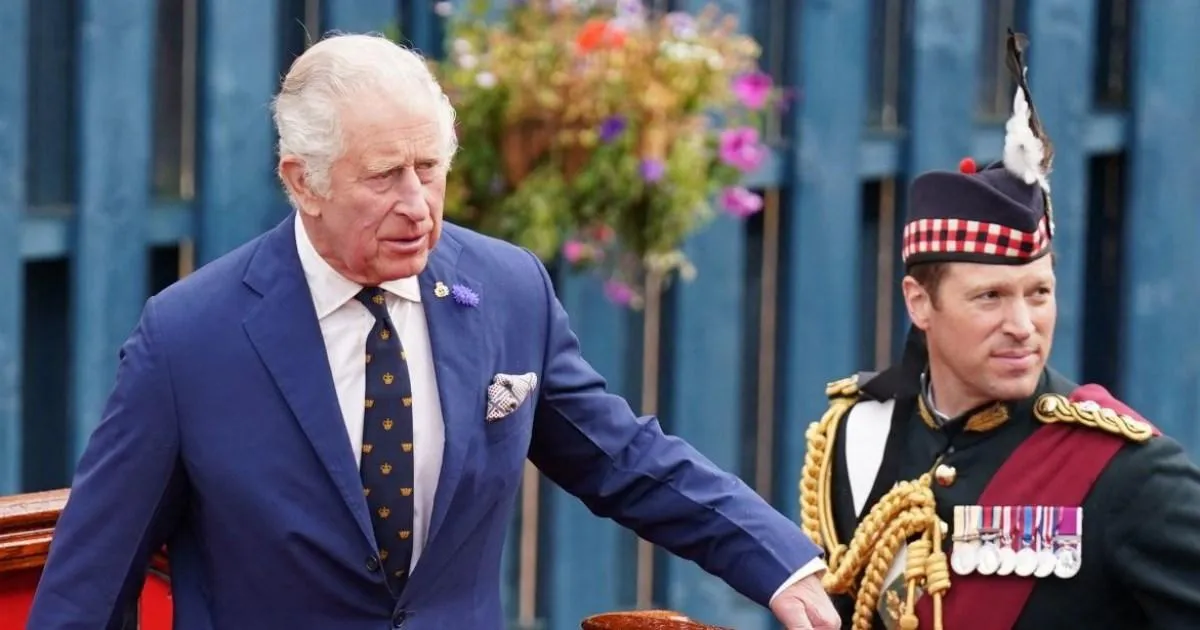
Buckingham Palace has announced that Lieutenant Colonel Jonny Thompson, the senior equerry to King Charles III and Queen Camilla, will step down at the end of the year, ending a remarkable chapter in the life of the Royal Household. Thompson has been the steady presence behind the King for years, the kind of quiet, competent figure who manages the impossible logistics of royal life without ever seeking the spotlight. A military officer who has served as the monarch’s personal assistant, he plans to move into the private sector, which also means bringing his nearly 22-year career in the British Army to a close. The palace was careful to express the King and Queen’s warmth and gratitude, saying that Their Majesties were aware of the plan in advance and are “most grateful” to Thompson for his support over the past seven years. It is difficult to overstate the significance of this departure. The equerry is not just a staff member, but rather a right-hand man, someone whose duty is to be at the monarch’s side through ceremonies, travel, and the countless small decisions that make up royal daily life. For the King, whose reign has already seen enormous change and public scrutiny, having someone like Thompson near helped quiet the chaos of a life lived entirely in protocol. To lose such a figure, especially during a period of fresh transition for the monarchy, marks the end of an era. For royal watchers, Thompson became a familiar and reassuring presence, standing near the King at state occasions, walking beside him in moments of grief and celebration. But behind the polished uniform and composed expression was a man who made a quiet choice to serve, and now, with the announcement confirmed, that service is about to take a different shape. The news has stirred both admiration and a touch of melancholy among those who followed his career, because it feels like more than a routine staff change; it feels like one of the pillars of the modern royal household is stepping away. And in typical fashion, Thompson himself has said nothing, letting the palace’s simple, gracious statement speak on his behalf. It is a rare kind of grace to serve so visibly yet remain so unknowable, and that grace defined him to the end.
Born in Morpeth, Northumberland, Thompson came to royal duty through a life shaped by discipline and service. He joined the British Army in 2005 and, after passing through the Royal Military Academy at Sandhurst, was deployed to Iraq and Afghanistan in 2006, 2009, and 2011. Those tours placed him in complex, dangerous environments and helped forge the calm resilience that would later define his work in royal service. After returning from active duty, he became one of Queen Elizabeth II’s most senior bodyguards, entrusted with the safety of the late monarch. That included quiet moments at Balmoral as well as formal duties in London, a reminder that his role was as much about privacy as public presence. In December 2019, he took on a new challenge as equerry to Charles and Camilla, who were then the Duke and Duchess of Cornwall. That role placed him at the heart of their household, coordinating everything from official engagements to the intimate rhythms of family life. When Queen Elizabeth II died in September 2022, Thompson remained with Charles, and his presence during the days of national mourning and the Coronation at Westminster Abbey was both a professional duty and a symbol of continuity. He stood beside the new King at one of the most historic moments in modern British history, a witness to an ancient rite who was also responsible for making sure it ran seamlessly. In October 2023, he was promoted to the senior equerry position, a promotion that formalised what many had already observed: he was the monarch’s right-hand man. The title may sound simple, but the work is all-consuming. It means being available at any hour, anticipating the King’s needs before they are voiced, and navigating the delicate boundary between public ceremony and private trust. Alongside figures such as the Princess of Wales and naval officer Rob Dixon, Thompson could be seen at major state events, but his true contribution was more often invisible—the quiet administrative mastery that allows a modern monarchy to function. His military background never left him, nor did his modest Northumberland roots; it was precisely this grounding that made him so effective in a world of pomp, protocol, and pressure.
Given his striking good looks, upright bearing, and constant proximity to the royal family, it was perhaps inevitable that Thompson would catch the public imagination. Royal fans, who tend to notice every detail of palace life, gave him affectionate nicknames, with “Major Eye Candy” quickly spreading across social media. Photos of him at official engagements were shared and admired, and he became something of an unexpected fixture in the online world of royal commentary. But while many public figures would enjoy such attention, Thompson reportedly became uncomfortable with it. He had not signed up to be a celebrity; he had signed up to serve. The very qualities that made him effective, professionalism, discretion, calmness under scrutiny, also made him ill-suited to the kind of viral fame that modern life can so quickly impose. Reports from the time suggested that the attention was a significant factor in his decision to accept a more senior, behind-the-scenes role; it was a move that allowed him to keep doing his job without the constant gaze of admirers. There is something profoundly human about this reaction. In an era when so many people chase visibility, Thompson seemed to want the opposite: the freedom to do his work properly, to serve without becoming a talking point. His discomfort with the nickname said more about his character than any official statement could ever convey. It spoke of a man who cared more about responsibility than recognition, who understood that the role of equerry was never meant to make him the story. Yet the public’s fascination continued, because the contrast between the polished figure in uniform and the private man who shunned attention was itself compelling. Thompson’s brief celebrity was never of his own making, but it revealed something about how people project onto those close to the crown. He was treated as a romantic figure, a fairytale character in the background, all the while quietly doing a job that demanded the opposite of fairytale thinking. His decision to step back from that visibility, and eventually to leave royal service altogether, is a reminder that the people who support the monarchy are themselves just that: people, with their own boundaries, discomforts, and desires for a normal life.
Behind the formal title and public appearances, Thompson’s private life has its own story, and one that humanises the official portrait in important ways. He was married to his first wife, Caroline, in 2010, and the couple had a son together. Like many marriages, this one did not last, and they eventually divorced, a reminder that even those inside the gilded circles of royal life face the same private heartbreaks as anyone else. After his divorce, Thompson found love again with Olivia Lewis, a public relations executive who is familiar with the pressures of managing reputations and public perception. The couple married in a low-key ceremony last year, an understated event that suited his preference for privacy. It is believed that the two met while Thompson was working for Charles and Camilla, meaning that his professional world and personal life were, quite naturally, intertwined. The image of Thompson and Olivia at Ascot, seen alongside Zara and Mike Tindall, offers a glimpse of a man comfortable in his own skin, able to enjoy a day at the races with his wife while still existing in the larger orbit of royal life. These details matter because they flesh out a figure who, until this week, was often known only through photographs and ceremonial uniforms. He was never a public personality in the conventional sense, but he was also never just a functionary. He is a father, a husband, a military officer, and a man who, after two decades of service, has decided to write the next chapter on his own terms. The decision to step away from royal duties and the armed forces at the same time must have been difficult, but the low-key nature of his private life suggests that he values the ordinary and the essential: family, partnership, friendships, and the freedom to move through the world without being recognised. That he managed to maintain a sense of personal dignity amid so much attention speaks well of him, and of the people who supported him through it all. In the end, his story is not just about a palace role; it is about the human capacity to serve, to love, to lose, and to begin again.
Thompson’s exit, significant as it is, does not happen in a vacuum. It comes at a moment of visible transition within the royal household, as a number of trusted figures prepare to move on. The King’s private secretary, Sir Clive Alderton, has also announced that he will be departing next year, and the King’s butler, Bernie Flannery, is stepping down after more than four decades of service. Together, these departures signal a much broader change in the machinery that supports the monarchy. For years, King Charles has relied on a tight circle of loyal aides, many of whom were with him long before he ascended the throne. Now, as the monarchy continues to adapt to a new reign, that circle is evolving. Every institution is ultimately made of people, and the royal household is no exception. When a trusted equerry leaves, when a private secretary plans his final months, when a lifelong butler retires, the invisible fabric that keeps the system running becomes a little thinner. It is easy to see the monarchy in abstract terms of crowns and palaces, but its everyday reality depends on individuals who bring their own histories, relationships, and memories to the job. Thompson’s seven years with the King and Queen were part of that living history, and his departure, alongside others, marks the end of a generation of palace service. At the same time, such changes also represent continuity, because the crown endures even as those who serve it come and go. The palace will find new faces, perhaps people who are not yet known to the public, and they will be expected to carry on the same quiet rituals of loyalty and care. But for those who have followed royal affairs closely, there is a wistful sense of watching something fade. The faces that have been anchors of steadiness during moments of national celebration and mourning are gradually disappearing, replaced by a new team still building its own trust and credibility. None of this is unusual, but it is a reminder that behind every smooth royal event, there is a network of real people making quiet sacrifices. Their rewards are not fame or fortune, but the satisfaction of a job well done and, perhaps, the gratitude of a monarch who knows exactly how much they have given.
As the calendar turns toward the end of the year, Jonny Thompson will begin another kind of service, this time in the private sector, with the good wishes of the King and Queen behind him. It is an ending, but it is also a beginning. For a man who joined the Army at a time when he could never have imagined where his career might lead, the journey from Northumberland to the front lines, and from the front lines to the Coronation of a new monarch, is a remarkable one. It is the kind of service that rarely makes headlines on its own, yet without it, the grand ceremonies and public rituals of the monarchy would be impossible. Thompson will leave with something far more enduring than a title: the respect of those who witnessed his work and the knowledge that he played a quiet but essential role in one of the world’s oldest institutions. His decision to step away, like his decision to accept promotion to a more private role, shows an uncommon level of self-awareness. He understood the difference between being good at something and being called to it, and he seems to have recognized when it was time to move on. Perhaps the greatest lesson from his story is that service is not about erasing oneself entirely, but rather about bringing one’s whole self to the cause. Thompson brought his military training, his steadiness, his sense of duty, and even his discomfort with fame, all of it contributing to a career that many will remember with admiration. The royal fans who nicknamed him “Major Eye Candy” may have been drawn by his looks, but what they ultimately saw was a man who remained unfailingly professional under a spotlight he never asked for. That is no small achievement. As the household changes and new faces appear at the King’s side, Thompson’s absence will be felt, though perhaps never spoken of publicly. The monarchy, after all, moves forward by design, but those who leave it carry with them a piece of its story. And those who remain, and those who watch, can only hope that he finds in his new life the same sense of purpose and quiet fulfilment that he clearly brought to years of service. For now, there is just the palace’s simple, gracious message: gratitude for the past, best wishes for the future, and one more reminder that even the most formal institutions are held up by human hearts.