


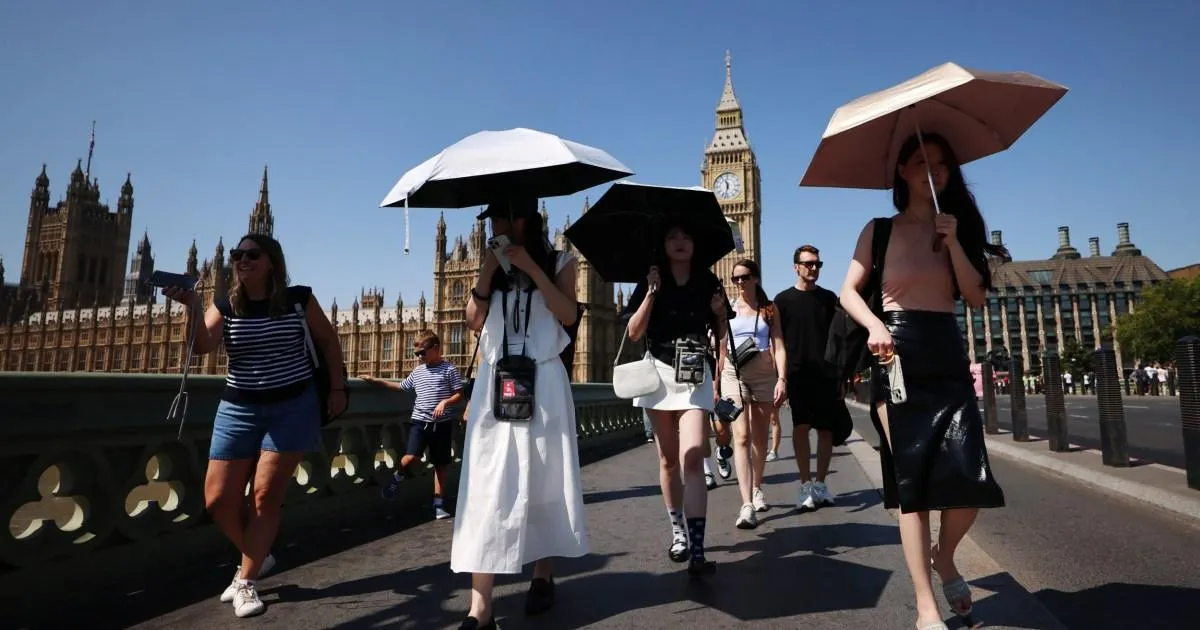
After a summer that has felt more like a relentless endurance test than the typical British getaway, the big question on everyone’s mind is whether we are heading for yet another heatwave. We have already weathered four significant spikes in temperature this year, with May and June shattering historical records and July providing almost no relief from the stifling conditions. While many of us have welcomed the slight cooling trend over the past few days, meteorologists are suggesting that we shouldn’t pack away the fans just yet. The summer, it seems, has one final act to play, and for those of us living in the southern parts of the country, that might mean reaching for the sunscreen once again.
The professional forecasters are understandably cautious, noting that it is still a bit too early to declare a formal fifth heatwave with absolute certainty. However, the long-range outlook suggests that a high-pressure system could begin building in the south by next week, effectively paving the way for the return of unseasonably warm weather. Dr. Christopher England, a meteorologist for Sky News, explains that while our current respite is a welcome change, the atmosphere remains unsettled and prone to shifting back into a “hot” pattern. Different forecast models are presenting a variety of scenarios, but they all seem to lean toward temperatures remaining consistently higher than what we would typically expect for this time of year.
The Met Office’s latest projections seem to align with this outlook, painting a picture of a country divided by its weather patterns. While northern England, Scotland, Wales, and Northern Ireland might see some much-needed rain, much of the south and east of England are expected to stay stubbornly dry. This persistent lack of rain is particularly concerning, as the dry, parched conditions we experienced throughout July have carried over into August. Even if we do see some stormy, thundery interludes, the rainfall is expected to be sporadic and insufficient to truly break the drought that has settled over much of our landscape.
It is impossible to discuss this weather without reflecting on the toll it has taken on the country. This has been a year of extreme contrasts, where the joy of sunshine has been overshadowed by the grim reality of more than 2,700 excess deaths linked to the heat in May and June alone. The dry spell has also triggered widespread wildfires and put an incredible strain on our infrastructure, from our water supplies to the very transit systems we rely on. Seeing the reports of bus drivers striking over “unacceptable” heat conditions serves as a sobering reminder that these temperatures are not just an inconvenience—they are a genuine health and safety crisis that society is struggling to adapt to.
For many of us, the term “heatwave” has become a buzzword that we throw around whenever the temperature climbs above twenty degrees, but there is a precise, scientific definition behind it. According to the Met Office, a heatwave is not just a hot day; it is a sustained period of at least three consecutive days where the temperature meets or exceeds a specific local threshold. In London and the Home Counties, that bar is set at 28°C, but in cooler regions of the UK, it can be as low as 25°C. Whether our upcoming warm spell will officially qualify as a heatwave remains to be seen, but the criteria remind us that the danger often lies in the lack of nighttime cooling and the cumulative effect of high humidity over several days.
As we look toward the final stretch of summer, the mood across the country feels conflicted. There is a sense of weariness, a longing for the cool, damp, and reliable weather that usually defines a British August. We have become hyper-aware of everything from faulty fans being recalled due to fire risks to the state of our gardens as we pray for a steady, soaking rain. Whatever happens in the coming week, we have certainly learned that our climate is shifting beneath our feet. We find ourselves waiting for the clouds to break, hoping that if more heat is on the way, we are at least better prepared for the challenges that come with it.