


For decades, London’s BT Tower has stood as a silent, monolithic sentinel over the city—a marvel of 1960s engineering that once served as the backbone of the nation’s communication network. Standing at 620 feet, the landmark has been largely inaccessible to the public since the 1980s, its top-floor revolving restaurant a fading memory for those old enough to remember its glory days. However, the tower is finally poised for a second act. Purchased by MCR, the third-largest hotel operator in the United States, for a staggering £275 million, the structure is currently undergoing a radical transition. The goal is to move beyond its status as a private communications hub and transform it into a world-class luxury hotel, effectively “re-opening” one of the capital’s most mysterious silhouettes to the people of London.
The new vision for the tower, unveiled following an extensive consultation process, is ambitious, blending modern luxury with a deep respect for the site’s mid-century origins. The plans abandon the idea of a traditional restaurant at the summit, opting instead for a 360-degree revolving observation deck that promises to offer the most iconic views in the city. Beyond the heights of the main tower, the “Podium” building at its base is set to become a vibrant, multifunctional space. Designers intend to include ground-level retail, upscale dining units, and a dedicated exhibition space that will detail the fascinating history of the tower—a perfect bridge for locals and visitors alike to connect with the building’s technological legacy.
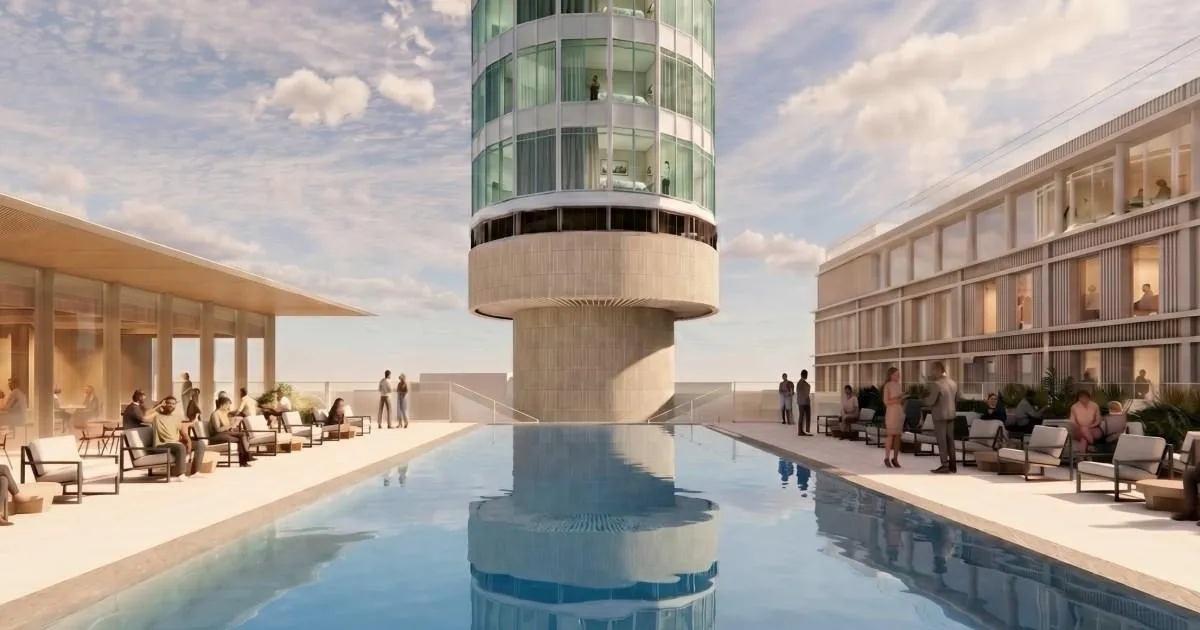
Perhaps the most exciting addition for the average Londoner is the inclusion of a publicly accessible heated swimming pool on the roof of the Podium building. Inspired by MCR’s successful TAW Hotel project, this space is designed to be a year-round urban oasis, with the developer specifically promising discounts for the local community. The project also aims to solve the problem of the tower’s historically “unwelcoming” exterior. By introducing a new public square and better pedestrian walkways, the developers hope to turn the base of the tower from a restricted industrial zone into a welcoming social space where visitors can walk beneath the tower’s “stick” and finally experience its scale firsthand.
Reflecting on the architectural significance of the project, archivists note that the tower’s design was born of necessity; it had to be tall and unobstructed to handle communication waves, which inherently created the stunning panoramic vistas it is famous for today. The new ownership intends to honor this by keeping the structural integrity of the “stick” intact. Plans show hotel rooms arranged around the tower’s unique curved geometry from floors seven to 23, with modern fire safety standards—including a new secondary staircase—carefully integrated to ensure that the heritage of the site is preserved while meeting 21st-century requirements. Every element, from the 1930s-inspired shopfronts to the careful restoration of the Howland Building, aims to balance nostalgia with contemporary comfort.
However, patience will be a virtue for those eager to step inside. The transition is a slow, methodical process, as BT is currently in the midst of clearing out decades of telecommunications equipment. The site is expected to be handed over to the hotel operators in late 2029, with construction following shortly thereafter. If everything goes according to plan, the grand reopening is scheduled for 2033. For those who visited the tower recently to see the remnants of old switchboards and dusty 1970s technology, it serves as a stark reminder of how quickly the world changes; what was once a cutting-edge hub for the nation’s phone calls and TV signals is being retired to make room for a new era of hospitality.
As the BT Tower prepares for this transformation, the mood is one of cautious excitement. It has been a symbol of both pride and mystery, having served the country through the height of the communications age. BT Group has expressed immense pride in their custodianship of the landmark, acknowledging that while the building was once essential for national infrastructure, the digital age has shifted the way we communicate, making this repurposing a fitting evolution. Ultimately, when the revolving observation deck spins for the first time in half a century, it will represent more than just a hotel; it will be the return of an icon, offering a new generation the chance to see London from the most storied vantage point in the city.