

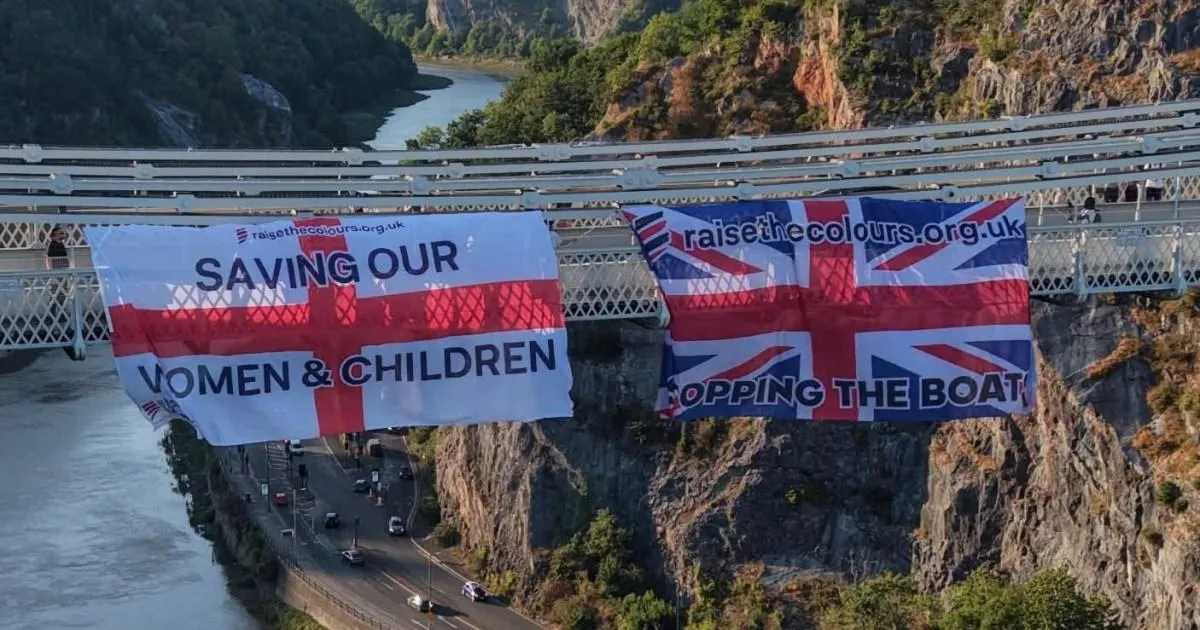
The recent incident at the Clifton Suspension Bridge, where a group of 30 activists known as “flaggers” orchestrated a quick, military-style operation to hang “Stop The Boats” banners, offers a window into a growing, albeit controversial, socio-political movement in the UK. Led by a figure known as “Flag Man UK,” the group spent weeks meticulously planning their five-minute stunt, an endeavor that highlights the lengths to which these activists will go to command public attention. While the flags were swiftly removed by security personnel, the event underscored the rising visibility of nationalism in public spaces. Though the participants claim their actions are a symbolic exercise in collective power and patriotism, the underlying message—focused specifically on immigration and border control—has sparked significant debate across the country.
The architect behind the movement, Danny, frames his activities as a crusade for national pride and fairness, yet he operates in a polarized landscape. Despite being associated with groups like “Raise The Colours,” Danny distances himself from the label of racism, citing his personal life—which includes diverse friendships and family ties—as evidence of his inclusivity. He even details instances of hanging Pride flags to challenge his critics. However, this defense contrasts sharply with the reality on the ground, where such flags are frequently deployed in ways that feel targeted and intimidating, particularly toward migrant hotels or minority-owned businesses. This tension illustrates the challenge of interpreting the movement’s intent: is it, as the founder claims, a peaceful rallying cry for the forgotten, or is it a vehicle for hostility?
Central to Danny’s rhetoric is a sense of misplaced grievance that resonates with a specific segment of the population. He argues that his followers aren’t necessarily fueled by blind hatred, but by a perceived inequality—the feeling that British citizens who are homeless, struggling with addiction, or suffering from mental health issues are being ignored while the state allocates resources to asylum seekers. For Danny, the flag has become a shorthand for this perceived betrayal. He goes as far as to issue a radical ultimatum: he claims he would halt the entire project if politicians like Andy Burnham successfully eradicated homelessness. By positioning his movement as an advocate for the “forgotten” British citizen, he taps into deep-rooted socio-economic frustrations that transcend simplistic political categories.
The irony of the movement remains one of its most scrutinized aspects: the flags themselves are largely manufactured in China. When confronted with this contradiction, Danny points to the decline of British manufacturing, explaining that the cost-prohibitive nature of UK production forces his hand. He frames this as a grim reflection of the state of the nation, rather than hypocrisy. By purchasing materials abroad and assembling them locally, he believes he is still serving his cause. This pragmatic approach to supply chains reflects a broader trend in political activism where the message—the presence of the flag—is prioritized above all else, even when the logistics seem at odds with the “patriotic” spirit they ostensibly celebrate.
The movement also finds itself grappling with the humanitarian crisis in the English Channel. When asked about the dangerous crossings, Danny expresses a surprising level of empathy, describing the deaths as a tragic, preventable reality. He suggests that the government should open the Channel Tunnel for safe passage, a sentiment that aligns more closely with refugee advocates than with traditional hardline nationalist rhetoric. This nuance exposes the complexity of his ideology; he is not explicitly calling for violence, but rather demanding an end to the current system, claiming that by doing so, he is trying to prevent further loss of life. It is an argument that shifts the focus from simple xenophobia to an aggressive, albeit disjointed, critique of government policy.
Ultimately, the phenomenon of “flagging” sits at an uncomfortable intersection of personal legacy and public disruption. Danny speaks of his grandfather’s military service with genuine sentiment, believing that his actions are a continuation of that historic sacrifice. To him, the sight of a flag is a source of hope and connection, particularly when he claims it brings comfort to homeless veterans who feel abandoned by the state. Yet, the friction created by his group’s actions—the confrontation with bridge security, the filming of altercations for social media, and the intimidation felt by minority groups—suggests that for many, these banners represent something far more divisive than national pride. Whether a force for social change or a catalyst for further polarization, the movement serves as a stark reminder of how raw and unresolved the issues of identity, immigration, and national belonging remain in contemporary Britain.