


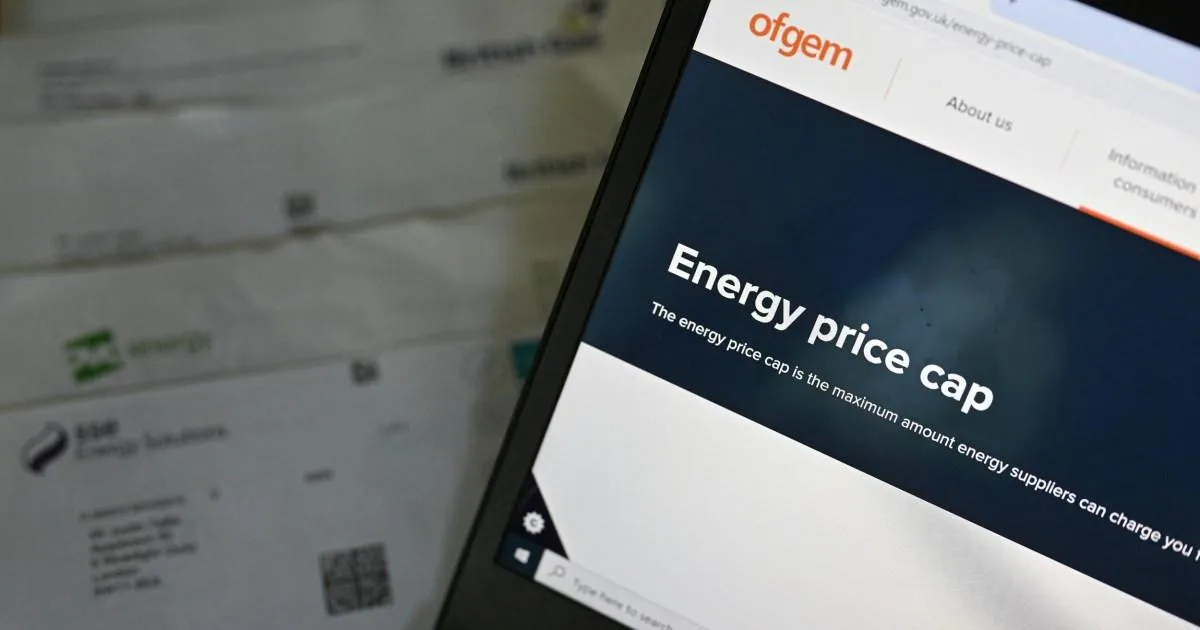
Today, in kitchens across England, Scotland and Wales, a familiar and unwelcome arrival has taken place: the energy price cap has gone up by 4%. For the average household paying by direct debit for gas and electricity, the new bill will reach £1,723 a year—roughly £5 more each month than before. That may not sound catastrophic when written on its own. But take a moment to place it in a real life. There are more than four million homes in Britain still on a standard energy tariff, and for those homes this is not an abstract number on a news website. It is the difference between switching the heating on when you feel cold and waiting until you feel desperate. It is the quiet arithmetic you do at the kitchen counter, turning annual predictions into weekly realities. The price cap, set by the regulator Ofgem, is not a cap on how much you can be charged in total; it is a cap on the unit price of the gas and electricity you use. So if you live in an old, draughty house, or if you need to keep medical equipment running, or if you have children who get sick easily, your actual bill will be far higher than the average. The cap simply means it will not be even worse. For millions, the arrival of the October cap rise is not a headline; it is a feeling of dread, a tightening in the chest, a decision postponed until the next payslip. And this time, that dread has arrived just as winter is closing in.
Worse, according to energy analysts at Cornwall Insight, is coming. The same experts who track the market with unnerving accuracy predict that the price cap will rise again on January 1, climbing by a further 16% to an average of £1,999 a year. That would be £276 more than the level set for October to December, and the biggest single jump since January 2023. On a page, that is just another statistic. In real life, it is a Christmas gift not bought, a car repair delayed, a dental appointment canceled, a loan from a friend, an extra shift taken in the cold. £276 is not a small thing. For a family already living close to the edge, it can be the difference between staying afloat and going under. And because the winter months are when energy use climbs, the January rise will arrive at the cruelest possible moment. People will come home from work, switch on the lights, turn up the thermostat, and immediately know, without looking at the meter, that they cannot afford tomorrow in the same way. The forecast is not inevitable; markets move, and governments can act. But as things stand, the direction of travel is unmistakable. The campaigners who talk about a terrible winter ahead are not being dramatic. They have read the same forecasts. They have spoken to the same families. They are simply refusing to smile and tell you everything will be fine when the numbers say otherwise.
Why is this happening? The answer lies thousands of miles away from British radiators, and yet it arrives in every draughty hallway. The latest increase in the price cap has been driven by the escalating conflict in the Middle East, and specifically by the effective closure of the Strait of Hormuz, one of the world’s most vital shipping routes for gas and oil. Since the war in Iran began in February, gas supplies to the UK and across the world have been disrupted in ways that the global market feels immediately. Even if Britain does not import most of its gas directly from that region, energy is a global commodity, and every price shock echoes through the system. Wholesale prices rise; suppliers pass the cost to households; the price cap moves up; and a family in Manchester or Cardiff or Glasgow ends up paying more for a system over which they have no control. It is a strange and cruel kind of geography: the same ice-cold air that makes you turn up the heating is made more expensive by a shipping lane you will never see. Yet this is the reality of energy dependency. When the world is unstable, the cost of living becomes unstable too. Economists talk about supply-side shocks and market volatility, but what that really means is that a war in one region can reach into your wallet and make you choose between a warm home and a full fridge. It is the defining injustice of the modern energy crisis: the people who burn the least are often hit the hardest, and the causes are so far away that they feel impossible to fix.
The Government has not been entirely silent. From today, the 5% VAT on electricity bills has been temporarily removed, and that will remain in place until March 31 next year. For the average household, the change cuts around £45 a year from electricity costs. But there is a catch, and it is a significant one: the VAT cut applies only to electricity. Gas bills still carry the full 5% VAT, which means many homes—especially those that rely on gas for heating—will still feel the squeeze. Prime Minister Andy Burnham has tried to frame this as a meaningful first step rather than a final answer. “For many families, the energy bill is the one they dread the most,” he said. “I don’t accept that it has to be this way, and I am determined to bring down costs for good. But I know people can’t wait. Families need breathing space now.” He also pointed to measures beyond energy, including a £2 cap on bus fares from January and cuts to business rates for pubs, social clubs, and live music venues. These are the kind of policies that may help communities feel a little less squeezed, but they do not solve the central problem: the price of energy itself remains dangerously high. Campaigners have welcomed the VAT cut but argued it is nowhere near enough. A £45 saving, while useful, is a bandage on a wound that needs surgery. The Government, they say, must do more: consider a social tariff, expand support for vulnerable households, fund insulation, and address the structural weaknesses that leave Britain at the mercy of international gas markets. The VAT cut is a gesture of compassion, but winter is a long season, and a gesture does not keep you warm in February.
To understand why campaigners sound so alarmed, it helps to put down the statistics for a moment and think about what a bill actually does to a life. A £1,999 average bill is not a number; it is a series of small decisions and quiet sacrifices. It is the parent who runs the dishwasher at midnight to save electricity during peak hours. The older man who has stopped turning on his heating because he is “fine with another jumper,” even though his hands never quite get warm. The mother who makes sure the children’s rooms are warm and then spends her own evening in the cold, saying she does not feel it. The young worker on a zero-hours contract who cannot fill in the direct debit form because the amount would bounce. It is the anxiety that wakes you up at 3 a.m. when you think about the meter. It is the shame that creeps in when you ask a neighbour for help. And it is the exhaustion of carrying all of this through every single day. Energy is not an indulgence; it is the invisible infrastructure of a human life. It is the difference between enjoying your home and enduring it. It is the backdrop to rest, family, work, and recovery. When the price of that infrastructure climbs, it does not just dent the economy—it frays people’s mental and physical health. The cold itself is dangerous, especially for the very old and the very young, but so is the stress. Campaigners who are calling for the Government to act now are not using rhetoric; they are describing the conversations they have every day with people who have already run out of options. They want intervention before the crisis, not after.
So what does this winter look like? It depends on what those in power do in the coming weeks. The energy price cap has already moved up, and the next forecast is grim. But the future is not entirely fixed. The Government could announce a more comprehensive package of support. It could extend the VAT cut, expand benefits, revive energy efficiency schemes, and offer a safety net for those who are most in danger. It could listen to the campaigners who have spent years warning that the energy market is broken and that a social tariff—a discounted rate for vulnerable and low-income households—would be a fair and practical solution. None of this is impossible. What would be truly impossible is pretending that families will simply cope because they have coped before. There is nothing normal about living in a country where a basic necessity is treated as a luxury and where the burden of global instability falls hardest on the people who are least able to carry it. Burnham is right that the energy bill is the one many families dread most. But dread should not be a permanent state. The humanisation of this crisis is simple: everyone should be able to live in a warm home without having to destroy their budget, their health, or their hope. As the temperature drops and the forecasts climb, the test of a society is not whether its officials issue statements, but whether the people actually make it through the winter. For millions of families, that test is about to begin. And they should not have to face it alone.