


Beneath the waves that surround the British Isles, hidden from satellites and invisible to the naked eye, lies a vast and silent network that keeps the modern world turning. Thousands of kilometres of fibre-optic cables and pipelines snake across the ocean floor, carrying more than 90 percent of the nation’s daily internet traffic and underpinning an estimated £65 billion of economic activity. Every email, every video call, every contactless payment, every military communication, and every emergency service dispatch depends on these slender threads of glass and copper. They are, in effect, the nervous system of the United Kingdom, yet they are also astonishingly exposed. Unlike the fortified data centres and guarded exchanges on land, these cables sit on the seabed with little physical protection, described by defence experts as “naked” and “incredibly vulnerable.” For decades, the greatest dangers were accidental: a ship dragging its anchor, a fisherman’s trawl scraping along the bottom, or the natural wear and tear of the deep. But that era of benign mishaps is over. The threat has changed, and the quiet battleground beneath the Atlantic and the North Sea has become a place of strategic anxiety, where hostile states are increasingly willing to probe, map, and potentially sever the connections that hold modern life together.
The shift from accident to sabotage has been gradual but unmistakable. In recent months, Nato forces have intercepted Russian vessels in Arctic waters that appeared to be training for attacks on undersea infrastructure, reportedly practising with secret weapons designed to damage or destroy cables. Meanwhile, the UK’s Defence Secretary, John Healey, stood before Parliament and warned that Russia was actively “gathering intelligence and mapping” Britain’s cable network. This is not idle speculation; it is a recognition that the seabed has become a new front line in a shadowy conflict between nations. The cables are not just commercial assets; they are military targets, and their destruction could cause chaos far beyond a few dropped Zoom calls. A coordinated attack on multiple landing points could disrupt financial markets, sever government communications, disable navigation systems, and undermine public trust in a way that few conventional weapons could match. And because the cables are so long, so numerous, and so remote, defending them with patrol boats and submarines is like trying to guard every mile of a motorway with a single traffic warden. The challenge is immense, and the military has been forced to think differently about how to protect these lifelines.
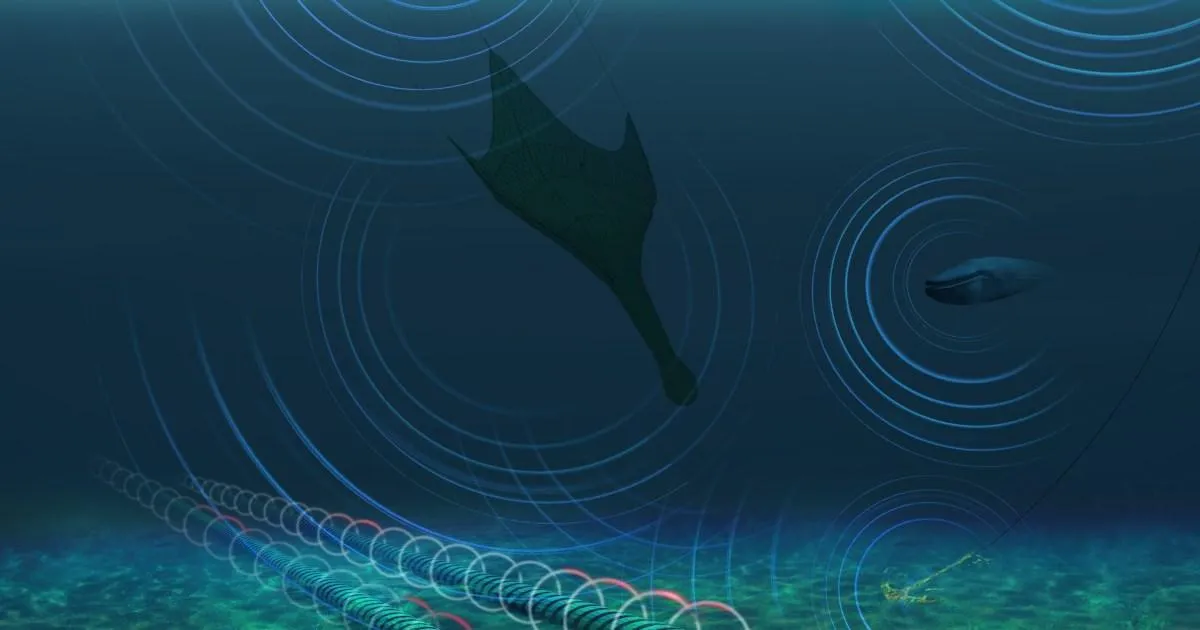
That is where a new and quietly revolutionary technology comes into play. Defence firm BAE Systems is developing a system known as distributed acoustic sensing, or DAS, which could turn the very vulnerability of the cables into a powerful military asset. The idea is elegantly simple: attach highly sensitive sensors to the fibre-optic cables themselves, and use the cables as a giant, continuous microphone stretching for hundreds of kilometres along the ocean floor. Any vibration near the cable, no matter how faint, causes tiny disturbances in the light pulses travelling through the fibre. By measuring those disturbances, the system can detect and locate the source of the vibration with remarkable precision. This means the seabed can be monitored in real time, picking up everything from the subtle shifts of ocean currents and the movements of marine life to the unmistakable drag of an anchor or the low hum of a submarine’s engines. Tim O’Neill, the Subsea Intelligence lead at BAE Systems, explains that the technology can provide an alert the moment something touches the seabed near a cable, giving operators precious time to respond. If a vessel begins dragging an anchor dangerously close to a cable, the system can warn it to stop; if the vessel ignores the warning, military assets can be dispatched to intercept it before serious damage is done.
The potential of this technology goes far beyond simply preventing accidents. BAE Systems is working to adapt DAS for military purposes, moving it from limited commercial use on land and in the sea into a sophisticated defence tool. The system is currently in its experimentation phase, with data from a sensor-equipped cable being fed into artificial intelligence and machine learning programmes that are learning to distinguish between harmless vibrations and genuine threats. The sheer volume of information is staggering: a single DAS unit can generate up to a petabyte of data per day, the equivalent of streaming 57 continuous years of high-definition video. Without intelligent filtering, this would be an overwhelming flood of noise. But the AI tools being developed are designed to identify signals of interest as they appear, alerting operators only when something truly unusual happens. This is not just about detecting an enemy attack; it is about understanding the normal rhythm of the ocean so deeply that anything out of place stands out immediately. With enough data, the system could learn to recognise the acoustic signature of a particular class of submarine, the pattern of a fishing fleet, or the approach of a small underwater drone. The seabed, once a dark and unknowable place, could become a transparent map of activity, constantly watched by the very cables that carry our digital lives.
Defence experts believe this could mark a “small revolution” in the future of underwater warfare. Alessio Patalano, who specialises in critical undersea infrastructure at King’s College London’s War Studies Department, argues that the persistent and consistent data provided by DAS sensors will transform how military chiefs understand and protect the cables. In the past, the ocean floor was a place of uncertainty, where incidents were discovered hours or days after they happened, and where the identity of an attacker could remain a mystery. With DAS, the seabed becomes slightly more transparent, making it easier to know where to operate, how to operate, and against whom you are operating. It also improves the ability to recover from any interference, because you can identify the location of a problem far more quickly and send repair teams directly to the site. This is crucial, because the damage from a severed cable is not just physical; it is also psychological. Every minute of downtime costs billions, erodes confidence, and demonstrates vulnerability. The faster the response, the smaller the window for chaos. And for a nation like the UK, which depends so heavily on its undersea connections, that speed could mean the difference between a minor disruption and a national crisis.
The race to protect these cables is not just a technical challenge; it is a strategic imperative that demands political will and international cooperation. BAE Systems is developing this technology with the hope of putting it into the hands of the UK government, and O’Neill is blunt about the stakes: “The reality is that this is a state problem.” Russia and other hostile nations are not going to stop probing, mapping, and testing the vulnerabilities of Western infrastructure. The cables that connect the UK to the world are too valuable, too exposed, and too tempting as targets. But the development of DAS sensing offers a glimmer of hope in this dark and uncertain landscape. It turns the cables from passive victims into active sentinels, creating a web of awareness that could deter attacks, catch saboteurs in the act, and reassure the public that their digital lives are not as fragile as they seem. The ocean floor, long seen as a remote and inaccessible frontier, is becoming a monitored, understood, and defended space. The work is still in its early stages, and there are many hurdles to overcome, from managing the flood of data to ensuring the sensors themselves cannot be disabled. But the direction is clear: the future of national security lies not only in the skies and on land, but in the silent depths where the world’s information flows. As the threats evolve, so too must the defences, and the humble fibre-optic cable may soon become one of the most powerful tools in the military’s arsenal. For now, the cables remain hidden, but they are no longer forgotten. They are the quiet guardians of modern life, and their protection has become a matter of survival.